



NOTE: VIDEO INSIDE THE ARTICLE
A normally routine political discussion on CNN’s “NewsNight” turned into a heated on‑air debate Tuesday evening after businessman and television personality Kevin O’Leary sharply criticized Democratic lawmaker Alexandria Ocasio‑Cortez for her recent comments at the Munich Security Conference — and compared her response to verbal miscues by former Vice President Kamala Harris. The exchange exposed deep divisions among commentators over expectations for political leaders on foreign policy and sparked a contentious back‑and‑forth among panelists that at times devolved into overlapping arguments.
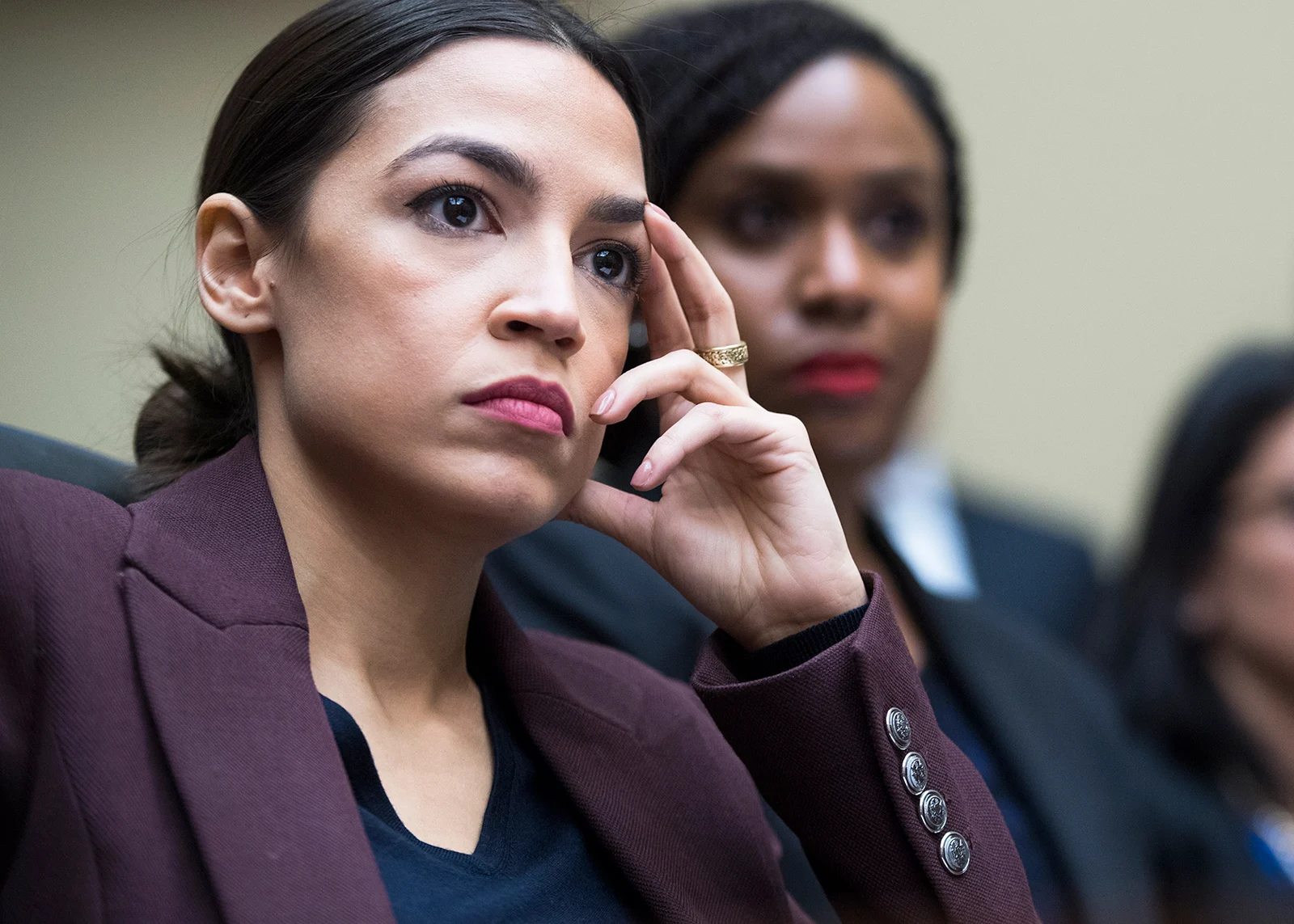
The segment was focused on Ocasio‑Cortez’s appearance at the annual Munich conference last week, where she was asked about whether the United States should commit ground troops to defend Taiwan if China were to attack. According to accounts of the exchange, the lawmaker delivered a response that was widely described as rambling or unfocused, lasting roughly 40 seconds as she worked through the complex question without offering a clear policy position. Her remarks were quickly dubbed a “word salad” by critics who said her language lacked clarity and specificity, and the comment drew attention across news outlets and social media.
The CNN panel discussion began with several commentators defending Ocasio‑Cortez’s effort, arguing that long‑form diplomacy questions can be nuanced and that occasional verbal stumbles should not define a politician’s capabilities, especially on complex international issues. Panelist Ana Navarro and journalist Cari Champion both pushed back on harsh critiques, suggesting that the lawmaker’s broader message about international cooperation and rule‑based order deserved consideration even if the delivery was imperfect.
That set the stage for O’Leary’s intervention, which sharply challenged the defenses of his fellow guests. O’Leary, a former “Shark Tank” investor and frequent media commentator, responded to Navarro’s remarks with heavy sarcasm, saying, “You’re right, she was fabulous,” before launching into his critique. He argued that public figures, particularly those speaking on foreign policy at major international events, are expected to deliver coherent, substantive answers and that falling short of that standard invites legitimate criticism.
O’Leary went further by comparing Ocasio‑Cortez’s delivery to verbal miscues attributed to Harris during her tenure as vice president. Harris faced public scrutiny for a few high‑profile stumbles on national television and was sometimes mocked for her cadence or choice of words. O’Leary framed the comparison as non‑partisan, saying the lawmaker “sounded like her” and that the criticism was about performance, not politics. “I’m sorry, it’s not a partisan issue,” he said. “She was terrible! Get over it. Maybe she’ll get better.”
The comments ignited a sharp reaction from other panelists. Champion, visibly irritated, accused O’Leary of being condescending and suggested he was misunderstanding the intent behind Ocasio‑Cortez’s remarks, which she said reflected thoughtfulness rather than incoherence. Navarro, meanwhile, noted that struggling briefly in response to a difficult question should not be tantamount to wholesale dismissal of a lawmaker’s capability.
The tension escalated when the discussion began to loop back on itself, with multiple panelists trying to speak at once. CNN host Abby Phillip worked to regain control of the narrative, telling commentators to listen and maintain order, but the heated exchanges continued, with O’Leary at one point telling the others they were “all nuts” before being cut off for time.
The incident represents a broader national conversation over how public officials are judged on international stages. Ocasio‑Cortez’s performance in Munich has drawn criticism not only from conservative commentators but also some moderate or liberal commentators, with debates over whether her answer was merely flawed or indicative of deeper weaknesses on foreign policy issues. Separately from the CNN segment, other commentators noted that her remarks included factual errors, such as incorrectly locating Venezuela relative to the equator — a mistake that drew its own share of attention.
Critics on both sides of the political spectrum have weighed in on the broader implications of the Munich remarks, with some Democratic commentators privately acknowledging that the performance could have been stronger and that political figures benefit from rigorous preparation before high‑stakes international engagements. Others argue that such moments are overemphasized by media commentators at the expense of substantive policy discussion.
The CNN exchange itself has become a talking point in social media discourse, with clips of the argument circulating widely on platforms such as X (formerly Twitter) and prompting comment across partisan lines. Supporters of Ocasio‑Cortez have accused critics of engaging in “gotcha” politics, while opponents have framed the panel fight as further evidence of what they see as uneven standards for political accountability.
Beyond the immediate back‑and‑forth, the segment highlights how media coverage can amplify disagreements over political performance and message discipline. Cable news panels, in particular, often serve as proxy battlegrounds for broader disputes between ideological perspectives, and Tuesday’s episode was no exception.
PLAY:
As the 2028 election cycle continues and foreign policy questions loom large, moments like Ocasio‑Cortez’s Munich remarks — and the media reactions that follow — are likely to remain part of the national conversation about leadership, communication, and public perception.

Emily Johnson is a critically acclaimed essayist and novelist known for her thought-provoking works centered on feminism, women’s rights, and modern relationships. Born and raised in Portland, Oregon, Emily grew up with a deep love of books, often spending her afternoons at her local library. She went on to study literature and gender studies at UCLA, where she became deeply involved in activism and began publishing essays in campus journals. Her debut essay collection, Voices Unbound, struck a chord with readers nationwide for its fearless exploration of gender dynamics, identity, and the challenges faced by women in contemporary society. Emily later transitioned into fiction, writing novels that balance compelling storytelling with social commentary. Her protagonists are often strong, multidimensional women navigating love, ambition, and the struggles of everyday life, making her a favorite among readers who crave authentic, relatable narratives. Critics praise her ability to merge personal intimacy with universal themes. Off the page, Emily is an advocate for women in publishing, leading workshops that encourage young female writers to embrace their voices. She lives in Seattle with her partner and two rescue cats, where she continues to write, teach, and inspire a new generation of storytellers.