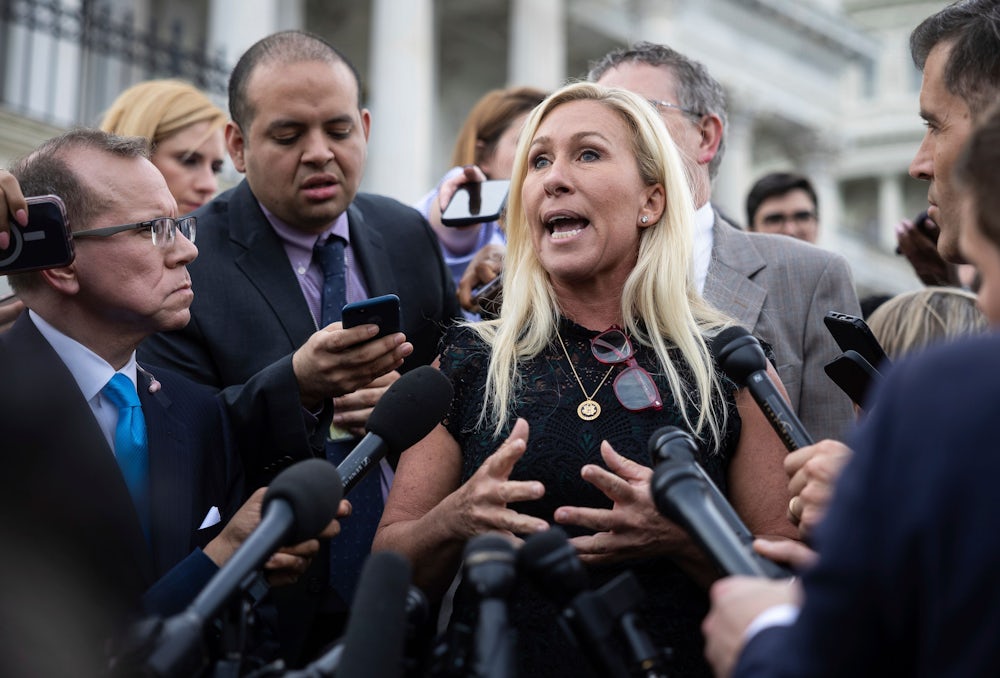
Former Representative Marjorie Taylor Greene (R-Ga.) has publicly responded to President Donald Trump calling her a “traitor,” reiterating her criticisms of the former president and his handling of sensitive information related to the late financier Jeffrey Epstein.
In a post on X (formerly Twitter) on Tuesday, Greene framed Trump’s comment as a “badge of honor.” She wrote:
“I’m not in his cult, I refused to bow to his demands to cover up the Epstein files to protect his friends, and I stopped fighting the hardest for a team that intentionally refuses to win.”
The post underscores the deepening rift between Greene, once a loyal Trump ally, and the former president. Greene, who resigned from her House seat representing Georgia’s 14th congressional district at the start of the year, has increasingly voiced criticisms of Trump, particularly over his handling of investigations connected to Epstein and the broader political priorities of the MAGA movement.
Trump’s criticism came shortly after Greene spoke publicly about her refusal to cooperate with efforts she views as protecting the interests of wealthy donors or shielding associates linked to Epstein. The former president has long cultivated loyalty among his supporters, and labeling Greene a “traitor” signals a significant break between the two, highlighting ongoing tensions within the Republican Party.
Earlier this month, Trump endorsed Clay Fuller, a district attorney, to replace Greene in the special election for Georgia’s 14th congressional district. Speaking to reporters aboard Air Force One on Monday, Trump said, “Well, we have a lot of people that want to take Marjorie ‘Traitor’ Greene’s place.”
Fuller, who finished fourth in the 2020 Republican primary that Greene won on her way to her first term in office, accepted Trump’s endorsement on X, calling it “the honor of a lifetime.” Trump, in turn, described Fuller as a strong candidate who “will not let you down,” framing the upcoming election as an opportunity to reinforce loyalty to his political brand.
The Georgia 14th congressional district special election has attracted 18 candidates. If no candidate secures more than 50 percent of the vote, a runoff election will be held on April 7. Trump is expected to campaign in the district on Thursday ahead of the vote, further cementing the high stakes of the election both for Greene’s supporters and for Trump-aligned Republicans seeking to assert control over the party’s direction.
Greene has repeatedly criticized the MAGA movement in recent weeks, calling it a “lie” in a radio interview with host Kim Iversen. She argued that the movement’s current priorities serve wealthy donors rather than ordinary voters, emphasizing her belief that Trump’s first year back in office prioritized elite interests over grassroots concerns. Greene told Iversen, “I think people are realizing it was all a lie. It was a big lie for the people. What MAGA is really serving in this administration, who they’re serving, is their big donors.”
This rift is emblematic of a larger trend within the Republican Party, as former allies of Trump increasingly question his leadership and the strategic direction of MAGA-aligned initiatives. Greene, a former supporter and outspoken Trump loyalist, has made headlines by refusing to conform to the former president’s expectations, signaling a broader challenge for Trump in maintaining control over his base and influencing GOP primaries and elections.
Political analysts note that Greene’s criticism of Trump over the Epstein files taps into a broader national conversation about accountability and the handling of information related to high-profile criminal investigations. Epstein, who was convicted on sex trafficking charges before his death, has remained a central figure in political discourse due to the scope of his connections with influential figures. Greene’s willingness to speak out publicly against Trump’s handling of Epstein-related information has elevated her profile, particularly among voters concerned about government transparency and ethics.
The special election for Georgia’s 14th congressional district will serve as a test case for the influence of Trump endorsements on GOP races. With 18 candidates vying for the seat, including several who align closely with the former president, Greene’s vocal opposition to Trump sets up a scenario where the party base is forced to weigh loyalty against perceived ethical considerations. Clay Fuller’s campaign, buoyed by Trump’s backing, represents a clear continuation of the MAGA-aligned political strategy, while Greene’s platform emphasizes independence and scrutiny of the former president’s actions.
Trump’s endorsement strategy has become a key tool in his continued influence over the Republican Party, allowing him to shape primaries and local elections across the country. By publicly labeling Greene a “traitor” and backing Fuller, Trump signals to voters that loyalty to him remains a central criterion for Republican candidates, potentially discouraging dissent within party ranks. However, Greene’s response illustrates that some former allies are willing to challenge that dynamic, raising questions about the long-term cohesion of Trump-aligned Republicans.
Greene’s political career has been defined by her willingness to speak out against party leadership and confront controversial issues head-on. From her first term in Congress, she became known for her combative style and outspoken positions on both domestic and foreign policy issues. While this approach initially aligned with Trump’s political agenda, Greene’s recent actions suggest a recalibration, prioritizing accountability and independence over personal loyalty to the former president.
Observers note that Greene’s stance could have ripple effects beyond Georgia, influencing other Republican candidates and officeholders who may be weighing whether to openly support Trump or assert their independence. The MAGA movement has traditionally emphasized loyalty, and Greene’s public criticisms challenge the notion that dissent within the party must be met with political isolation or retribution.
In her posts and interviews, Greene has consistently framed her criticism of Trump as a matter of principle rather than personal animus. By positioning herself as independent of the “cult” mentality she attributes to Trump supporters, Greene underscores a broader ideological debate within the party about the balance between loyalty, accountability, and governance. Her messaging also appeals to voters who may be frustrated with partisan politics and the influence of wealthy donors on policy decisions.
As the April 7 runoff approaches, the outcome of the Georgia 14th special election will provide insight into how much sway Trump’s endorsements still hold among GOP voters, particularly in a district previously represented by a staunch MAGA supporter. Greene’s outspoken criticism, coupled with her refusal to conform to Trump’s expectations, could either serve as a rallying point for voters seeking independence or as a cautionary tale for other Republicans considering similar challenges to the former president’s influence.
The clash between Greene and Trump reflects a broader tension within the Republican Party between maintaining loyalty to a single figure and addressing ethical and policy concerns that may diverge from that individual’s agenda. It also highlights the evolving nature of political alliances and the potential consequences for candidates who publicly challenge party leaders.
Greene’s response to being labeled a “traitor” demonstrates her willingness to engage in this broader debate while maintaining her political profile and influence. As the election in Georgia’s 14th district unfolds, both Greene and Fuller will serve as symbols of competing visions for the future of the Republican Party—one emphasizing independence and accountability, the other reinforcing loyalty to Trump and the MAGA agenda.
Ultimately, Greene’s public statements and the dynamics of the upcoming special election illustrate how intra-party conflicts can shape local and national political landscapes. Voter response in the district may provide a bellwether for the broader Republican base, shedding light on the balance between loyalty and principle in determining the party’s path forward.

Emily Johnson is a critically acclaimed essayist and novelist known for her thought-provoking works centered on feminism, women’s rights, and modern relationships. Born and raised in Portland, Oregon, Emily grew up with a deep love of books, often spending her afternoons at her local library. She went on to study literature and gender studies at UCLA, where she became deeply involved in activism and began publishing essays in campus journals. Her debut essay collection, Voices Unbound, struck a chord with readers nationwide for its fearless exploration of gender dynamics, identity, and the challenges faced by women in contemporary society. Emily later transitioned into fiction, writing novels that balance compelling storytelling with social commentary. Her protagonists are often strong, multidimensional women navigating love, ambition, and the struggles of everyday life, making her a favorite among readers who crave authentic, relatable narratives. Critics praise her ability to merge personal intimacy with universal themes. Off the page, Emily is an advocate for women in publishing, leading workshops that encourage young female writers to embrace their voices. She lives in Seattle with her partner and two rescue cats, where she continues to write, teach, and inspire a new generation of storytellers.