

A towering presence on screen whose angular features and quiet intensity made him one of Hollywood’s most distinctive character actors has died at the age of 74. Known for portraying complex villains and enigmatic outsiders, he passed away peacefully on Valentine’s Day, according to a longtime collaborator.
News of his death was confirmed by actress Karen Sillas, who shared the announcement publicly and reflected on the creative partnership they forged decades ago. The actor, she said, left behind a body of work that continues to resonate with audiences and filmmakers alike.
Only further into his career did many audiences learn his name, but his face and voice were instantly recognizable. The man being remembered is Tom Noonan — a performer whose contributions to film, television and theater spanned more than four decades.
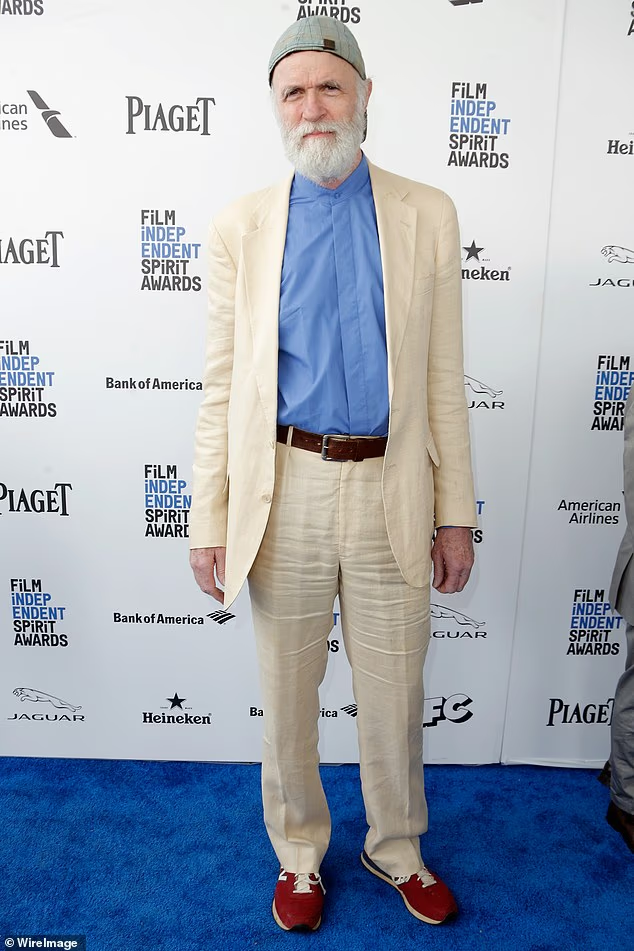
Noonan built a reputation as what some admirers called the “perfect bad guy,” though those who worked closely with him often emphasized his sensitivity and intelligence behind the scenes. On screen, he frequently portrayed antagonists or figures operating at the margins, characters who were unsettling not because they were loud or explosive, but because they radiated quiet unpredictability.
His most widely recognized role came in RoboCop 2, the sequel to Paul Verhoeven’s 1987 science fiction hit. In the film, Noonan portrayed Cain, the calculating leader of the Nuke drug cartel who ultimately becomes the cyborg antagonist RoboCain. The performance cemented his status as a formidable on-screen presence in big-budget studio fare.
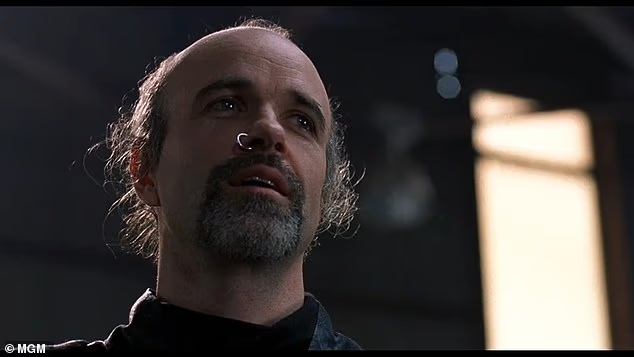
Yet it was several years earlier, in Manhunter, that Noonan delivered what many critics consider his breakout performance. Cast as Francis Dollarhyde, the deeply disturbed serial killer at the center of Michael Mann’s psychological thriller, Noonan brought a chilling restraint to the role. Rather than leaning into melodrama, he played Dollarhyde with a controlled fragility that made the character all the more disturbing.
The film itself, an adaptation of Thomas Harris’s novel “Red Dragon,” later gained renewed appreciation as a precursor to the Hannibal Lecter franchise. Noonan’s portrayal stood apart for its emotional nuance, revealing flashes of vulnerability within a character defined by violence. Over time, the performance has been cited as one of the most haunting depictions in the serial killer genre.
Another memorable turn came in The Monster Squad, where Noonan portrayed Frankenstein’s Monster. Beneath heavy prosthetics and makeup, he imbued the iconic creature with pathos, presenting a gentler interpretation that resonated with younger viewers. For many fans who grew up with the film, his Monster became a defining childhood image.
Throughout the 1990s and 2000s, Noonan continued to work steadily across genres. He appeared in Last Action Hero, the satirical action comedy starring Arnold Schwarzenegger, playing the Ripper in a performance that unsettled audiences despite limited screen time. He later featured in films such as Heat and The House of the Devil, demonstrating his range in both mainstream thrillers and independent horror.
His work extended beyond cinema. Television audiences encountered him in series including The X-Files and CSI: Crime Scene Investigation, where his distinctive voice and measured delivery lent authority and tension to episodic storytelling. Even in brief appearances, he had the ability to elevate scenes through subtle gestures and carefully modulated performances.
Despite his reputation for playing villains, colleagues often described Noonan as thoughtful and generous. In her tribute, Sillas recalled collaborating with him on the off-Broadway production of What Happened Was…, a play he wrote and later adapted into an independent film. The project, staged at the Paradise Factory Theatre in New York in the early 1990s, became a significant milestone in both of their careers.
Sillas described working on the production as a turning point, one that influenced her artistic path for years to come. When the play was later filmed, it went on to earn critical acclaim within the independent film community, further showcasing Noonan’s talents not only as an actor but also as a writer and director.
“Working with him was a privilege,” she wrote, adding that his legacy would continue to inspire.
That legacy includes his distinctive approach to character work. Standing over six feet tall with an imposing frame, Noonan could easily have been typecast as a conventional heavy. Instead, he cultivated performances that resisted cliché. His villains were rarely one-dimensional; they possessed inner lives that suggested loneliness, confusion or moral struggle.
Film scholars have noted that in Manhunter, for example, Noonan avoided meeting the gaze of his co-stars directly, a choice that heightened the character’s social alienation. In RoboCop 2, his portrayal of Cain combined icy composure with moments of manic fervor, creating a memorable antagonist in a franchise defined by stylized violence.
Fans responded to news of his death with tributes that highlighted both his intensity and his versatility. On social media, viewers described him as a “secret weapon” — an actor whose presence automatically raised the stakes of any project. Others pointed to childhood memories of watching The Monster Squad, recalling how his portrayal of Frankenstein’s Monster had left a lasting emotional impression.
Noonan’s career began in the early 1980s, when he secured small roles in films including Heaven’s Gate. Though those early appearances were modest, they marked the start of a steady ascent. Over time, he became a reliable choice for directors seeking depth and gravitas in supporting roles.
Unlike many actors who chase leading-man status, Noonan seemed comfortable inhabiting the margins of a story. He excelled at suggesting histories that existed beyond the screenplay, hinting at untold experiences through posture and silence. Directors frequently relied on him to anchor scenes with understated tension.
The commercial success of the original RoboCop — which topped the box office upon release and became one of the year’s highest-grossing films — ensured that its sequel would attract attention. While RoboCop 2 received mixed reviews, Noonan’s performance as Cain was widely regarded as a standout element.
In later years, he continued to balance mainstream appearances with independent projects, often choosing roles that allowed for experimentation. His filmography reflects a willingness to explore darker themes without sacrificing emotional authenticity.
Industry observers note that Noonan belonged to a generation of character actors who flourished in the 1980s and 1990s, a period when mid-budget studio films and independent cinema provided space for distinctive personalities. While he may not have been a household name for all viewers, his contributions were integral to many films that have since achieved cult or classic status.
As tributes continue to circulate, colleagues and fans alike emphasize the durability of his work. Performances captured decades ago remain compelling to new audiences discovering them for the first time on streaming platforms and repertory screenings.
Though often cast in ominous roles, those closest to him remember a collaborative artist dedicated to craft rather than celebrity. His death on Valentine’s Day adds a poignant note to the remembrance of a man whose screen persona frequently explored the shadows of human behavior, even as those who knew him describe warmth and loyalty in private life.
In an industry that often celebrates marquee names, Tom Noonan carved out a lasting place through subtlety and commitment. Whether portraying a calculating crime lord, a tormented killer, or a misunderstood monster, he brought a depth that transcended genre conventions.
His passing at 74 marks the end of a career defined not by flash, but by focus — a steady accumulation of performances that, taken together, form a portrait of an actor unafraid to inhabit the darker corners of storytelling. For audiences who recall his work, and for younger viewers who will encounter it anew, that legacy remains firmly intact.

Emily Johnson is a critically acclaimed essayist and novelist known for her thought-provoking works centered on feminism, women’s rights, and modern relationships. Born and raised in Portland, Oregon, Emily grew up with a deep love of books, often spending her afternoons at her local library. She went on to study literature and gender studies at UCLA, where she became deeply involved in activism and began publishing essays in campus journals. Her debut essay collection, Voices Unbound, struck a chord with readers nationwide for its fearless exploration of gender dynamics, identity, and the challenges faced by women in contemporary society. Emily later transitioned into fiction, writing novels that balance compelling storytelling with social commentary. Her protagonists are often strong, multidimensional women navigating love, ambition, and the struggles of everyday life, making her a favorite among readers who crave authentic, relatable narratives. Critics praise her ability to merge personal intimacy with universal themes. Off the page, Emily is an advocate for women in publishing, leading workshops that encourage young female writers to embrace their voices. She lives in Seattle with her partner and two rescue cats, where she continues to write, teach, and inspire a new generation of storytellers.