


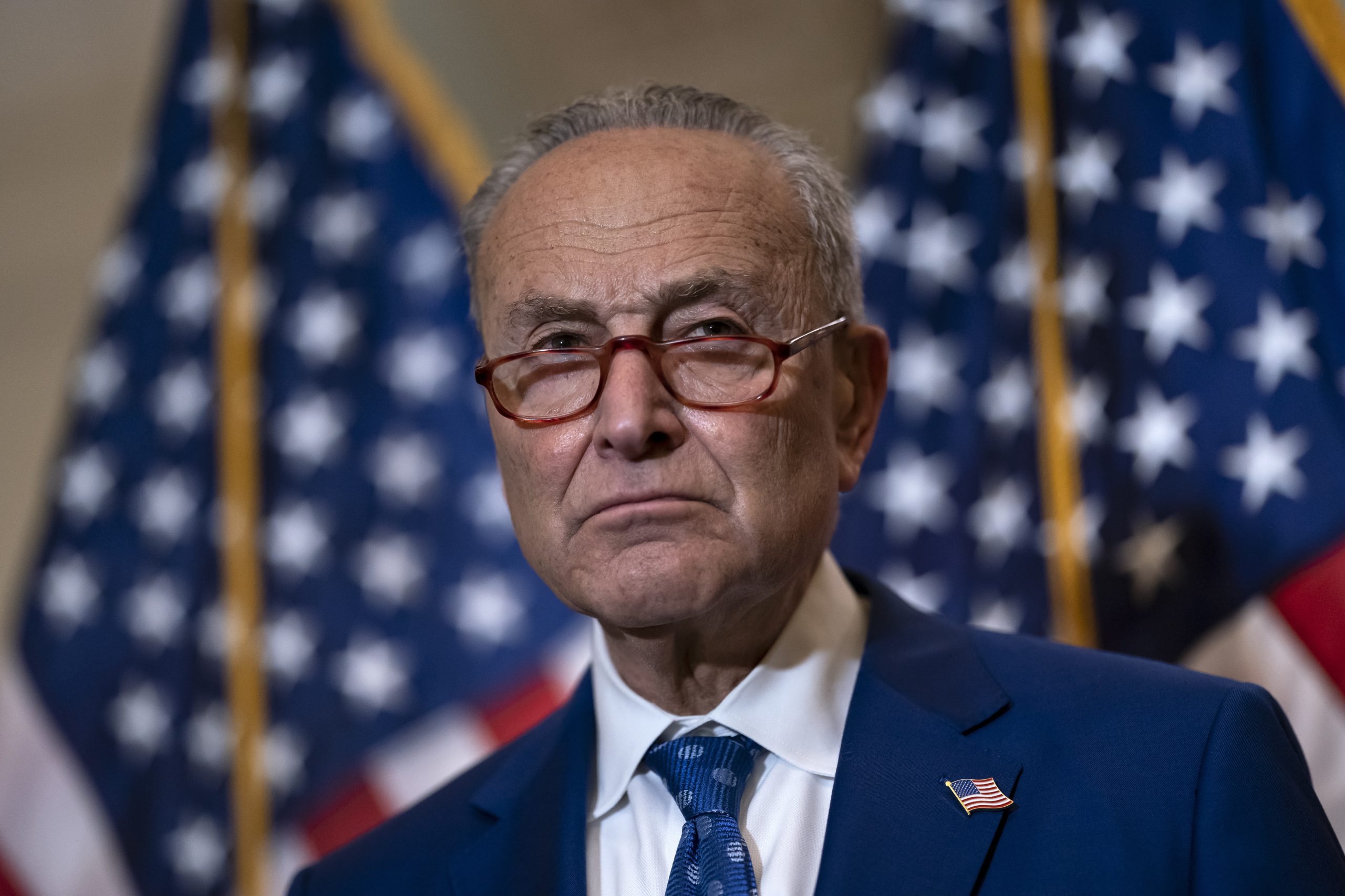
Senate Minority Leader Chuck Schumer appeared on national television this weekend to address a growing political standoff in Washington, but the conversation quickly turned toward a broader issue that has increasingly dominated national debate: election integrity.
During an appearance on CNN’s State of the Union, Schumer discussed the ongoing government funding impasse led by Senate Democrats. The dispute centers on immigration policy and funding priorities tied to the Department of Homeland Security (DHS). With negotiations stalled after a two-week window failed to produce agreement, much of the federal government now faces uncertainty, including agencies responsible for border security and national operations.
Republicans, meanwhile, have used the standoff to advance legislation they argue is central to safeguarding federal elections. The House has already passed a measure aimed at tightening voter registration requirements, setting the stage for a contentious battle in the Senate.
While the interview initially focused on funding disagreements and immigration reform, it soon pivoted to a separate but politically potent issue that has long animated both parties: voter identification requirements.
Immigration Dispute and Legislative Strategy
The current standoff began after Senate Democrats declined to move forward on a continuing resolution without securing additional immigration provisions. According to Democratic leadership, proposed reforms were necessary to address humanitarian concerns and border management. Republicans, however, argue that the requested changes would undermine enforcement efforts and weaken deportation policies.
As negotiations broke down, attention shifted to other legislative priorities. Among them is the Safeguard American Voter Eligibility Act, commonly referred to as the SAVE Act. The House-approved bill would require individuals registering to vote in federal elections to provide documentary proof of U.S. citizenship, such as a passport or birth certificate.
The legislation would amend the National Voter Registration Act of 1993 by mandating in-person verification of citizenship and prohibiting voter registration without qualifying documentation.
Supporters argue that the measure strengthens election integrity by ensuring only eligible citizens cast ballots in federal elections. Critics contend it creates unnecessary hurdles that could disproportionately affect certain communities.
The Interview Turns
Midway through the discussion, CNN host Jake Tapper introduced polling data that has fueled much of the national conversation.
“About 83 percent of the American people, including a majority of Democrats, support voter ID laws,” Tapper said, pressing Schumer on why his party continues to oppose such measures.
The question shifted the tone of the interview.
Schumer responded by emphasizing that individual states already have authority to implement their own voter ID requirements. “Each state can have its own voter ID laws, and some do and some don’t,” he said.
However, he argued that the SAVE Act goes beyond traditional voter ID laws and would impose stricter documentation standards that, in his view, could disenfranchise millions of Americans.
“What they are proposing in this so-called SAVE Act is like Jim Crow 2.0,” Schumer said. He claimed that the documentation requirements would make it difficult for more than 20 million legitimate voters — particularly lower-income individuals and people of color — to participate in federal elections.
He further pledged that Senate Democrats would oppose the bill vigorously. “We will not let it pass in the Senate. We are fighting it tooth and nail,” Schumer stated, describing the legislation as politically motivated.
Historical Comparisons and Political Fallout
Schumer’s comparison to “Jim Crow 2.0” echoes rhetoric used by Democrats during earlier debates over election law changes at the state level. In 2021, similar language was directed at Georgia’s election integrity legislation, which introduced restrictions on ballot drop boxes while also expanding early voting access.
At the time, critics characterized the Georgia law as suppressive. However, subsequent election cycles in the state saw record turnout, including increased participation among Black voters in the 2024 presidential election.
Republicans have frequently cited Georgia’s turnout numbers as evidence that voter ID and related measures do not necessarily reduce participation. Democrats counter that broader voter engagement efforts, grassroots mobilization, and legal challenges mitigated potential suppressive effects.
The exchange between Tapper and Schumer reflects a broader tension within national politics: while polling consistently shows strong public support for voter identification requirements, Democratic leaders often frame federal proposals as excessive or discriminatory in scope.
https://www.youtube.com/watch?v=W4U6RRoLEEY&pp=ygUZc2NodW1lciBmb3ggbmV3cyB2b3RlciBpZNIHCQmHCgGHKiGM7w%3D%3D
Polling and Public Opinion
Recent surveys underscore the complexity of the issue. A Quantus Insights poll found that 74 percent of respondents support voter ID measures, while only 16 percent oppose them outright. Other national polls have similarly indicated bipartisan backing for requiring identification at the polls.
Republicans argue that such numbers demonstrate clear public mandate. They maintain that verifying citizenship through documentary proof protects the legitimacy of elections and bolsters public confidence.
Democrats, however, distinguish between basic voter ID requirements — such as presenting a driver’s license — and documentary proof-of-citizenship mandates that require additional paperwork during registration.
Critics of the SAVE Act argue that documentation requirements may pose challenges for individuals who lack immediate access to birth certificates or passports, particularly elderly citizens, rural residents, or individuals whose records may be difficult to obtain.
Supporters dismiss those concerns, asserting that citizenship documentation is a reasonable standard for participation in federal elections.
Broader Political Implications
The SAVE Act’s fate in the Senate remains uncertain. With Democrats holding sufficient votes to block the measure under current rules, the legislation faces significant procedural hurdles.
Nevertheless, the debate itself may carry political consequences. Republicans have increasingly centered election integrity in campaign messaging, framing opposition to the bill as resistance to transparency and security. Democrats, meanwhile, argue they are defending voting access against what they view as restrictive federal overreach.
The interview exchange has already circulated widely online, with commentators on both sides highlighting Schumer’s remarks. Supporters praised his defense of voting rights, while critics accused him of sidestepping the popularity of voter ID laws.
The Larger Debate Over Election Integrity
The clash underscores a persistent national divide over how best to balance election security with accessibility. While instances of noncitizen voting remain statistically rare, concerns about election integrity have grown more prominent in recent years, fueled by broader political disputes and litigation following the 2020 presidential election.
For many voters, the issue is less about documented cases of fraud and more about public confidence in the electoral system.
Political analysts note that both parties are positioning themselves strategically ahead of upcoming elections. Republicans are likely to continue advancing voter ID and citizenship verification measures, citing strong polling support. Democrats are expected to maintain their argument that certain federal proposals risk unintended disenfranchisement.
Conclusion
What began as a discussion about government funding and immigration policy evolved into a pointed exchange over voter identification — an issue that continues to resonate deeply across the electorate.
Schumer’s remarks reflect the Democratic Party’s broader stance against federal proof-of-citizenship mandates, even as polling suggests widespread support for voter ID requirements in principle.
As the SAVE Act moves through the legislative process, the debate is unlikely to fade. Instead, it appears poised to remain a central fault line in national politics, shaping campaign narratives and legislative priorities in the months ahead.
The exchange on national television may have lasted only a few minutes, but it underscored a reality that both parties recognize: election policy remains one of the most politically potent and publicly scrutinized issues in American governance.

Emily Johnson is a critically acclaimed essayist and novelist known for her thought-provoking works centered on feminism, women’s rights, and modern relationships. Born and raised in Portland, Oregon, Emily grew up with a deep love of books, often spending her afternoons at her local library. She went on to study literature and gender studies at UCLA, where she became deeply involved in activism and began publishing essays in campus journals. Her debut essay collection, Voices Unbound, struck a chord with readers nationwide for its fearless exploration of gender dynamics, identity, and the challenges faced by women in contemporary society. Emily later transitioned into fiction, writing novels that balance compelling storytelling with social commentary. Her protagonists are often strong, multidimensional women navigating love, ambition, and the struggles of everyday life, making her a favorite among readers who crave authentic, relatable narratives. Critics praise her ability to merge personal intimacy with universal themes. Off the page, Emily is an advocate for women in publishing, leading workshops that encourage young female writers to embrace their voices. She lives in Seattle with her partner and two rescue cats, where she continues to write, teach, and inspire a new generation of storytellers.