


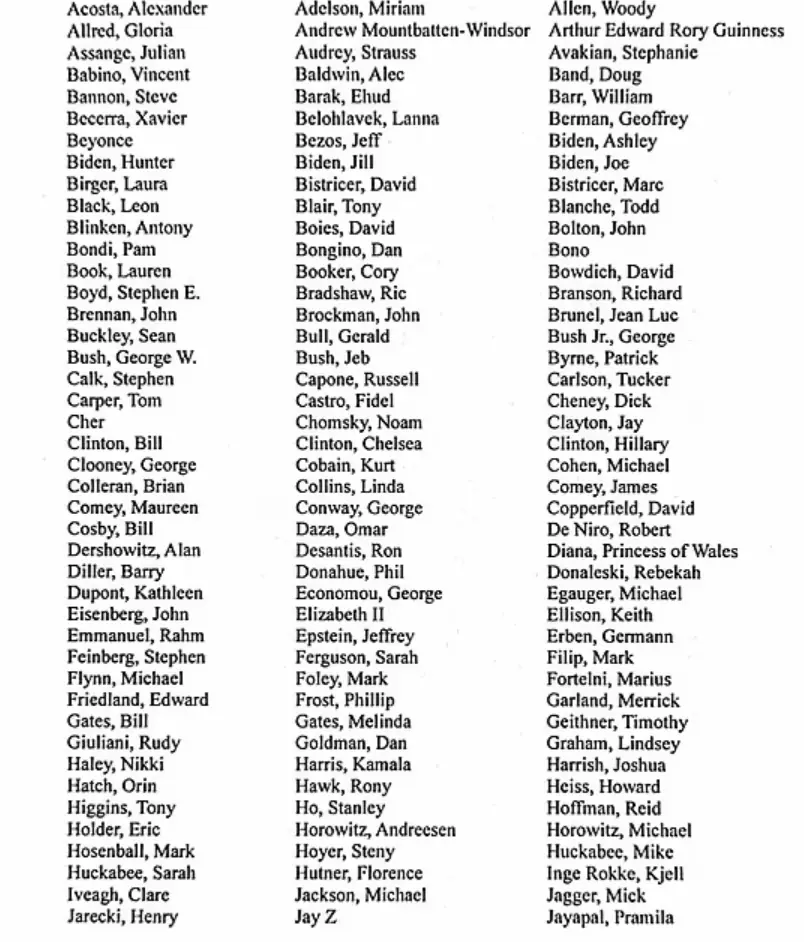
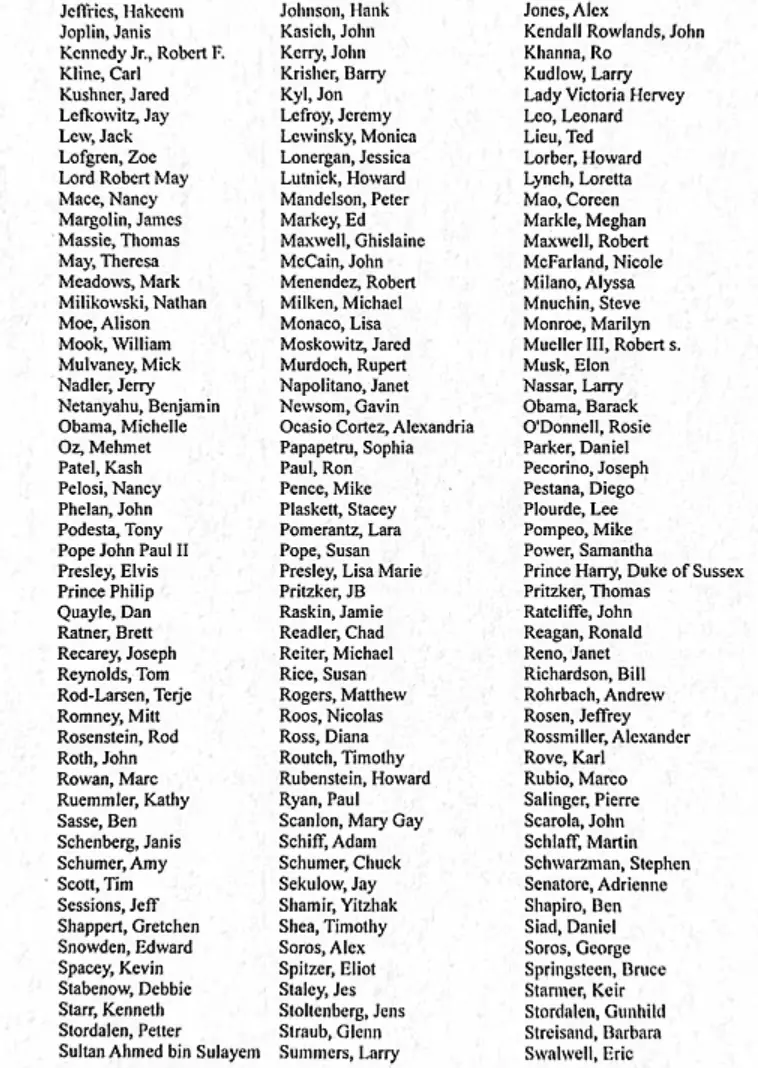
NOTE: FULL LIST INSIDE THE ARTICLE:
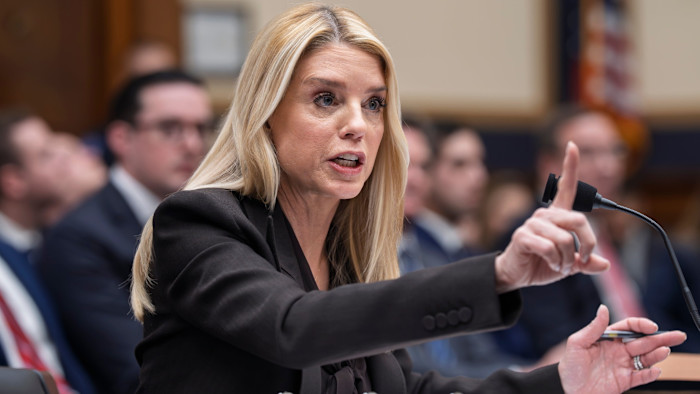
Attorney General Pam Bondi has confirmed that all documents tied to disgraced financier Jeffrey Epstein have now been made public, marking the conclusion of a months-long transparency effort. The announcement comes after staggered releases carried out by the Trump administration, in accordance with Section 3 of the Epstein Files Transparency Act.
Millions of emails, photographs, and other documents connected to Epstein’s case had already been released in batches across December 2025 and January 2026. Federal personnel spent extensive hours reviewing the material to ensure sensitive information was appropriately handled prior to public disclosure.
Bondi, 60, emphasized that the final release represents a full accounting of the files overseen by the Department of Justice. She noted that the disclosure includes more than 300 high-profile individuals whose names appear across the documents.
High-Profile Names in the Files
The list of names includes a broad mix of political leaders, public figures, and industry icons. Among them are President Donald Trump, Microsoft founder Bill Gates, former Prime Minister Margaret Thatcher, former President Barack Obama and First Lady Michelle Obama, Israeli Prime Minister Benjamin Netanyahu, Princess Diana, and former President Bill Clinton and former Secretary of State Hillary Clinton.
Entertainment and cultural figures also appear in the files, including Barbara Streisand, Amy Schumer, Bruce Springsteen, Kim Kardashian, Bill Cosby, and Robert De Niro, highlighting the wide-ranging social network Epstein maintained prior to his arrest.
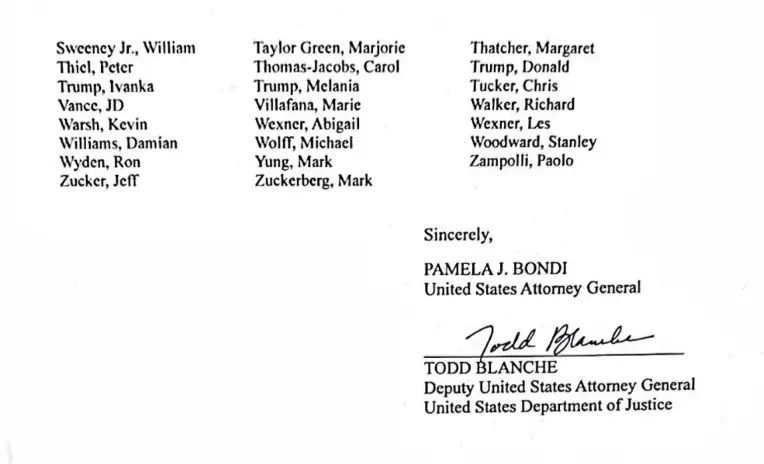
Bondi’s letter, released February 14, included a separate compilation of individuals who “are or were a government official or politically exposed person” referenced in the files at least once. The attorney general and her deputy, Todd Blanche, emphasized that the contexts in which names appear are varied. Being mentioned in the files does not imply guilt or involvement in Epstein’s criminal activities.
Clarifying Withheld Records and Redactions
Bondi addressed questions about withheld material, explaining that only a limited category of records remained undisclosed. “The only category of records withheld were those records where permitted withholdings under Section 2(c) and privileged materials were not segregable from material responsive under Section 2(a),” she wrote.
The withheld material, she clarified, fell under standard legal protections, including deliberative-process privilege, work-product privilege, and attorney-client privilege. Crucially, she stressed that reputational concerns or potential embarrassment did not influence the decision to redact or withhold any material. “No records were withheld or redacted ‘on the basis of embarrassment, reputational harm, or political sensitivity, including to any government official, public figure, or foreign dignitary,’” Bondi added.
Conclusion of the Transparency Process
With the final batch now released, the Department of Justice has completed its obligations under the Epstein Files Transparency Act, ensuring that the public now has access to the entirety of the documents reviewed and released under federal oversight.
The files continue to be of interest to lawmakers, journalists, and advocacy groups, providing insight into the wide-ranging associations and activities of Jeffrey Epstein. While the documents list numerous prominent individuals, Bondi’s office has emphasized repeatedly that inclusion in the files is not evidence of wrongdoing and must be interpreted with caution.
Bondi’s confirmation marks the formal end of the disclosure process, bringing closure to months of gradual document releases and reinforcing the government’s commitment to transparency in high-profile federal investigations.
FULL LIST BY DOJ:

Emily Johnson is a critically acclaimed essayist and novelist known for her thought-provoking works centered on feminism, women’s rights, and modern relationships. Born and raised in Portland, Oregon, Emily grew up with a deep love of books, often spending her afternoons at her local library. She went on to study literature and gender studies at UCLA, where she became deeply involved in activism and began publishing essays in campus journals. Her debut essay collection, Voices Unbound, struck a chord with readers nationwide for its fearless exploration of gender dynamics, identity, and the challenges faced by women in contemporary society. Emily later transitioned into fiction, writing novels that balance compelling storytelling with social commentary. Her protagonists are often strong, multidimensional women navigating love, ambition, and the struggles of everyday life, making her a favorite among readers who crave authentic, relatable narratives. Critics praise her ability to merge personal intimacy with universal themes. Off the page, Emily is an advocate for women in publishing, leading workshops that encourage young female writers to embrace their voices. She lives in Seattle with her partner and two rescue cats, where she continues to write, teach, and inspire a new generation of storytellers.