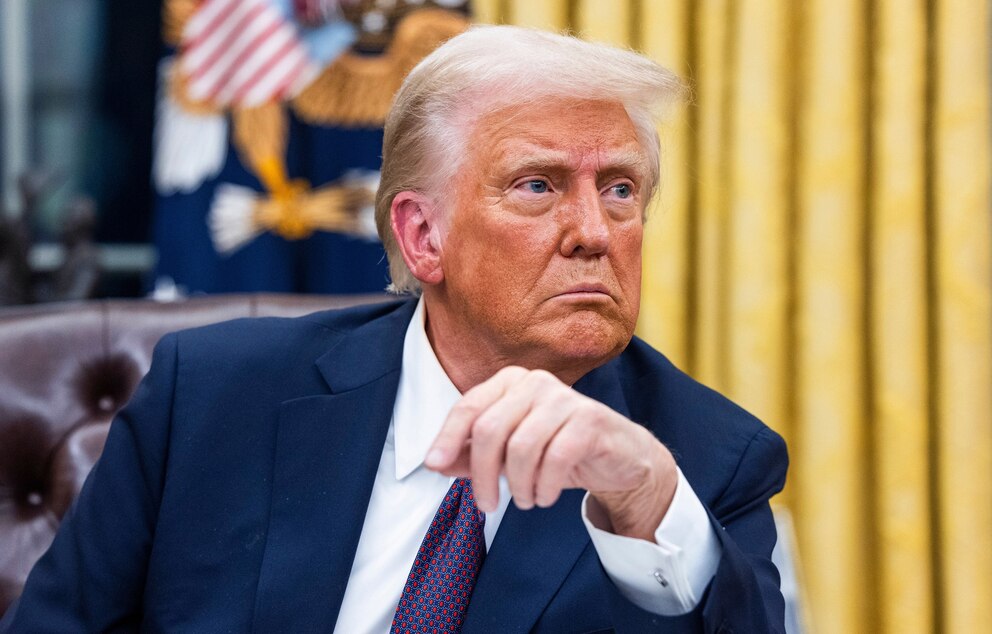
On Valentine’s Day, one unusual recipient of a message from President Donald Trump was not a spouse or family member, but late-night host Bill Maher. However, the note was far from romantic. In an unusually long and detailed statement, Trump criticized Maher as a “jerk” and recounted what he described as an awkward dinner at the White House last April. The tirade comes after Maher’s recent commentary ridiculing Trump’s remarks on international trade and hockey, sparking a rare public feud between the two figures.
Trump’s grievance appears to have been triggered by Maher’s jokes on his Real Time show the previous Friday, which mocked a remark Trump made suggesting that China would “terminate all ice hockey” if Canada signed a trade deal with the United States’ rival. On the program, Maher responded with incredulity, asking, “What the f***k?” and joking that such a statement was ludicrous. Trump clearly took offense, citing both Maher’s commentary and his own personal experiences with the comedian in crafting a long-winded response posted on his social media platforms.
According to Trump, Maher had previously requested a dinner invitation through a mutual friend, which Trump accepted. The president detailed their encounter in the Oval Office, painting Maher as “extremely nervous” and immediately requesting a vodka tonic upon arrival. Trump quoted Maher saying, “I’ve never felt like this before, I’m actually scared.” The president described this moment as “somewhat endearing” and noted that Maher had initially appeared to be polite and respectful during the meal.
Trump recounted that after the dinner, Maher appeared courteous in his first show following their meeting. However, according to Trump, Maher’s subsequent programming became increasingly critical of the Trump administration, devolving into what the president described as “Very boring, ANTI TRUMP” commentary. Trump listed several achievements he believed Maher failed to acknowledge, including a robust economy with historically high stock market levels, low inflation, significant crime reductions, military rebuilding, foreign policy successes such as the deaths of terrorist leaders, and other domestic accomplishments.
In the Valentine’s Day message, Trump framed his complaints with both humor and exasperation. He emphasized that Maher’s continued criticism was a personal slight, noting, “In any event, it was a total waste of time for me to have this jerk at the White House.” He also reiterated that Maher had declined further invitations to the White House, including a Christmas party, which Trump said added to his frustration.
Trump further addressed the specific incident regarding the Stanley Cup and his joking remark about China eliminating ice hockey in Canada. He claimed Maher treated the joke as a serious statement, when in fact it was intended as humor. “Well, he went on and on about the Hockey statement, like ‘What kind of a person would say such a foolish thing as this,’ as though I were being serious when I said it,” Trump wrote. The president added that Maher’s low television ratings meant that his commentary would have limited reach, but that it nonetheless prompted personal irritation.
Throughout the statement, Trump compared Maher to other late-night hosts such as Jimmy Kimmel, Jimmy Fallon, and Stephen Colbert, stating, “He is no different than Kimmel, Fallon, or Colbert but, I must admit, slightly more talented!” Despite this acknowledgment, Trump ultimately labeled Maher “a highly overrated LIGHTWEIGHT” and criticized Republicans for using Maher as a bridge to reach left-leaning audiences. Trump suggested that the party base found Maher’s commentary amusing rather than insightful, stating, “Our Base, the Greatest of All Time, laughs at your weakness when you do it!”
The president’s message was both a personal reflection on the dinner experience and a broader critique of Maher’s public persona. He repeatedly framed the comedian’s comments as evidence of what he calls “Trump Derangement Syndrome (TDS),” a term Trump frequently uses to describe perceived bias against him in the media. “Bill continues to suffer from a severe case of Trump Derangement Syndrome, and there is nothing that will ever be done to cure him of this very serious disease,” Trump wrote.
Trump’s account of the dinner highlighted several idiosyncratic details. He described Maher as “extremely nervous” throughout the meal, implying that the host’s anxiety was unusual given his public persona as a confident, outspoken figure. Trump also recalled that Maher had asked for a vodka tonic within moments of entering the Oval Office and that he repeatedly expressed fear during the encounter. Nevertheless, the president noted that Maher had initially behaved respectfully, contrasting those early impressions with the host’s subsequent public criticism.
The president also described his own perspective on prioritizing national achievements over perceived slights from celebrities. He emphasized that he would rather focus on “MAKING AMERICA GREAT AGAIN than wasting [his] time” on media figures like Maher. The statement combined both personal anecdotes and political commentary, illustrating how Trump intertwines interpersonal grievances with broader critiques of the media and his administration’s portrayal.
Trump concluded the Valentine’s Day message with an explicit admonition and a tone of finality, asserting that the dispute with Maher was minor in the broader scope of his work and accomplishments. He thanked readers for their attention to “this minor matter,” reinforcing his perspective that Maher’s jokes were of limited consequence relative to the president’s priorities and achievements.
This public confrontation adds a rare personal dimension to the ongoing discourse between Trump and late-night television hosts. While Maher has long been a critic of Trump, few occasions have prompted the former president to respond in such a detailed and emotionally charged manner. The timing—on Valentine’s Day—and the blending of personal recollections with policy achievements creates a uniquely Trumpian narrative, illustrating the interplay between celebrity culture, media commentary, and presidential communication.
Observers note that Trump’s extensive message reflects his characteristic style: mixing anecdote, complaint, humor, and political boasting in a single public statement. The discussion of Maher’s nervous demeanor, the vodka tonic, and the details of the White House dinner underscore how Trump often personalizes interactions, using specific incidents to illustrate broader points about loyalty, respect, and media bias.
While Maher has yet to respond publicly to Trump’s Valentine’s Day message, the incident is likely to reignite discussions about late-night media criticism, the relationship between presidents and celebrities, and the ways in which public figures respond to humor and satire. The episode serves as a reminder of the ongoing tension between the Trump administration and media personalities, highlighting how even lighthearted commentary can trigger intense public reactions.

Emily Johnson is a critically acclaimed essayist and novelist known for her thought-provoking works centered on feminism, women’s rights, and modern relationships. Born and raised in Portland, Oregon, Emily grew up with a deep love of books, often spending her afternoons at her local library. She went on to study literature and gender studies at UCLA, where she became deeply involved in activism and began publishing essays in campus journals. Her debut essay collection, Voices Unbound, struck a chord with readers nationwide for its fearless exploration of gender dynamics, identity, and the challenges faced by women in contemporary society. Emily later transitioned into fiction, writing novels that balance compelling storytelling with social commentary. Her protagonists are often strong, multidimensional women navigating love, ambition, and the struggles of everyday life, making her a favorite among readers who crave authentic, relatable narratives. Critics praise her ability to merge personal intimacy with universal themes. Off the page, Emily is an advocate for women in publishing, leading workshops that encourage young female writers to embrace their voices. She lives in Seattle with her partner and two rescue cats, where she continues to write, teach, and inspire a new generation of storytellers.