

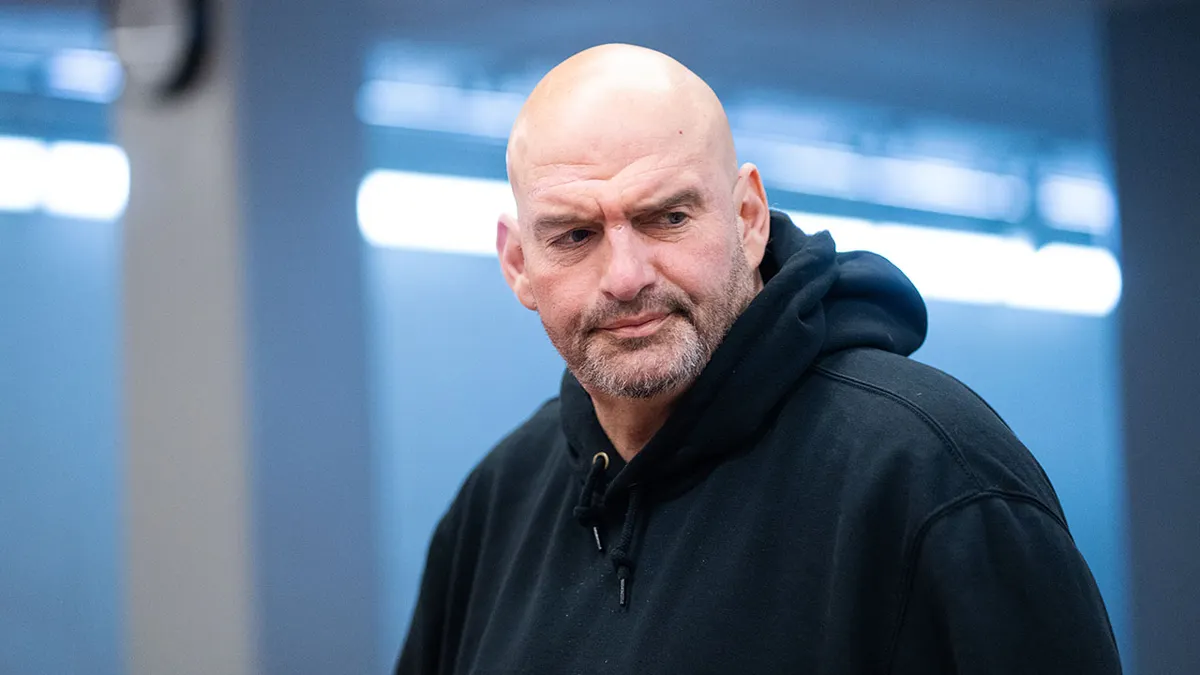
Senator John Fetterman (D-Pa.) has once again drawn attention for breaking with many in his party by voicing support for voter identification requirements, but he made clear that his endorsement of photo ID does not extend to the Republican-backed Safeguard American Voter Eligibility (SAVE) America Act, which recently passed the House of Representatives. Fetterman’s nuanced stance reflects both his personal views on election integrity and the broader political dynamics surrounding voting legislation in the United States.
The SAVE America Act passed the House earlier this week, with a near-unified Republican vote and one Democrat, Representative Henry Cuellar of Texas, crossing party lines to support the legislation. The bill aims to impose stricter requirements on voters, including mandatory proof of citizenship when registering and photo identification for in-person and mail-in ballots. It also includes provisions that would limit registration by mail, mandate more frequent voter-roll purges of individuals deemed ineligible, and impose other administrative changes. Republicans have framed the bill as a measure to strengthen election integrity, emphasizing the need for verification and safeguards in the voting process.
Fetterman, however, has made it clear that while he views voter ID requirements as broadly reasonable, the broader provisions of the SAVE America Act are unacceptable to him. In an appearance on Politico’s The Conversation with Dasha Burns on February 12, 2026, Fetterman addressed questions about the legislation and his position on voter ID. “Yeah, but I don’t support [the] SAVE Act,” he said when asked whether his support for voter ID extended to the House-passed bill.
Fetterman argued that requiring voters to show identification is widely seen as a practical and reasonable step for securing elections, a position that contrasts with some Democrats who have characterized voter ID laws as forms of voter suppression. Senate Minority Leader Chuck Schumer (D-N.Y.) and other party leaders have described the SAVE America Act as a modern-day equivalent of Jim Crow laws, suggesting that its restrictions on registration and mail-in voting could disproportionately affect people of color, young voters, and others who face barriers to accessing identification or documentation.
Schumer, in comments on MSNBC’s Morning Joe, directly compared the legislation to historical voter suppression measures: “It’s Jim Crow 2.0, and I called it Jim Crow 2.0. What they’re trying to do here is the same thing that was done in the South for decades to prevent people of color from voting.” He warned that the bill could disenfranchise voters whose personal information or documentation does not align perfectly with official records, including women who have changed their last names due to marriage. “You will not get a single Democratic vote in the Senate,” Schumer emphasized.
Fetterman, by contrast, has resisted framing voter ID in such stark terms. While acknowledging the broader debate, he specifically refused to characterize the requirement as equivalent to Jim Crow-era restrictions. He pointed to existing Democratic-led states, such as Virginia and Wisconsin, that already require voters to present photo identification without evident suppression of eligible voters. “I refuse to call it Jim Crow 2.0,” he said, stressing that a voter ID requirement can be implemented in ways that do not disenfranchise eligible citizens.
Despite his support for voter ID in principle, Fetterman made it clear that he will not vote for the SAVE America Act. He highlighted both practical and procedural obstacles that make the legislation unviable in the Senate under current rules. “No, no, I won’t, but even if I loved it, and I vote for it, I’ll be the only Democrat, and that doesn’t matter, because we won’t come anywhere close to hitting 60,” Fetterman said, referencing the Senate’s 60-vote threshold necessary to overcome a filibuster.
Fetterman has also emphasized that provisions of the bill restricting mail-in voting are a “non-starter” for him. Pennsylvania’s no-excuse mail-in voting system, established under a 2019 state law, has become a critical and often contested component of the state’s elections. Republican legal challenges over how mail ballots are processed, including disputes about undated or misdated ballots, remain ongoing. Just this week, the Republican National Committee petitioned the Supreme Court to overturn a ruling requiring Pennsylvania to count certain ballots, highlighting how central mail voting has become in political debates.
The SAVE America Act is currently being pressed by Republicans for consideration in the Senate. House Republicans and their allies have portrayed the legislation as necessary to ensure election security, emphasizing verification of citizenship and voter identity. Democrats, on the other hand, argue that it introduces unnecessary hurdles for eligible voters and could complicate access, particularly through new limits on registration by mail and stricter maintenance of voter rolls. Fetterman’s stance attempts to navigate this tension: he supports the principle of voter ID but rejects the broader restrictions and procedural changes the bill would introduce.
In his interviews, Fetterman has also voiced concern about what might happen if the bill were ever passed under a weakened or eliminated filibuster rule. “We would have a much bigger problem if that does pass,” he said in reference to potential scenarios in which the Senate changes its procedural rules, allowing the bill to advance with a simple majority. Fetterman’s comments underscore his wariness of sweeping changes to voting law that could take effect without bipartisan consensus or sufficient safeguards.
The senator’s approach demonstrates an effort to separate the debate over voter ID from broader partisan battles over election law. While many Democrats see voter ID as a symbol of potential suppression, Fetterman frames it as a reasonable security measure that can coexist with protections for mail-in voters and other access initiatives. By clarifying that his support does not extend to the SAVE America Act, Fetterman positions himself in a centrist space: advocating for election integrity in principle while opposing measures that could restrict participation or disproportionately affect vulnerable voters.
Fetterman’s position also reflects the unique political context of Pennsylvania, a key swing state where mail-in ballots and voter access have been intensely debated. As an advocate for practical election security measures without broad restrictions, Fetterman’s stance illustrates how legislators can support certain safeguards while rejecting partisan legislation that might have negative unintended consequences.
In conclusion, Senator John Fetterman has made it clear that his support for voter identification does not equate to an endorsement of the SAVE America Act. While he affirms that requiring voters to show ID is reasonable, he rejects the bill’s limitations on mail voting and other administrative provisions. At the same time, he recognizes the Senate’s procedural reality, noting that the bill is unlikely to clear a filibuster under current rules. Fetterman’s position highlights the ongoing national debate over voting access, election security, and the balance between safeguarding the ballot and ensuring broad participation. By distinguishing voter ID from the broader legislative package, he attempts to chart a middle path in a highly polarized political landscape.

Emily Johnson is a critically acclaimed essayist and novelist known for her thought-provoking works centered on feminism, women’s rights, and modern relationships. Born and raised in Portland, Oregon, Emily grew up with a deep love of books, often spending her afternoons at her local library. She went on to study literature and gender studies at UCLA, where she became deeply involved in activism and began publishing essays in campus journals. Her debut essay collection, Voices Unbound, struck a chord with readers nationwide for its fearless exploration of gender dynamics, identity, and the challenges faced by women in contemporary society. Emily later transitioned into fiction, writing novels that balance compelling storytelling with social commentary. Her protagonists are often strong, multidimensional women navigating love, ambition, and the struggles of everyday life, making her a favorite among readers who crave authentic, relatable narratives. Critics praise her ability to merge personal intimacy with universal themes. Off the page, Emily is an advocate for women in publishing, leading workshops that encourage young female writers to embrace their voices. She lives in Seattle with her partner and two rescue cats, where she continues to write, teach, and inspire a new generation of storytellers.