


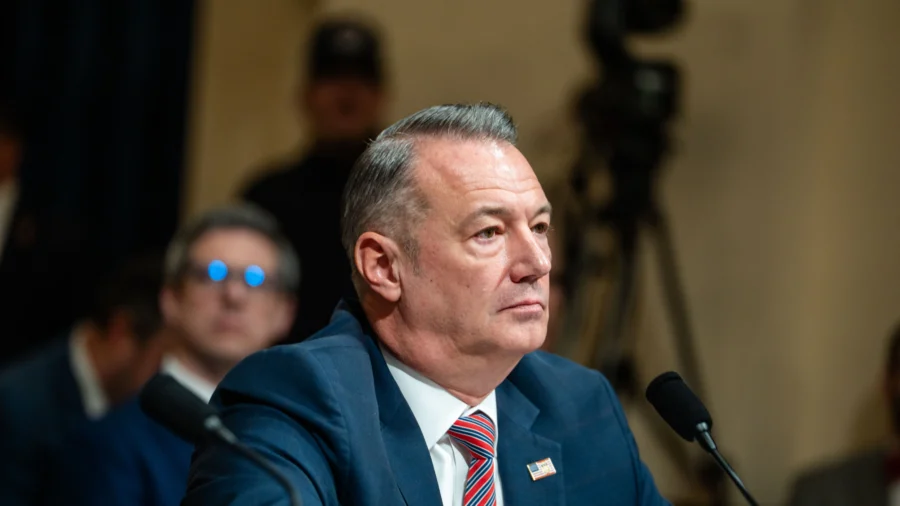
The U.S. Immigration and Customs Enforcement (ICE) agency announced on February 13 that two officers have been placed on administrative leave following allegations that they provided false testimony in a federal case. Acting ICE Director Todd Lyons confirmed the development in a statement, emphasizing the seriousness of lying under oath and the ongoing federal investigation into the matter.
“A joint review by ICE and the Department of Justice (DOJ) of video evidence has revealed that sworn testimony provided by two separate officers appears to have made untruthful statements,” Lyons told The Epoch Times. “Both officers have been immediately placed on administrative leave pending the completion of a thorough internal investigation. Lying under oath is a serious federal offense. The U.S. Attorney’s Office is actively investigating these false statements.”
According to Lyons, the outcome of the investigation could include termination of employment for the officers and potential criminal prosecution. “The men and women of ICE are entrusted with upholding the rule of law and are held to the highest standards of professionalism, integrity, and ethical conduct,” he said. “Violations of this sacred sworn oath will not be tolerated. ICE remains fully committed to transparency, accountability, and the fair enforcement of our nation’s immigration laws.”
The allegations come in the context of a larger operation in Minneapolis that began during the Trump administration, when federal ICE personnel were sent to the city to assist in managing illegal immigration. Officials recently announced that the operation is ending, but it has left behind a trail of legal and administrative challenges, including the case involving two men, Afredo Aljorna and Julio Sosa-Celis.
In an affidavit supporting federal charges against Aljorna and Sosa-Celis, an FBI agent stated that the men had aided and abetted assaulting and interfering with ICE officers during an apprehension attempt of an undocumented immigrant. The affidavit described a confrontation in which ICE officers alleged that the men resisted law enforcement efforts, prompting claims of obstruction and assault.
However, attorneys for both defendants strongly disputed the allegations. Lawyers representing Aljorna argued in court filings that their client did not engage in any assault, emphasizing that “no independent evidence supports the federal officer’s claim to the contrary.” Similarly, Sosa-Celis’s attorneys asserted that he did not assault any officers but was instead attempting to pull Aljorna away from law enforcement when an ICE officer discharged a firearm.
The dispute over the officers’ credibility came to a head in recent court proceedings. On February 11, prosecutors from the U.S. Attorney’s Office for the District of Minnesota filed a motion urging the court to dismiss the case, citing “newly discovered evidence in this matter [that] is materially inconsistent with the allegations.” While the prosecutors did not elaborate on the evidence, the filing underscored that the initial claims against Aljorna and Sosa-Celis were undermined.
The federal judge overseeing the case agreed with the prosecutors’ assessment, dismissing the case with prejudice on February 13. This legal designation prevents the charges from being refiled in the future, effectively ending the litigation surrounding the incident.
The fallout has reverberated through ICE, drawing attention to internal accountability and the standards to which federal law enforcement officers are held. According to Lyons, ICE personnel are expected to adhere to the highest ethical standards, both in the execution of their duties and in the provision of sworn testimony. Misrepresentation or dishonesty, particularly under oath, is treated as a serious breach of trust with potential legal and professional consequences.
The agency’s decision to place the officers on leave reflects an effort to maintain transparency while the investigation proceeds. Administrative leave is standard practice in situations where the conduct of employees is under review, allowing agencies to carry out inquiries without interference while signaling a commitment to accountability.
This incident highlights the complex interplay between federal law enforcement, the judicial system, and immigrant communities. The Minneapolis operation itself was a politically and operationally sensitive effort, designed to supplement local authorities’ ability to manage undocumented immigration. While officials have stated that the operation is concluding, the legacy of cases like those involving Aljorna and Sosa-Celis demonstrates the challenges that arise when law enforcement actions are scrutinized under legal and public oversight.
In his statement, Lyons emphasized that the investigation will be comprehensive. He indicated that ICE is cooperating fully with the Department of Justice and the U.S. Attorney’s Office to ensure that any violations of law or professional standards are addressed appropriately. The outcomes could include criminal charges against the officers if prosecutors determine that the false testimony meets the threshold for federal prosecution.
Federal law recognizes lying under oath, also known as perjury, as a serious criminal offense. Perjury carries the potential for significant legal penalties, including imprisonment, fines, and the loss of federal employment. In the context of ICE, officers who engage in such misconduct not only jeopardize their own careers but also risk undermining the integrity of ongoing immigration enforcement efforts and the public’s trust in federal law enforcement.
The decision to dismiss the Minnesota case with prejudice also sends a broader message to federal prosecutors and law enforcement agencies. When evidence comes to light that materially contradicts sworn statements, courts are compelled to take action to ensure fairness and uphold the rule of law. The court’s ruling in favor of Aljorna and Sosa-Celis underscores the judiciary’s role in evaluating the credibility of law enforcement testimony and ensuring that prosecutions are supported by verifiable evidence.
While the case is legally closed, the implications for ICE’s internal procedures remain ongoing. The agency has stated that it will review training, oversight, and accountability measures to prevent similar incidents in the future. Acting Director Lyons’ public comments suggest a commitment to reinforcing ethical standards and reaffirming that ICE personnel must maintain integrity in every aspect of their work.
Observers and immigration advocates are closely watching the situation, recognizing that cases like this one can have wider ramifications for public confidence in federal enforcement operations. Transparency in investigations and clear consequences for misconduct are viewed as essential to maintaining trust between law enforcement agencies and the communities they serve.
The Minneapolis operation, which brought an influx of ICE officers into the city, had previously been the subject of political debate. Supporters argued that the additional personnel were necessary to address undocumented immigration effectively, while critics raised concerns about civil liberties, community relations, and oversight. The current investigation into the officers’ conduct adds another layer of scrutiny, illustrating the ongoing tension between operational goals and accountability standards.
Lyons’ statement makes clear that ICE does not take allegations of dishonesty lightly. By placing the officers on administrative leave and cooperating with federal prosecutors, the agency seeks to demonstrate that even high-ranking or experienced personnel are subject to the same rules and potential consequences as any other federal employee.
As the federal investigation continues, additional information may emerge about the nature of the alleged false statements, the context of the incident in Minneapolis, and any potential criminal implications. For now, the case serves as a high-profile example of the intersection of law enforcement authority, judicial oversight, and ethical responsibility.
In conclusion, ICE’s decision to place the two officers on administrative leave following allegations of false testimony represents a significant step toward accountability within the agency. The dismissal of the Minnesota case against Aljorna and Sosa-Celis highlights the critical role of evidence and credible testimony in federal prosecutions. As the investigation unfolds, both the officers’ careers and public confidence in ICE operations may be affected, reflecting the broader stakes of professional integrity within federal law enforcement.

Emily Johnson is a critically acclaimed essayist and novelist known for her thought-provoking works centered on feminism, women’s rights, and modern relationships. Born and raised in Portland, Oregon, Emily grew up with a deep love of books, often spending her afternoons at her local library. She went on to study literature and gender studies at UCLA, where she became deeply involved in activism and began publishing essays in campus journals. Her debut essay collection, Voices Unbound, struck a chord with readers nationwide for its fearless exploration of gender dynamics, identity, and the challenges faced by women in contemporary society. Emily later transitioned into fiction, writing novels that balance compelling storytelling with social commentary. Her protagonists are often strong, multidimensional women navigating love, ambition, and the struggles of everyday life, making her a favorite among readers who crave authentic, relatable narratives. Critics praise her ability to merge personal intimacy with universal themes. Off the page, Emily is an advocate for women in publishing, leading workshops that encourage young female writers to embrace their voices. She lives in Seattle with her partner and two rescue cats, where she continues to write, teach, and inspire a new generation of storytellers.