Uncertainty Clouds House Majority as Veteran Lawmaker Weighs Early Departure
on
Control of the United States House of Representatives once again hangs on a razor’s edge as a senior Republican lawmaker from Florida is reportedly considering an early exit from Congress. While no formal announcement has been made, multiple reports indicate that the veteran representative is weighing whether to step down before the completion of his current term — a move that could significantly alter the balance of power in Washington.
The timing of the potential resignation has drawn particular scrutiny. Republicans currently maintain only a narrow majority in the House, leaving little margin for internal dissent or unexpected vacancies. In such an environment, even a single departure can have outsized consequences. Should another Republican seat become vacant before scheduled special elections are completed, the chamber could effectively grind to a halt on contentious legislation, particularly if party unity falters.
According to individuals familiar with the discussions, the Florida congressman has not yet finalized a decision but is said to be seriously evaluating the possibility of leaving office in the coming days. If he were to resign soon, the move would likely trigger a special election later this year to fill the seat. While his district leans Republican, the interim period before a successor is sworn in could temporarily narrow the GOP majority to a single vote.
The lawmaker in question has already announced that he will not seek re-election at the conclusion of his current term. In a public statement issued in mid-January, he described his desire to return home, spend more time with family, and pass the torch to a new generation of conservative leadership. He spoke of grandchildren, community ties, and a renewed focus on private life after years in public service.
At 72 years old, the Florida representative has built a lengthy résumé both inside and outside Congress. Before entering politics, he worked as a physician and served as an Army surgeon. Since arriving in Washington in 2017, he has established himself as a reliable conservative vote, generally aligning with party leadership on fiscal and national security matters. He represents Florida’s 2nd Congressional District, a region covering much of the state’s Panhandle and rated as a solidly Republican seat.
Despite the public retirement announcement for the end of his term, speculation about an earlier departure intensified this week following a report from Fox News. The outlet cited multiple lawmakers who suggested that conversations about stepping down before the term’s completion were underway. No specific timeline was provided, but sources indicated that any resignation would likely occur early enough to allow for a summer special election.
The congressman’s office has pushed back against the rumors. When asked directly about the reports by journalists from Politico and Punchbowl News, the lawmaker offered only a brief “no comment.” A spokesperson later stated that the speculation was “not originating through this office” and reiterated that he intends to complete his term. Still, the absence of a firm denial has done little to quiet the swirling questions on Capitol Hill.
Behind the scenes, party leadership is keenly aware of the stakes. House Speaker Mike Johnson has reportedly urged the Florida Republican to remain in office through the end of the term, citing the precarious numerical advantage held by Republicans. With several seats already vacant or awaiting special elections, every vote matters.
The current arithmetic in the House reflects an unusually fragile majority. Earlier this month, Marjorie Taylor Greene resigned from Congress, creating an open seat in Georgia that will be filled in a special election this spring. Just one day later, California Republican Doug LaMalfa passed away, prompting another special election scheduled for early summer in that state’s 1st Congressional District. Both districts lean Republican, and party officials expect to retain them. However, until successors are sworn in, those seats remain vacant.
Democrats are also operating with one fewer member after Mikie Sherrill resigned her House seat following her victory in New Jersey’s gubernatorial election. That safely Democratic district is likewise expected to remain in her party’s hands once filled. Still, the temporary vacancies on both sides underscore the delicate balance currently shaping legislative strategy.
If the Florida Republican were to leave early, the GOP majority would effectively shrink to a single-seat advantage. Under such conditions, internal party divisions could prove decisive. Kentucky Representative Thomas Massie has frequently broken with his party on high-profile votes, occasionally siding with Democrats on fiscal and procedural matters. Since President Donald Trump returned to the White House last year, Massie has opposed several key Republican-backed initiatives, including a major spending package informally dubbed the “Big Beautiful Bill.” His independent streak has complicated efforts to maintain unified GOP support on contentious legislation.
For Republican leadership, therefore, the question is not merely about filling a safe district but about surviving the interim period without losing operational control of the chamber. Even short-term instability can delay committee work, stall appropriations, and complicate negotiations with the Senate and the White House.
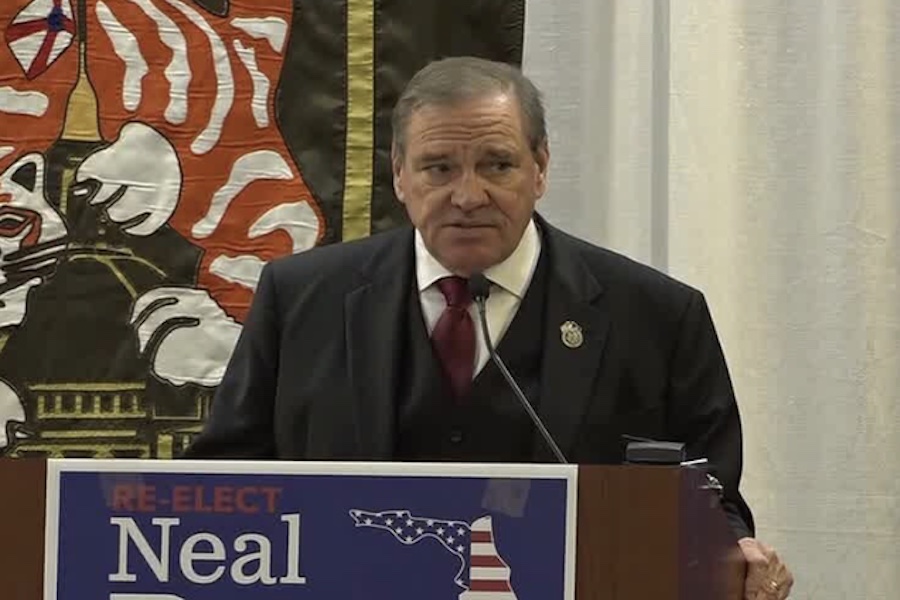
Amid this uncertainty, the identity of the Florida lawmaker at the center of the speculation has been widely known within political circles but carefully managed in official communications. That lawmaker is U.S. Rep. Neal Dunn (R-FL).
Screenshot
Dunn, first elected in 2016, has consistently won re-election in Florida’s 2nd District, an area with a Republican lean of approximately R+8. His background as a physician and former Army surgeon has shaped his legislative focus, particularly on veterans’ health care and medical policy. Over nearly a decade in Congress, he has cultivated a reputation as a steady, if low-profile, conservative voice.
In January, Dunn formally announced that he would not seek re-election at the end of his term. In that statement, he framed the decision as a personal one, emphasizing his desire to return to Panama City and prioritize family life. He spoke of “passing leadership to new conservative figures” and expressed confidence in the district’s future representation.
Health considerations have also been part of the broader discussion, though no clear link has been established between any past medical issues and the current rumors of an early resignation. Dunn has faced health challenges in prior years, but neither he nor his office has suggested that such matters are driving the present speculation.
As of now, Dunn has not publicly committed to stepping down before his term concludes. His spokesperson has maintained that he intends to serve out the remainder of his time in office. Nonetheless, the mere possibility of his early departure has heightened tensions within a House already defined by narrow margins and unpredictable alliances.
In the coming days, attention will remain fixed on whether Dunn offers clarity. For Republicans, the stakes are straightforward: maintaining control of the House requires not only winning elections but also managing the calendar, vacancies, and internal cohesion. In a chamber where a single vote can determine the fate of major legislation, even rumors of a resignation carry significant weight.
Until a definitive decision is announced, uncertainty will continue to shadow the Capitol — a reminder that in today’s closely divided Congress, stability can hinge on the choice of one member.
Emily Johnson is a critically acclaimed essayist and novelist known for her thought-provoking works centered on feminism, women’s rights, and modern relationships. Born and raised in Portland, Oregon, Emily grew up with a deep love of books, often spending her afternoons at her local library. She went on to study literature and gender studies at UCLA, where she became deeply involved in activism and began publishing essays in campus journals. Her debut essay collection, Voices Unbound, struck a chord with readers nationwide for its fearless exploration of gender dynamics, identity, and the challenges faced by women in contemporary society. Emily later transitioned into fiction, writing novels that balance compelling storytelling with social commentary. Her protagonists are often strong, multidimensional women navigating love, ambition, and the struggles of everyday life, making her a favorite among readers who crave authentic, relatable narratives. Critics praise her ability to merge personal intimacy with universal themes. Off the page, Emily is an advocate for women in publishing, leading workshops that encourage young female writers to embrace their voices. She lives in Seattle with her partner and two rescue cats, where she continues to write, teach, and inspire a new generation of storytellers.