



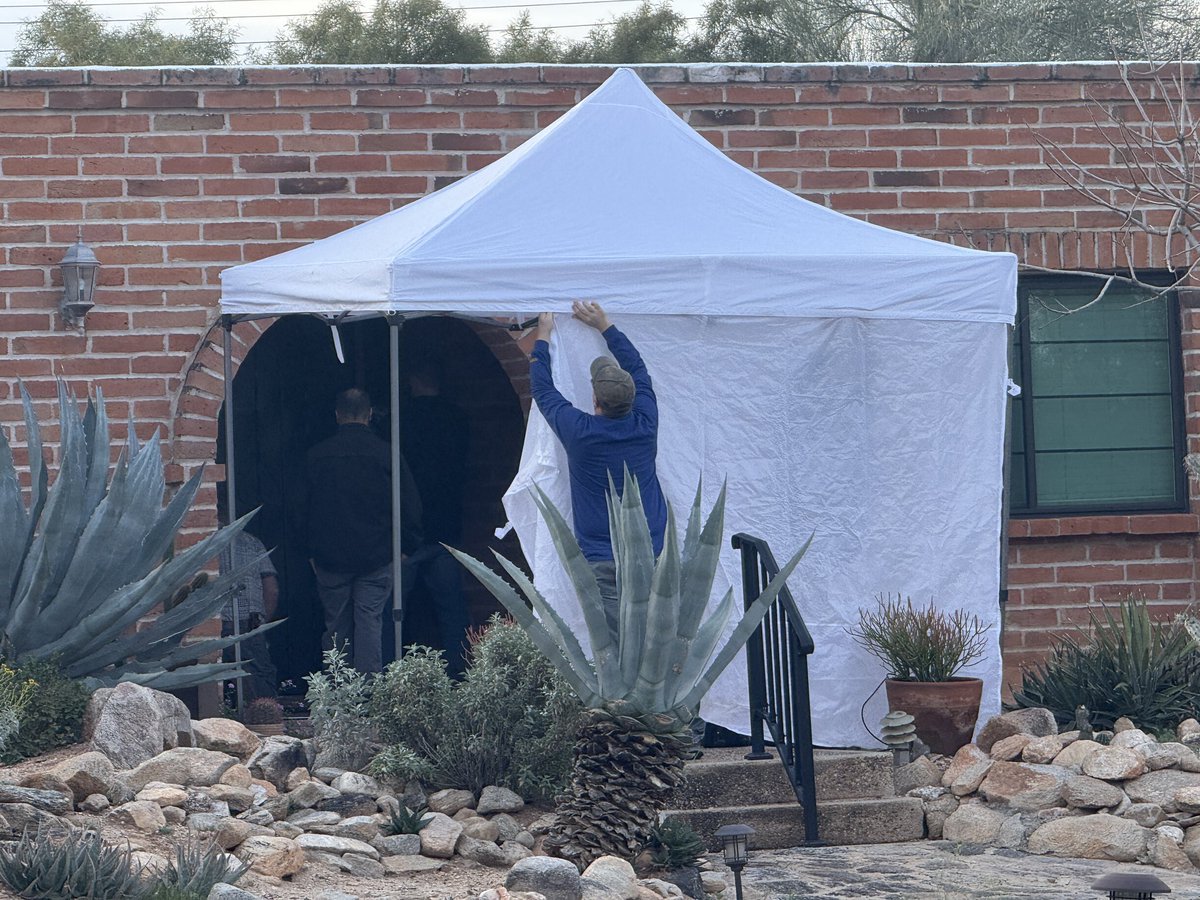
The search for 84-year-old Nancy Guthrie entered its eleventh day this week as federal and local authorities continued combing the desert terrain surrounding her Catalonia Foothills residence, pursuing what they describe as a steadily evolving investigation marked by new developments and mounting public concern.
Guthrie was abducted from her secluded home on February 1 in a case that has since drawn national attention. Surveillance footage released earlier this week shows a masked individual approaching her front door in the early hours of the morning. The individual, whose identity remains unknown, appeared to be carrying a backpack and wearing dark clothing. Investigators also noted the presence of a holstered handgun visible in the footage.
Since the video’s release, law enforcement agencies — including the FBI’s Phoenix field office and the Pima County Sheriff’s Office (PCSO) — have expanded their search radius, focusing heavily on roadways, brush-filled lots, drainage areas and outlying structures within several miles of Guthrie’s property.
On Tuesday, teams from the FBI’s Evidence Response unit were observed conducting a methodical search along a stretch of roadway approximately 1.5 miles from the victim’s home. Agents in protective gear sifted through thorny desert shrubbery and patches of dried grass, at times using tools to lift debris and inspect rocks embedded in the sandy soil. The activity drew media attention as helicopters circled overhead and reporters documented the scene from a distance.
Authorities have not publicly disclosed every detail of what prompted the concentrated search in that particular area. However, law enforcement sources indicated that investigators were acting on information developed through a combination of digital forensics, surveillance analysis, and tips from the public.
The discovery made during that roadside sweep may represent one of the most tangible pieces of physical evidence recovered so far in the case.
Agents were seen carefully extracting an item from thick brush before placing it into an evidence bag. The object, partially concealed among dry twigs and desert debris, was handled with caution, photographed in place, and then transported for forensic examination.
That item was later identified as a black insulated glove.
🚨 NOW: Investigators have found a black glove as they hunt for the kidnappers of Nancy Guthrie — NYP
I hope they're getting closer 👀👀
She MUST be found! pic.twitter.com/rWlL2CWgOi
— Eric Daugherty (@EricLDaugh) February 11, 2026
According to multiple reports, the glove closely resembles those worn by the masked individual captured in the doorbell camera footage at Guthrie’s home. In the grainy black-and-white video released by the FBI, the suspect appears dressed in dark clothing, with gloves visible as the person approaches the residence.
Law enforcement officials have stopped short of declaring the glove a definitive breakthrough. A spokesperson for the Pima County Sheriff’s Department confirmed that the item is undergoing forensic processing but declined to comment on its evidentiary value.
“We continue to process all items collected as part of this investigation,” the spokesperson said. “At this time, we cannot speculate on what significance any single piece of evidence may hold.”
Still, experts say such a discovery could prove critical.
Dr. Gregory Vecchi, a retired supervisory special agent and former chief of the FBI’s Behavioral Science Unit, noted that a recovered article of clothing can yield multiple forms of forensic evidence.
“A glove like that could potentially provide DNA, latent fingerprints, or fiber transfer evidence,” Vecchi explained in a televised interview. “If it was worn during the commission of a crime and later discarded, that can be very significant.”
Investigators will likely test the glove for touch DNA, examine it for hair or fiber fragments, and compare it to materials seen in the surveillance footage. They may also analyze soil and plant matter attached to it to determine whether it was discarded immediately after the abduction or transported from another location.
The glove’s proximity to Guthrie’s residence has further intensified speculation that the suspect may be familiar with the area.
The Catalonia Foothills neighborhood is known for its quiet desert landscape, scattered homes, and limited through-traffic. Residents have described the area as peaceful and somewhat isolated — a feature that may have emboldened whoever carried out the abduction.
Authorities have urged residents within a several-mile radius to review security footage from the night of February 1 and the days following. Investigators are particularly interested in any recordings that may show unfamiliar vehicles, individuals walking along roadways, or suspicious activity in outlying desert areas.
The latest development comes less than 24 hours after law enforcement officers executed a search warrant at a home in Rio Rico, roughly an hour south of Tucson. An individual was detained for questioning during that operation but was released without charges early Wednesday morning.
Officials have not clarified whether the Rio Rico search is directly connected to the glove recovered near Guthrie’s home. However, the timing suggests that investigators are pursuing multiple leads simultaneously.
Adding to the complexity of the case are ransom communications sent to various media outlets, including Arizona-based television stations and the celebrity news site TMZ. The notes reportedly demanded payment in cryptocurrency in exchange for Guthrie’s safe return.
Harvey Levin, founder of TMZ, stated in a televised interview that law enforcement believes the suspect — or suspects — may reside within the Tucson metropolitan area. He suggested that the focus on local media outlets could indicate familiarity with the region.
“Law enforcement has told me they are operating under the theory that this person lives in the Tucson television area,” Levin said, referencing the targeted distribution of ransom messages.
Levin also reported that activity had recently been detected in cryptocurrency accounts associated with the ransom demand, marking the first such movement since the notes were sent. Local outlet KGUN later confirmed that investigators are analyzing digital wallet activity as part of the broader probe.
Despite these developments, authorities have emphasized that the investigation remains active and fluid. They have declined to confirm whether they believe Guthrie is still alive, though search efforts continue at full scale.
FBI agents and sheriff’s deputies have been seen canvassing properties, inspecting sheds, and examining vacant lots. Particular attention appears to be focused on areas where items could be discarded without immediate detection — including roadside brush and desert wash zones.
The recovery of the black glove has heightened both hope and anxiety among residents.
For some, the discovery signals that investigators are closing in on critical evidence. For others, it underscores the unsettling reality that the suspect may have moved through the community undetected.
As forensic testing proceeds, authorities are urging patience and caution against speculation. Results from DNA or fingerprint analysis can take time, particularly when processing must be conducted meticulously to preserve evidentiary integrity.
Meanwhile, family members of Nancy Guthrie have remained largely out of the public eye, releasing only brief statements expressing gratitude for law enforcement efforts and asking for privacy.
The 84-year-old’s disappearance has galvanized volunteers and prompted neighborhood watch groups to increase patrols. Flyers bearing her photograph remain posted along roadways and at local businesses.
Eleven days into the investigation, officials have not announced any arrests. However, they continue to describe the case as active and progressing.
Whether the black glove ultimately proves to be the decisive clue investigators have been seeking remains to be seen. What is certain is that every recovered item, every digital trace, and every tip from the public is being scrutinized as authorities work to piece together what happened on the night Nancy Guthrie vanished from her home.
For now, the desert landscape surrounding Catalonia Foothills remains at the center of an intense and highly coordinated search — one that investigators hope will soon yield answers.

Emily Johnson is a critically acclaimed essayist and novelist known for her thought-provoking works centered on feminism, women’s rights, and modern relationships. Born and raised in Portland, Oregon, Emily grew up with a deep love of books, often spending her afternoons at her local library. She went on to study literature and gender studies at UCLA, where she became deeply involved in activism and began publishing essays in campus journals. Her debut essay collection, Voices Unbound, struck a chord with readers nationwide for its fearless exploration of gender dynamics, identity, and the challenges faced by women in contemporary society. Emily later transitioned into fiction, writing novels that balance compelling storytelling with social commentary. Her protagonists are often strong, multidimensional women navigating love, ambition, and the struggles of everyday life, making her a favorite among readers who crave authentic, relatable narratives. Critics praise her ability to merge personal intimacy with universal themes. Off the page, Emily is an advocate for women in publishing, leading workshops that encourage young female writers to embrace their voices. She lives in Seattle with her partner and two rescue cats, where she continues to write, teach, and inspire a new generation of storytellers.