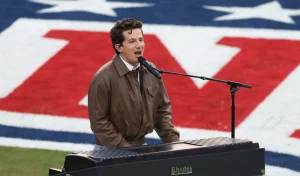
Bad Bunny’s Super Bowl LX halftime show delivered spectacle, symbolism, and a wave of online speculation — particularly over one emotional moment involving a young boy on stage.
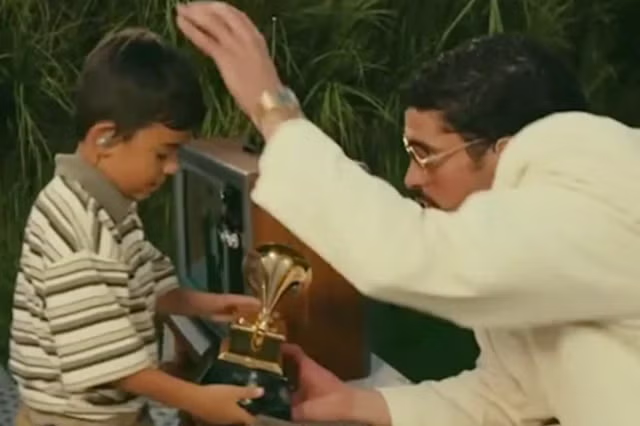
During the 15-minute performance, the Puerto Rican superstar — born Benito Antonio Martínez Ocasio — blended high-energy choreography with imagery rooted in Latin American heritage. One of the most talked-about segments came when he appeared to move through recreated sugar cane fields inspired by Puerto Rico. In the middle of the performance, he briefly paused, knelt down, and handed a Grammy trophy to a small child standing nearby.
Within minutes, social media began circulating claims that the boy was 5-year-old Liam Ramos (sometimes referred to online as Liam Conejo), a child who had recently drawn headlines after being reportedly detained by ICE while walking home from school with his father in Minnesota. The resemblance, combined with Bad Bunny’s outspoken criticism of immigration enforcement, led many viewers to assume the cameo was deliberate and politically symbolic.
Posts on X quickly amplified the theory.
One user wrote: “The little boy Bad Bunny gave the Grammy to resembles Liam Ramos. Wouldn’t be surprised if it was intentional.”
Another added: “BENITO GAVE HIS GRAMMY TO LIAM RAMOS? I didn’t even realize that was him I just thought it was like a little version of himself. MY HEART.”
Others directly asked whether the child was the same boy connected to the ICE case.
However, the speculation is incorrect.
The child who appeared during the halftime performance was not Liam Ramos. He has been identified as Lincoln Fox, a young actor. After the show aired, Fox’s Instagram account shared footage from the moment along with the caption: “I’ll remember this day forever! @badbunnypr – it was my truest honor.”
Sources connected to the production have indicated that the child’s role was symbolic, representing Bad Bunny as a young boy — a visual callback to his roots and personal journey rather than a direct reference to any specific immigration case.
The confusion was fueled in part by the broader themes embedded throughout the performance. Bad Bunny has consistently used major stages to highlight Puerto Rican identity, Latin American culture, and political issues affecting immigrant communities. Given that context, viewers were primed to interpret the Grammy handoff as a statement.
The moment gained additional traction because of remarks Bad Bunny made elsewhere during Super Bowl weekend. Addressing criticism and broader political tensions, he delivered a pointed message about immigration enforcement.
“Before I say thanks to God, I’m gonna say ‘ICE OUT.’ We’re not savage, we’re not animals, we’re not aliens, we’re Americans,” he said.
He continued with a call for unity rather than division: “The hate gets more powerful with more hate. The only thing more powerful than hate is love… If we fight, we have to do it with love.”
Those comments reinforced the perception among some viewers that every element of his halftime performance was politically coded. In reality, large-scale halftime productions are choreographed months in advance, with casting decisions and narrative themes carefully planned as part of a broader artistic direction.
There is no verified evidence linking the child in the performance to the Minnesota ICE case. The identification of Lincoln Fox as the performer effectively puts the online rumor to rest.
This episode illustrates how quickly symbolic imagery can be reframed in the social media era. A brief, emotionally charged visual — a global music icon handing a Grammy to a child — became a viral flashpoint within minutes. Without confirmation, assumptions spread rapidly, shaped by ongoing national debates over immigration policy and high-profile enforcement cases.
It also reflects how audiences increasingly interpret live entertainment through a political lens. For supporters, the moment represented empowerment and cultural pride. For critics, it was another example of pop culture intersecting with activism. For others, it became a fact-checking exercise.
What remains clear is that the halftime cameo was not what many online claimed it to be. The boy was an actor portraying a symbolic younger version of the artist — not a detained child from a recent ICE case.
In an age where viral narratives form instantly, the truth often requires a pause. In this case, that pause reveals a straightforward explanation behind one of the most debated moments of the night.

Emily Johnson is a critically acclaimed essayist and novelist known for her thought-provoking works centered on feminism, women’s rights, and modern relationships. Born and raised in Portland, Oregon, Emily grew up with a deep love of books, often spending her afternoons at her local library. She went on to study literature and gender studies at UCLA, where she became deeply involved in activism and began publishing essays in campus journals. Her debut essay collection, Voices Unbound, struck a chord with readers nationwide for its fearless exploration of gender dynamics, identity, and the challenges faced by women in contemporary society. Emily later transitioned into fiction, writing novels that balance compelling storytelling with social commentary. Her protagonists are often strong, multidimensional women navigating love, ambition, and the struggles of everyday life, making her a favorite among readers who crave authentic, relatable narratives. Critics praise her ability to merge personal intimacy with universal themes. Off the page, Emily is an advocate for women in publishing, leading workshops that encourage young female writers to embrace their voices. She lives in Seattle with her partner and two rescue cats, where she continues to write, teach, and inspire a new generation of storytellers.