For decades, a distinctive voice accompanied mornings, afternoons, and long drives across one corner of England, becoming part of daily life for thousands of listeners. It was the kind of voice that felt familiar even to those who had never met the person behind the microphone — warm, wry, and unmistakably rooted in place. This week, that voice fell silent.
A veteran radio broadcaster has died at the age of 75 following a short illness, prompting an outpouring of tributes from colleagues, listeners, and the community he served for much of his career. The announcement marked the end of an era for a local station whose identity had long been shaped by his presence.
The death was confirmed by the station itself in a statement shared with listeners, describing the loss as deeply felt both on and off air. While many national broadcasters come and go, local radio presenters often occupy a different space — becoming companions, storytellers, and trusted guides through everyday life. This was especially true in this case.
Listeners across the region remembered tuning in not just for news or music, but for conversation that felt personal, grounded, and genuine. His style was never flashy or forced. Instead, it was built on sharp humor, deep listening, and an intuitive understanding of how radio works best when it feels human.
Before radio ever became his calling, his life took a very different path. Born in the southwest of England, he initially trained as a livestock auctioneer — a profession that required confidence, clarity, and the ability to hold a room. Those skills would later translate seamlessly into broadcasting, though few could have predicted the journey ahead.
His first step into radio came in the early 1970s, when he joined a service that catered to British forces stationed overseas. It was there that he learned not only the technical craft of radio production, but also the responsibility that comes with speaking to audiences far from home. For service members, radio was often more than entertainment — it was a lifeline.
Over the next two decades, he worked and lived across the world, producing and presenting programmes in places as varied as Cyprus, Gibraltar, Germany, Belize, the Falkland Islands, and the Gulf. The experience shaped his worldview and his broadcasting style, giving him a rare ability to connect with people from all walks of life.
After more than 20 years abroad, he returned to the UK and eventually joined a regional BBC station in the early 1990s. It was there that he would leave his most lasting mark.
At this point in the story, many listeners already know exactly who is being remembered.
It was Richard Nankivell, a BBC Radio Cumbria presenter whose name became synonymous with the station itself.
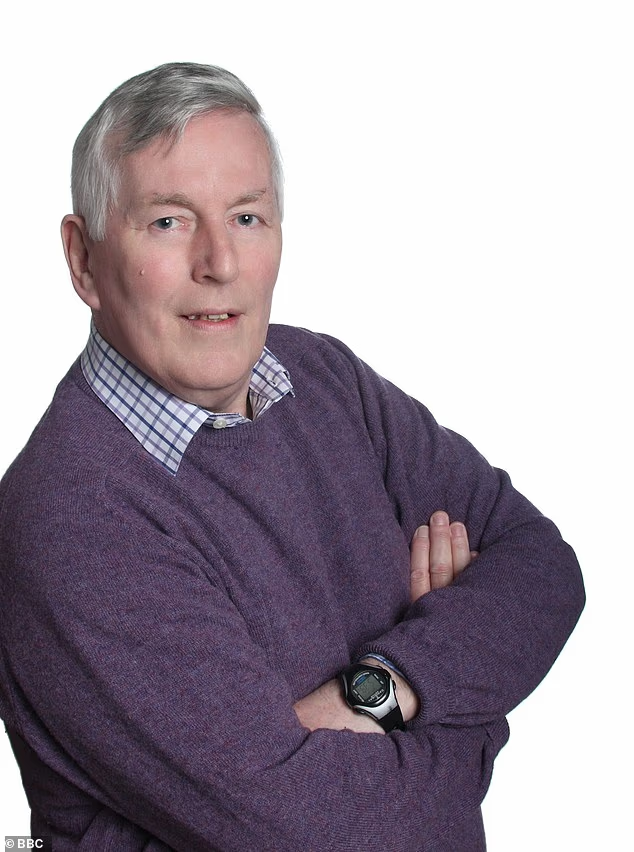
Richard joined BBC Radio Cumbria in 1992 and remained a central figure on its schedule until his retirement in 2015. Over those 23 years, he helped define the sound and personality of the station, earning a loyal following that extended well beyond county borders.
In a tribute shared on social media, the station described him as one of its best-known and most fondly remembered presenters. The message emphasized not only his longevity, but the affection listeners held for him — an affection reflected in the hundreds of comments that followed.
Colleagues described Richard as someone who instinctively understood radio. He knew when to speak, when to listen, and when to let a moment breathe. His humor was sharp but never cruel, and his curiosity about people was genuine. On air, he was engaging; off air, he was remembered as equally entertaining and kind.
The station’s executive editor noted that even years after his retirement, stories about Richard continued to circulate among staff. His nickname, “Nanks,” was still spoken with warmth, often accompanied by laughter and fond recollections of his larger-than-life personality.
Richard’s impact wasn’t limited to his professional output. He was also deeply connected to the people around him, both at work and at home. He is survived by his wife, Heather Wainwright, herself a familiar voice to listeners as the station’s breakfast newsreader. Their shared commitment to local radio made them a well-known couple within the broadcasting community.
Following the announcement of his death, listeners flooded the station’s social media pages with tributes. Many recalled hearing his show during night shifts, long commutes, or difficult moments in their lives. Others praised his unique ability to create “brilliant radio,” describing him as funny, clever, and unforgettable.
Several comments focused on his voice — distinctive, instantly recognizable, and comforting. In radio, a voice can become a constant companion, and for many, Richard’s was exactly that. His passing, for those listeners, feels personal.
Though he stepped away from broadcasting more than a decade ago, his influence never truly faded. Local radio, by its nature, is intimate and enduring. Presenters don’t just deliver content; they become part of the rhythm of a place. Richard Nankivell understood that better than most.
His death marks not just the loss of a broadcaster, but the loss of a storyteller who knew how to reflect a community back to itself — with humor, honesty, and heart.
As tributes continue to pour in, one theme stands out above all others: gratitude. Gratitude for the laughs, the companionship, and the countless hours of radio that turned ordinary days into something warmer and more connected.
A familiar voice may be gone, but for many across Cumbria and beyond, its echo will linger for a long time to come.