


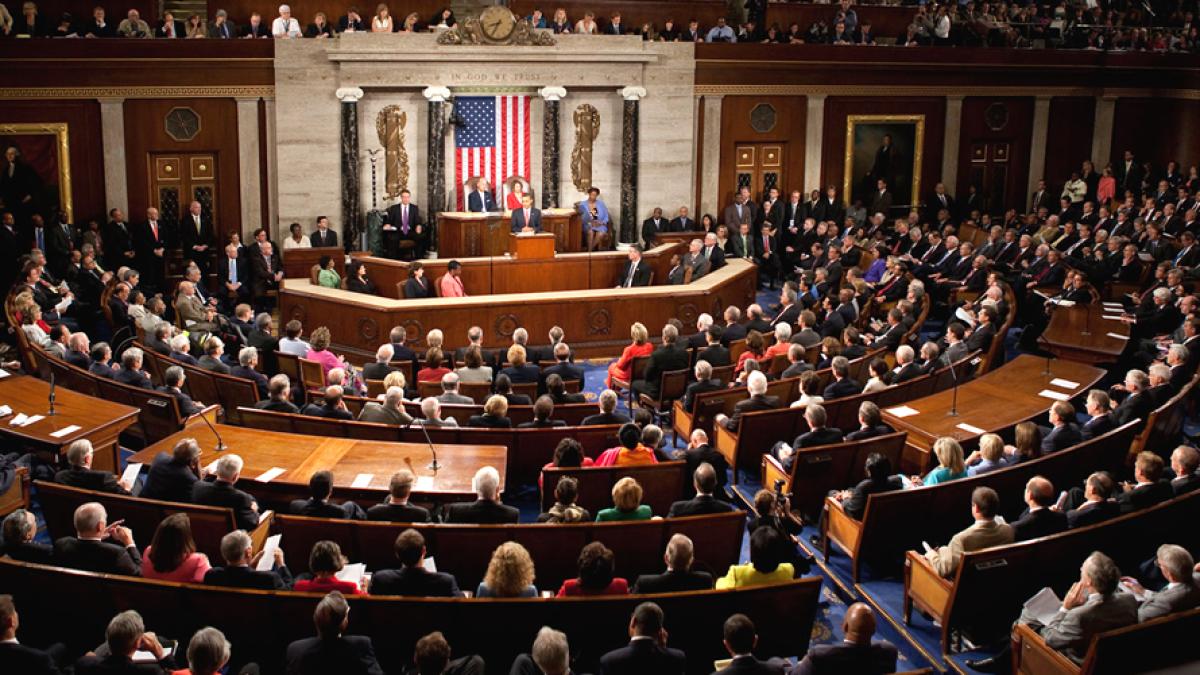
After nearly four days of a partial government shutdown, the House of Representatives voted to approve a funding package that reopens most shuttered federal departments through the end of the fiscal year and temporarily extends funding for the Department of Homeland Security (DHS). The measure, which passed by a razor-thin margin of 217–214, now heads to President Trump’s desk for his signature.
The vote was notable not only for its closeness but also for its bipartisan fractures. Twenty-one Republicans broke ranks to oppose the bill, while twenty-one Democrats crossed the aisle to support it. Yet Democratic leadership, including House Minority Leader Hakeem Jeffries, ultimately rejected the package, citing concerns about the lack of meaningful reforms at DHS.
Trump’s signature is expected to formally end the shutdown, but the underlying dispute that triggered the funding lapse remains unresolved: what reforms, if any, should be imposed on Immigration and Customs Enforcement (ICE) and broader DHS operations. That question is likely to dominate negotiations in the coming days, as lawmakers face a February 13 deadline to reach a longer-term agreement.
A Contentious Path to Passage
The final vote capped a dramatic day on Capitol Hill. Earlier, House Republican leaders struggled to secure support for a procedural rule that allowed the funding bill to move forward. Several GOP holdouts had tied their support to unrelated demands, particularly surrounding election legislation.
The funding package itself is a “minibus” appropriations bill, covering five full-year spending measures for departments including Energy, Defense, Treasury, State, Labor, Transportation, Health and Human Services, and Education. It also funds the judicial branch and independent agencies through September 30. DHS, however, received only a short-term extension of 10 days, reflecting the deep divisions over immigration enforcement policy.
This was not the first time the House attempted to pass such a package. In January, lawmakers approved all six funding bills, but Senate Democrats blocked the measure in response to outrage over the killing of Minneapolis ICU nurse Alex Pretti by federal immigration enforcement agents. That incident intensified scrutiny of ICE and DHS, fueling demands for reform.
Senate Negotiations and the Two-Week Patch
The bill’s passage followed a tumultuous week in the Senate. Republicans and appropriators were forced to retreat from their initial plan to advance the full six-bill minibus after Democrats refused to budge on immigration enforcement concerns. Negotiations between the White House and Senate Democratic leaders produced a compromise: strip out the DHS funding bill and replace it with a short-term patch.
As a result, DHS funding lapsed from Saturday until Tuesday, when the House acted. Trump is expected to sign the legislation quickly, ensuring that most government functions resume, but leaving DHS funding unresolved.
Democratic Leadership Pushes for Reform
House Democratic leaders withheld their position until shortly before the final vote, focusing instead on the procedural rule battle. Ultimately, they voted against the funding bill, arguing that it failed to provide a clear path toward reforming DHS.
Jeffries explained his “nay” vote by emphasizing the need for “dramatic changes” at DHS, including stronger oversight and accountability. He later scheduled a meeting with Senate Minority Leader Chuck Schumer to coordinate the Democratic strategy moving forward.
“There’s no daylight between us,” Jeffries said, despite the fact that Schumer had supported the compromise bill. “We need dramatic reform of the Department of Homeland Security before full-year funding can move forward.”
Republican Frustrations and the SAVE Act Debate
While Trump backed the compromise, many Republicans expressed frustration at the concessions made to Democrats. Representative Anna Paulina Luna of Florida spearheaded calls to attach the SAVE Act to the funding measure. The GOP-backed bill would require voter ID and proof of citizenship to register, a proposal Democrats strongly oppose.
Luna argued that the funding bill represented the best chance to advance the SAVE Act in the Senate, given the chamber’s filibuster rules. After meeting with Trump at the White House, she claimed to have received assurances that the Senate would pursue a “standing filibuster” workaround, which she described as a procedural maneuver that could allow the bill to move forward without formally eliminating the filibuster.
Her optimism contrasted sharply with Democratic leaders, who dismissed the SAVE Act as a non-starter.
Procedural Drama and Political Calculations
House Speaker Mike Johnson faced a difficult task in corralling Republican votes for the procedural rule. Representative John Rose of Tennessee initially opposed the rule, mistakenly believing that Senate Majority Leader John Thune had promised a vote on the SAVE Act. Thune later clarified that no such promise had been made.
Rose eventually reversed his position, though it remained unclear what concessions he received. Johnson suggested Rose’s gubernatorial ambitions played a role, noting that Rose is locked in a competitive primary against Senator Marsha Blackburn.
The episode highlighted the political calculations underlying the funding debate, with lawmakers balancing legislative priorities against electoral considerations.
The Road Ahead: DHS Funding Negotiations
The immediate challenge now is securing a DHS funding deal before the February 13 deadline. Democrats have outlined a series of demands, including stricter warrant requirements, bans on ICE and Border Patrol agents wearing masks during operations, independent investigations, and clearer guidelines for use of force.
Johnson rejected these proposals, particularly the warrant requirement, calling them “unworkable.” He also signaled that Republicans would push for reforms targeting “sanctuary cities” that limit cooperation with federal immigration enforcement.
The compressed timeline and deep partisan divisions suggest that negotiations will be arduous. Some Republicans have floated the idea of another continuing resolution (CR) to extend DHS funding, potentially for the rest of the year. Representative Andy Harris of Maryland, chair of the House Freedom Caucus, argued that such a move could put the issue to rest.
Democrats, however, have ruled out another CR. Jeffries insisted that Republicans must negotiate “in good faith” and accept “bold and transformative changes.”
Stakes and Consequences
The stakes of the DHS funding battle are high. Republicans argue that Democrats’ refusal to fund DHS will not affect border security, pointing to the $75 billion boost ICE received in last year’s GOP-backed “One Big Beautiful Bill,” which they claim could sustain operations for four years.
Johnson warned that a shutdown of DHS would instead disrupt critical functions such as FEMA disaster response, TSA airport security, and Coast Guard operations. “So many important functions in the Department of Homeland Security would be shut down,” he said.
Democrats counter that without reforms, DHS will continue to operate without sufficient accountability, particularly in immigration enforcement.
Conclusion
The House’s narrow vote to end the partial government shutdown provides only temporary relief. While most federal departments are funded through September, DHS remains on a short leash, with just 10 days of funding secured. The coming negotiations will test the ability of Congress and the White House to bridge deep partisan divides over immigration enforcement, civil liberties, and election integrity.
The procedural drama, political maneuvering, and competing visions for DHS reform underscore the complexity of governing in a polarized environment. As the February 13 deadline approaches, both parties face pressure to deliver a solution that avoids another shutdown while addressing the contentious issues at the heart of the debate.

Emily Johnson is a critically acclaimed essayist and novelist known for her thought-provoking works centered on feminism, women’s rights, and modern relationships. Born and raised in Portland, Oregon, Emily grew up with a deep love of books, often spending her afternoons at her local library. She went on to study literature and gender studies at UCLA, where she became deeply involved in activism and began publishing essays in campus journals. Her debut essay collection, Voices Unbound, struck a chord with readers nationwide for its fearless exploration of gender dynamics, identity, and the challenges faced by women in contemporary society. Emily later transitioned into fiction, writing novels that balance compelling storytelling with social commentary. Her protagonists are often strong, multidimensional women navigating love, ambition, and the struggles of everyday life, making her a favorite among readers who crave authentic, relatable narratives. Critics praise her ability to merge personal intimacy with universal themes. Off the page, Emily is an advocate for women in publishing, leading workshops that encourage young female writers to embrace their voices. She lives in Seattle with her partner and two rescue cats, where she continues to write, teach, and inspire a new generation of storytellers.