



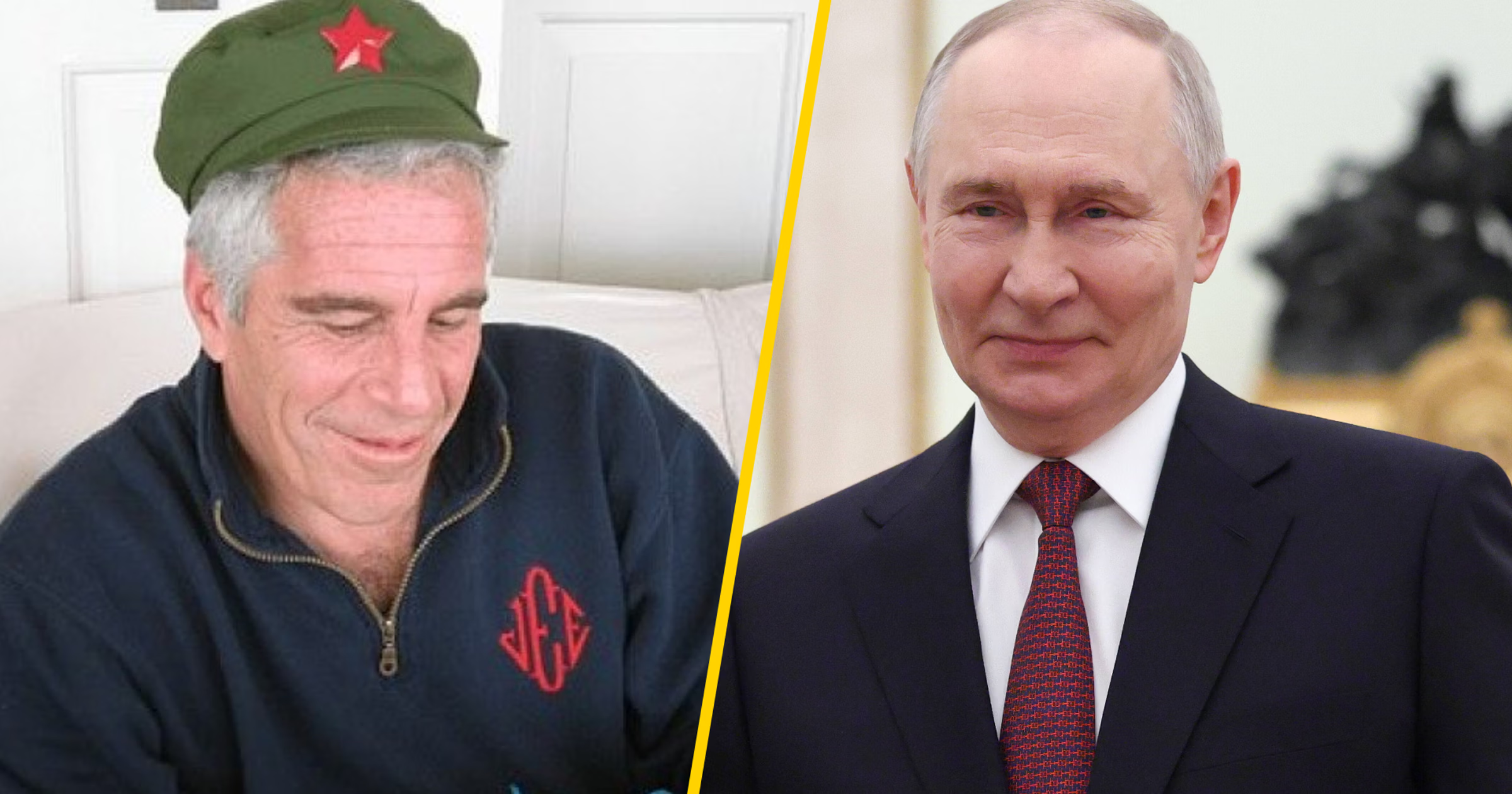
The U.S. Justice Department has released a new tranche of documents connected to the late financier Jeffrey Epstein, offering additional insight into the personal and professional world of a man whose name has become synonymous with wealth, power, and criminal scandal. While Epstein’s sex crimes have been extensively documented, the newly unsealed records focus largely on his business activities and relationships with influential figures around the globe, raising fresh questions about the scope of his financial operations and the circles in which he moved.
The documents were made public as part of ongoing efforts to increase transparency around investigations tied to Epstein and his associates. Among them is testimony provided to the FBI by a confidential human source in late 2017—nearly a year and a half before Epstein’s arrest on federal sex trafficking charges in July 2019. Epstein later died by suicide while in federal custody, awaiting trial.
The testimony does not address Epstein’s criminal sexual conduct, for which he had already been convicted in 2008 on state charges related to soliciting prostitution, including from a minor. Instead, the focus of the testimony is Epstein’s role as a financier and wealth manager, particularly the methods by which he allegedly generated and protected vast sums of money for himself and others.
A Fortune Shrouded in Mystery
At the time of his death, Epstein’s financial standing was the subject of intense scrutiny. A court filing in his federal case estimated his net worth at approximately $560 million. His assets included a Manhattan townhouse valued at more than $50 million, a New Mexico ranch worth roughly $17 million, a Palm Beach mansion estimated at $12 million, an apartment in Paris valued at $8.6 million, and two private Caribbean islands—Great St. James and Little St. James—purchased for a combined $60 million.
Despite the visibility of these properties, the origins of Epstein’s wealth have long been opaque. Unlike many financiers of comparable means, Epstein did not manage a well-known hedge fund, nor did he publicly represent a large roster of clients. This lack of clarity has fueled speculation for years about how he accumulated such extraordinary riches.
According to the FBI testimony included in the newly released records, a confidential source claimed that Epstein earned money by charging wealthy clients fees to move and conceal assets offshore. The source, who had an established relationship with the bureau, described Epstein as a facilitator who specialized in shielding money from scrutiny by routing it through complex international structures.
Allegations Involving Global Power
Midway through the newly unsealed testimony, the source made a claim that has drawn particular attention: that Epstein provided wealth management services not only to prominent business figures, but also to powerful political leaders. Among those named was Russian President Vladimir Putin, as well as former Zimbabwean President Robert Mugabe.
The source alleged that Epstein served as Putin’s wealth manager, offering the same offshore financial services he reportedly provided to other elite clients. The Justice Department documents make clear that these are allegations attributed to the confidential source, not findings formally adjudicated in court. Nonetheless, the claims add another layer to the enduring mystery surrounding Epstein’s clientele.
The Kremlin has been contacted for comment regarding the allegations involving Putin, but as of publication, no public response has been issued.
Putin’s Finances and Longstanding Questions
The claims stand out in part because President Putin’s personal finances are notoriously difficult to verify. Official disclosures portray him as a modestly compensated public servant, earning an annual salary of roughly $140,000. According to publicly available information, his declared assets include an apartment in St. Petersburg, a plot of land outside Moscow, several vintage vehicles, and a trailer.
However, for years, critics and investigators have argued that these disclosures fail to reflect the true scale of Putin’s wealth. In July 2017, financier Bill Browder—once the largest foreign portfolio investor in Russia—testified before the U.S. Senate Judiciary Committee about what he described as endemic corruption within the Russian system.
Browder told senators that he believed Putin had accumulated as much as $200 billion through corruption and criminal activity, and that much of this wealth was held outside Russia, including in Western financial systems. While Browder’s claims have been strongly denied by Russian officials, they have been widely cited by analysts examining the intersection of politics, corruption, and global finance.
The FBI source’s testimony about Epstein’s alleged role as a facilitator for offshore wealth has renewed interest in these broader allegations, though it is important to note that no direct documentary evidence tying Epstein to Putin’s finances has been publicly presented.
A Web of High-Profile Associations
Epstein’s name has long been linked to a constellation of powerful individuals across politics, business, and royalty. Over the years, photographs, flight logs, and court filings have connected him socially to figures such as former U.S. President Donald Trump, Microsoft co-founder Bill Gates, and Britain’s Prince Andrew.
The newly released Justice Department documents add to that picture by including emails purportedly exchanged between Epstein and Tesla and SpaceX CEO Elon Musk. The emails, dated between 2012 and 2013, involve discussions about the possibility of Musk visiting Epstein’s private island in the U.S. Virgin Islands.
In one November 2012 exchange, Musk asked Epstein how many people he could bring to the island, mentioning that it would likely be just himself and actress Talulah Riley, his partner at the time. He also asked which day or night would host “the wildest party.” In a later exchange in December 2013, Musk again inquired about visiting, asking whether there was a good time during the holiday period.
Epstein responded that any day between the first and eighth of the month would work and assured Musk that there was “always space.”
Responses and Denials
The emails do not establish that Musk ever visited the island, nor do they allege any criminal conduct by him. Following the release of the documents, Musk publicly denied any involvement in Epstein’s criminal activities and pushed back strongly against speculation.
In a series of posts on X, Musk stated that he had never attended Epstein’s parties and had repeatedly called for the prosecution of anyone who committed crimes in connection with Epstein. He also dismissed the idea that he would need Epstein’s assistance to socialize, emphasizing that he distanced himself from Epstein after becoming aware of allegations surrounding him.
Musk’s response reflects a broader pattern seen after each major release of Epstein-related documents: renewed scrutiny of high-profile names, followed by denials, clarifications, and, in some cases, legal defenses.
What the New Files Do—and Do Not—Show
It is important to distinguish between verified facts, sworn testimony, and unproven allegations contained in investigative records. The Justice Department’s release does not constitute formal findings against the individuals named in the FBI source’s testimony. Instead, it provides a window into what investigators were told and what lines of inquiry they considered.
Confidential human sources can play a critical role in federal investigations, but their statements are not automatically corroborated. Law enforcement agencies typically seek additional evidence before drawing conclusions or pursuing charges.
Nonetheless, the release of these records has intensified public debate about Epstein’s role as a financial intermediary and the extent to which his services may have intersected with global political power.
A Continuing Reckoning
Years after Epstein’s death, the steady release of documents continues to reshape public understanding of his life and influence. What began as a criminal case centered on sexual exploitation has expanded into a broader examination of wealth, secrecy, and accountability at the highest levels of society.
For victims of Epstein’s crimes, these disclosures can reopen wounds, even as they contribute to a fuller historical record. For the public, they raise difficult questions about how individuals like Epstein were able to operate for so long, cultivate relationships with powerful figures, and avoid scrutiny despite repeated warnings.
As more records are unsealed and more details come to light, Epstein’s legacy remains a symbol not only of personal criminality, but also of systemic failures—in oversight, transparency, and justice—that allowed his world to exist largely in the shadows.

Emily Johnson is a critically acclaimed essayist and novelist known for her thought-provoking works centered on feminism, women’s rights, and modern relationships. Born and raised in Portland, Oregon, Emily grew up with a deep love of books, often spending her afternoons at her local library. She went on to study literature and gender studies at UCLA, where she became deeply involved in activism and began publishing essays in campus journals. Her debut essay collection, Voices Unbound, struck a chord with readers nationwide for its fearless exploration of gender dynamics, identity, and the challenges faced by women in contemporary society. Emily later transitioned into fiction, writing novels that balance compelling storytelling with social commentary. Her protagonists are often strong, multidimensional women navigating love, ambition, and the struggles of everyday life, making her a favorite among readers who crave authentic, relatable narratives. Critics praise her ability to merge personal intimacy with universal themes. Off the page, Emily is an advocate for women in publishing, leading workshops that encourage young female writers to embrace their voices. She lives in Seattle with her partner and two rescue cats, where she continues to write, teach, and inspire a new generation of storytellers.