



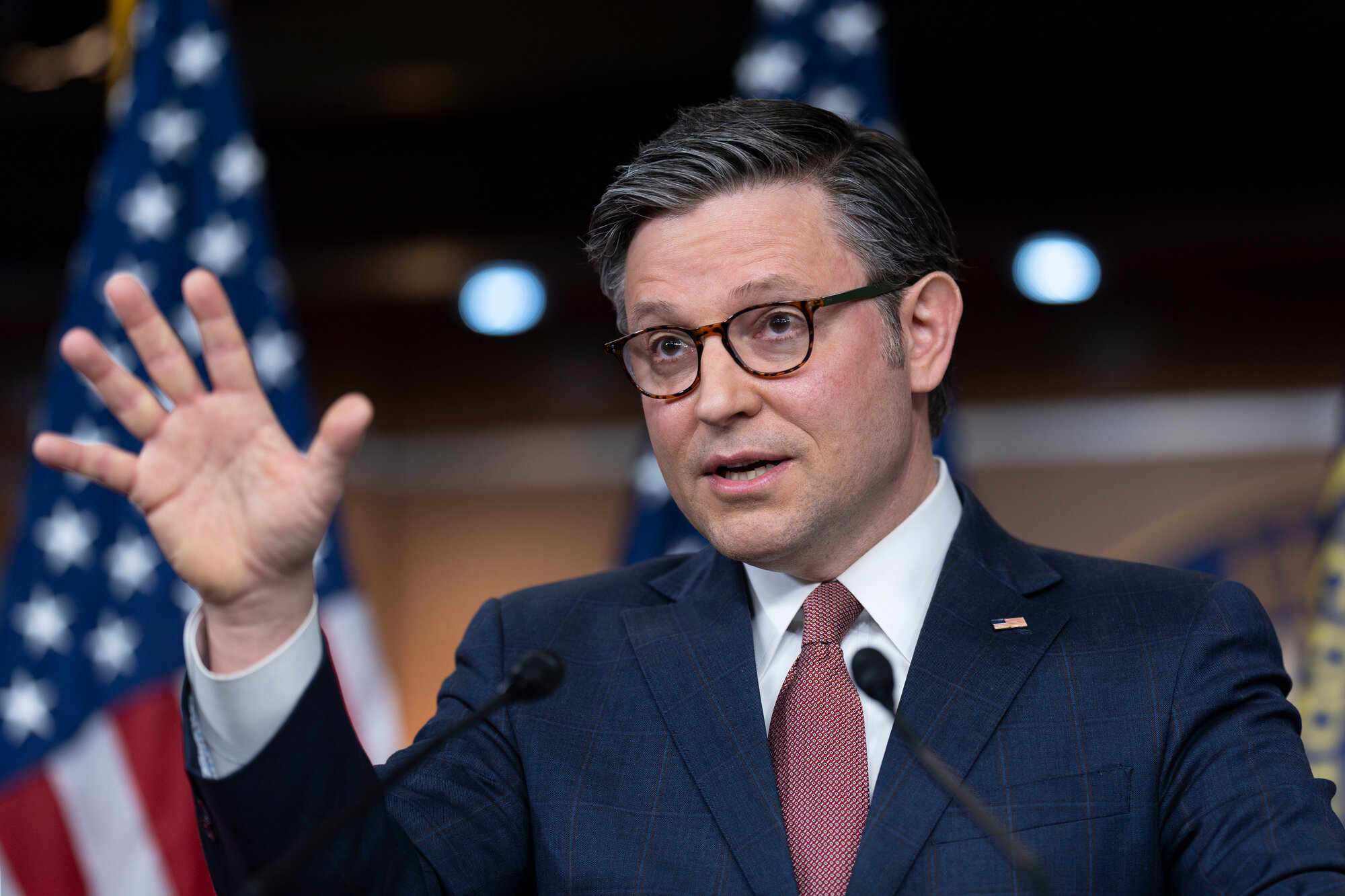
House Speaker Mike Johnson said Sunday that he expects the ongoing partial government shutdown to come to an end early this week, projecting that federal operations could resume by Tuesday if lawmakers are able to navigate remaining procedural and political hurdles.
Speaking during an appearance on Meet the Press, the Louisiana Republican expressed confidence that the House would move swiftly to approve a Senate-passed spending package, despite continued resistance from Democrats and logistical challenges complicating lawmakers’ return to Washington.
The shutdown began at midnight on January 31 after Congress failed to finalize funding legislation for the current fiscal year. While most federal agencies have been operating under temporary funding measures in recent months, the lapse triggered disruptions across multiple departments, raising concerns about delayed pay for federal workers, interruptions to essential services, and broader economic consequences if the shutdown were prolonged.
Johnson Cites Logistics and Political Reality
During his interview with host Kristen Welker, Johnson acknowledged that practical obstacles—particularly weather-related travel delays—have slowed the House’s ability to act immediately. A major snowstorm affecting parts of the southeastern United States has disrupted flights and transportation, delaying the return of some members of Congress to the Capitol.
“We have a logistical challenge of getting everyone in town,” Johnson said, adding that the House must still adopt a procedural rule before it can vote on the Senate-approved package. He indicated that, based on recent conversations with House Minority Leader Hakeem Jeffries, Democrats are unlikely to provide the votes needed to fast-track the legislation.
“Because of the conversation I had with Hakeem Jeffries, I know that we’ve got to pass a rule and probably do this mostly on our own,” Johnson said, signaling that Republicans are preparing to move forward without Democratic cooperation.
House rules often require a supermajority or bipartisan support to expedite legislation. Without Democratic backing, Republican leaders must rely on near-unanimous support within their own conference—an approach that can be challenging given internal ideological divisions.
Democratic Resistance Centers on Immigration Policy
At the heart of the standoff is a dispute over funding for the Department of Homeland Security (DHS) and the future of federal immigration enforcement. While the Senate-approved package funds most government operations through the end of the fiscal year in September 2026, it treats DHS differently by extending its funding for only two weeks at current levels.
Democratic leaders have insisted that any long-term DHS funding be paired with what they describe as “reforms” to immigration enforcement practices. According to Johnson and other Republicans, these proposals include ending roving patrols by immigration agents, requiring body cameras for enforcement officers, and mandating judicial warrants for certain Immigration and Customs Enforcement (ICE) operations.
House Democrats have framed these measures as necessary accountability and civil liberties protections. Republicans, however, argue that such requirements would severely restrict enforcement capabilities and effectively bring deportations to a standstill.
GOP lawmakers have warned that accepting these conditions would undermine border security and contradict the administration’s stated immigration priorities. As a result, Republican leaders have treated Democratic demands as unacceptable, further entrenching the partisan divide.
Senate and White House Reach Temporary Compromise
The House negotiations come after the White House and Senate leaders reached a compromise designed to prevent a prolonged shutdown. The Senate-approved legislation bundles five appropriations bills that had already passed the House, providing full-year funding for most federal agencies through September 2026.
By separating DHS funding and extending it only briefly, the deal allows lawmakers additional time to negotiate immigration-related issues without keeping the rest of the government shuttered. Supporters of the compromise argue that it strikes a balance between maintaining essential services and preserving leverage for ongoing policy talks.
President Donald Trump publicly endorsed the agreement, warning that a lengthy shutdown would harm the country.
“The only thing that can slow our Country down is another long and damaging Government Shutdown,” Trump wrote on Truth Social. “Republicans and Democrats in Congress have come together to get the vast majority of the Government funded until September, while at the same time providing an extension to the Department of Homeland Security.”
The president’s statement underscored the administration’s desire to see the government reopen quickly, even as broader immigration debates continue.
House Vote Timeline and Next Steps
According to House leadership, consideration of the bill is expected to begin Monday afternoon with a meeting of the Rules Committee, which will determine the terms under which the legislation is debated. A full House vote could follow later that day or early Tuesday, depending on attendance and procedural timing.
If the House passes the bill without further delays, the government could reopen shortly thereafter, restoring normal funding operations. Such an outcome would avert additional disruptions, including delayed or reduced pay for military personnel, Transportation Security Administration workers, and other federal employees. It would also ensure continuity for federal healthcare programs and disaster response efforts that could be strained by a prolonged shutdown.
Still, Johnson acknowledged that the path forward is not without risk. With Democrats withholding support and some Republicans pushing for amendments, leadership must carefully manage the process to avoid defections that could derail the vote.
Potential Amendments and Broader Political Stakes
While Democrats are expected to continue pressing for immigration-related changes, Republicans may also seek to attach amendments of their own. Some GOP lawmakers have suggested using the legislative process to advance unrelated priorities, including a House-passed voter identification bill.
Such additions could complicate the bill’s prospects, particularly if they trigger procedural objections or require the legislation to return to the Senate for further consideration. Senate leaders have signaled little appetite for reopening negotiations on issues outside the scope of the funding agreement.
The shutdown fight also carries broader political implications. With an election cycle approaching, both parties are keenly aware of public frustration with congressional gridlock. Prolonged shutdowns have historically damaged the standing of lawmakers perceived as responsible, increasing pressure on leaders to resolve disputes quickly.
For Johnson, who has worked to consolidate his leadership within a narrowly divided House, the episode represents a test of his ability to govern amid deep partisan polarization. Successfully navigating the shutdown could bolster his standing within the Republican conference, while failure could expose internal fractures.
Outlook
Despite the uncertainty, Johnson’s comments suggest cautious optimism that the shutdown will be brief. By projecting a Tuesday resolution, he aimed to reassure federal workers and the public that Congress is close to restoring full operations.
Whether that timeline holds will depend on lawmakers’ ability to overcome logistical challenges, procedural obstacles, and entrenched policy disagreements. If the House acts as expected, the shutdown could soon become another chapter in Washington’s ongoing struggle to balance governance with partisan priorities—resolved, at least temporarily, while deeper debates remain unresolved.

Emily Johnson is a critically acclaimed essayist and novelist known for her thought-provoking works centered on feminism, women’s rights, and modern relationships. Born and raised in Portland, Oregon, Emily grew up with a deep love of books, often spending her afternoons at her local library. She went on to study literature and gender studies at UCLA, where she became deeply involved in activism and began publishing essays in campus journals. Her debut essay collection, Voices Unbound, struck a chord with readers nationwide for its fearless exploration of gender dynamics, identity, and the challenges faced by women in contemporary society. Emily later transitioned into fiction, writing novels that balance compelling storytelling with social commentary. Her protagonists are often strong, multidimensional women navigating love, ambition, and the struggles of everyday life, making her a favorite among readers who crave authentic, relatable narratives. Critics praise her ability to merge personal intimacy with universal themes. Off the page, Emily is an advocate for women in publishing, leading workshops that encourage young female writers to embrace their voices. She lives in Seattle with her partner and two rescue cats, where she continues to write, teach, and inspire a new generation of storytellers.