


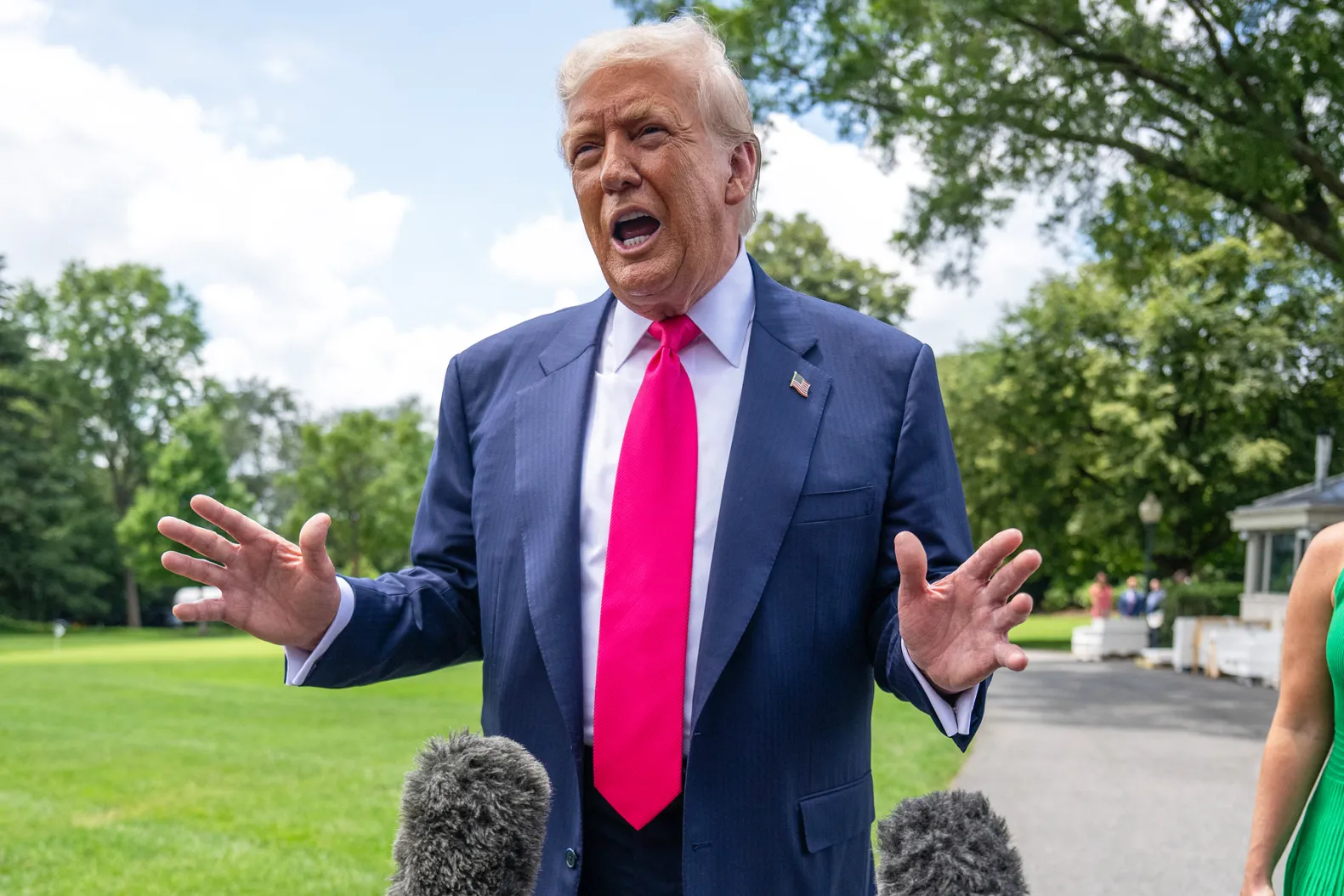
President Donald Trump, without providing evidence, claimed that Representative Ilhan Omar (D-Minn.) may have staged an incident during her town hall in Minneapolis on Tuesday night, when a man sprayed her with an unknown liquid.
“I don’t think about her. I think she’s a fraud,” Trump told ABC News. “She probably had herself sprayed, knowing her.” When pressed about whether he had seen video footage of the incident, the former president said, “I haven’t seen it. No, no. I hope I don’t have to bother.”
The remarks come in the context of Trump’s long-standing criticism of Omar, who has frequently been the target of the former president’s xenophobic and inflammatory commentary. Omar is the first Somali American to serve in Congress, representing Minnesota’s Fifth Congressional District, and she has become a prominent voice on immigration, civil rights, and social justice issues.
Video footage and livestreams from the event show a man moving quickly toward the front of the room and yelling at Omar while she addressed her audience. The lawmaker was calling for Homeland Security Secretary Kristi Noem to resign or face impeachment in the wake of two fatal shootings involving federal immigration enforcement officers in Minneapolis. The suspect was subdued and arrested immediately after spraying the substance, which authorities initially could not identify.
Minnesota police later confirmed that the man, identified as 55-year-old Anthony Kazmierczak, used a syringe to spray an unknown liquid on Omar. He was promptly arrested, booked into Hennepin County Jail for third-degree assault, and is currently facing legal proceedings. Despite the sudden attack, Omar was uninjured and resumed her town hall address without interruption.
“I’ve survived war and I’m definitely going to survive intimidation or whatever these people think they can throw at me, because I’m built that way,” Omar told reporters following the incident. She later posted on the social platform X: “I’m ok. I’m a survivor so this small agitator isn’t going to intimidate me from doing my work. I don’t let bullies win. Grateful to my incredible constituents who rallied behind me. Minnesota strong.”
Omar’s defiance underscores her longstanding approach to public service in the face of threats and harassment. In recent years, she has been targeted repeatedly with both verbal abuse and credible threats against her safety, largely stemming from her outspoken stance on immigration policy and criticism of federal enforcement actions. This town hall, held amid heightened tensions in Minnesota over immigration enforcement, drew national attention not only for the attack itself but also for Omar’s insistence on continuing her work despite intimidation.
The attack prompted immediate responses from multiple federal and local authorities. The U.S. Capitol Police (USCP) described the incident as “an unacceptable decision that will be met with swift justice.” A spokesperson emphasized the importance of holding offenders accountable: “We are grateful for the rapid response of onsite security and our local law enforcement partners. We are now working with our federal partners to see this man faces the most serious charges possible to deter this kind of violence in our society.”
Minneapolis Police confirmed that officers responded quickly and that forensic teams processed the scene to ensure public safety. The man’s motives remain under investigation, with authorities reviewing his background, intentions, and potential connections to other threats. The incident has highlighted the ongoing risks faced by elected officials during public engagements, particularly in an era of heightened political polarization.
Despite the attack, Omar’s focus remained on the substantive issues at her town hall. She criticized Homeland Security Secretary Kristi Noem, demanding accountability for federal immigration enforcement operations in Minneapolis that had resulted in two recent deaths. The broader political context involves increasing scrutiny of federal immigration enforcement practices and rising calls from both parties for reforms or stricter oversight. Omar’s town hall was part of a larger effort to bring attention to these issues at the local and national level.
While Democrats and independent observers condemned the attack, some members of the Republican Party echoed Trump’s insinuations about the event. This divide reflects the highly polarized political climate in which Omar operates, where elected officials are often subjected to both rhetorical and physical threats. However, other GOP lawmakers publicly denounced the attack. Representatives Mark Alford (Mo.), Mike Lawler (N.Y.), and Nancy Mace (S.C.) expressed their condemnation of the incident, emphasizing that political disagreements should never escalate into violence. Lawler wrote on X: “What happened at Rep. Ilhan Omar’s town hall — where she was sprayed with a substance during the event — is completely unacceptable. Regardless of political views, we should all agree this behavior crosses a line and cannot be tolerated.”
The political implications of the attack extend beyond Omar herself. The event has renewed discussion about the safety of lawmakers, particularly as threats against elected officials have increased in recent years. According to the USCP, nearly 15,000 “concerning statements, behaviors, and communications” directed at members of Congress, their families, staff, and the Capitol were investigated in 2025 alone. In 2024, the department investigated approximately 9,500 such cases. These figures reflect a broader trend of escalating threats, harassment, and intimidation directed at public officials in the United States.
Experts note that incidents like the one at Omar’s town hall pose challenges for security agencies and elected officials alike. Public engagements are crucial for democratic accountability, but they also expose officials to risks that can compromise both personal safety and the functioning of government. The balance between open access for constituents and protective measures has become increasingly difficult to maintain, particularly amid heightened political polarization and the proliferation of social media amplification.
The incident also highlights the role of misinformation and public commentary in shaping narratives around attacks on officials. President Trump’s immediate suggestion that Omar staged the event—despite not having seen footage or presented evidence—demonstrates how public figures can influence perception and potentially heighten threats against individuals. Analysts warn that such statements can embolden extremists, create confusion, and complicate law enforcement investigations.
Omar’s response, both during and after the town hall, emphasized resilience and a refusal to be silenced. Her remarks underscored the importance of standing firm in the face of intimidation while continuing to engage with constituents on critical issues. Many constituents, colleagues, and advocacy groups have praised her composure and courage, framing the incident as an example of democratic fortitude in challenging times.
The attack on Omar, while alarming, is part of a larger pattern of confrontations facing public officials. Federal and local agencies continue to stress the importance of rapid response, thorough investigation, and preventive measures to protect those serving in public office. The incident serves as a stark reminder of the increasingly volatile intersection of politics, public engagement, and personal safety in modern American governance.
In conclusion, the Minneapolis town hall incident involving Representative Ilhan Omar illustrates the complex challenges facing elected officials today: navigating polarized political environments, maintaining personal safety, and continuing to perform public duties under threat. Omar’s resilience, the swift response by law enforcement, and the bipartisan condemnation of physical threats reinforce the need for vigilance, security, and the reaffirmation of democratic norms. Meanwhile, controversial comments by prominent figures, including former President Trump, show how rhetoric can amplify tensions, underscoring the ongoing stakes for both public servants and the broader political system.

Emily Johnson is a critically acclaimed essayist and novelist known for her thought-provoking works centered on feminism, women’s rights, and modern relationships. Born and raised in Portland, Oregon, Emily grew up with a deep love of books, often spending her afternoons at her local library. She went on to study literature and gender studies at UCLA, where she became deeply involved in activism and began publishing essays in campus journals. Her debut essay collection, Voices Unbound, struck a chord with readers nationwide for its fearless exploration of gender dynamics, identity, and the challenges faced by women in contemporary society. Emily later transitioned into fiction, writing novels that balance compelling storytelling with social commentary. Her protagonists are often strong, multidimensional women navigating love, ambition, and the struggles of everyday life, making her a favorite among readers who crave authentic, relatable narratives. Critics praise her ability to merge personal intimacy with universal themes. Off the page, Emily is an advocate for women in publishing, leading workshops that encourage young female writers to embrace their voices. She lives in Seattle with her partner and two rescue cats, where she continues to write, teach, and inspire a new generation of storytellers.