

The fatal shooting of Alex Pretti, a 37-year-old intensive care unit nurse, by a federal immigration agent in Minneapolis has intensified an already fraught national debate over gun rights, law enforcement conduct, and the limits of lawful firearm possession during protests. The incident, which occurred on January 24, has drawn responses from the White House, senior federal officials, and major gun rights organizations, including the National Rifle Association (NRA), exposing deep divisions over responsibility, risk, and constitutional protections.
The Incident in Minneapolis
On the evening of January 24, Alex Pretti was shot and killed on the streets of Minneapolis amid protests that had erupted following earlier federal enforcement actions in the city. Pretti, who worked as an ICU nurse at a Veterans Affairs medical center, was pronounced dead after being struck multiple times by gunfire from a federal immigration agent.
Shortly after the shooting, the Department of Homeland Security released a statement asserting that the agent had acted in self-defense. According to the department’s initial account, Pretti allegedly brandished a handgun, prompting the agent to respond with lethal force.
However, that narrative was quickly challenged. Video footage circulating on social media, along with eyewitness statements, suggested that Pretti may not have been holding a firearm at the time he was shot, but rather a mobile phone. The conflicting accounts have raised serious questions about the circumstances of the encounter and whether the use of deadly force was justified.
Federal authorities have said the incident remains under investigation, but the lack of clarity has fueled public anger and skepticism, particularly given the tense atmosphere surrounding federal law enforcement activity in Minneapolis in recent weeks.
Trump’s Remarks Add Fuel to the Fire
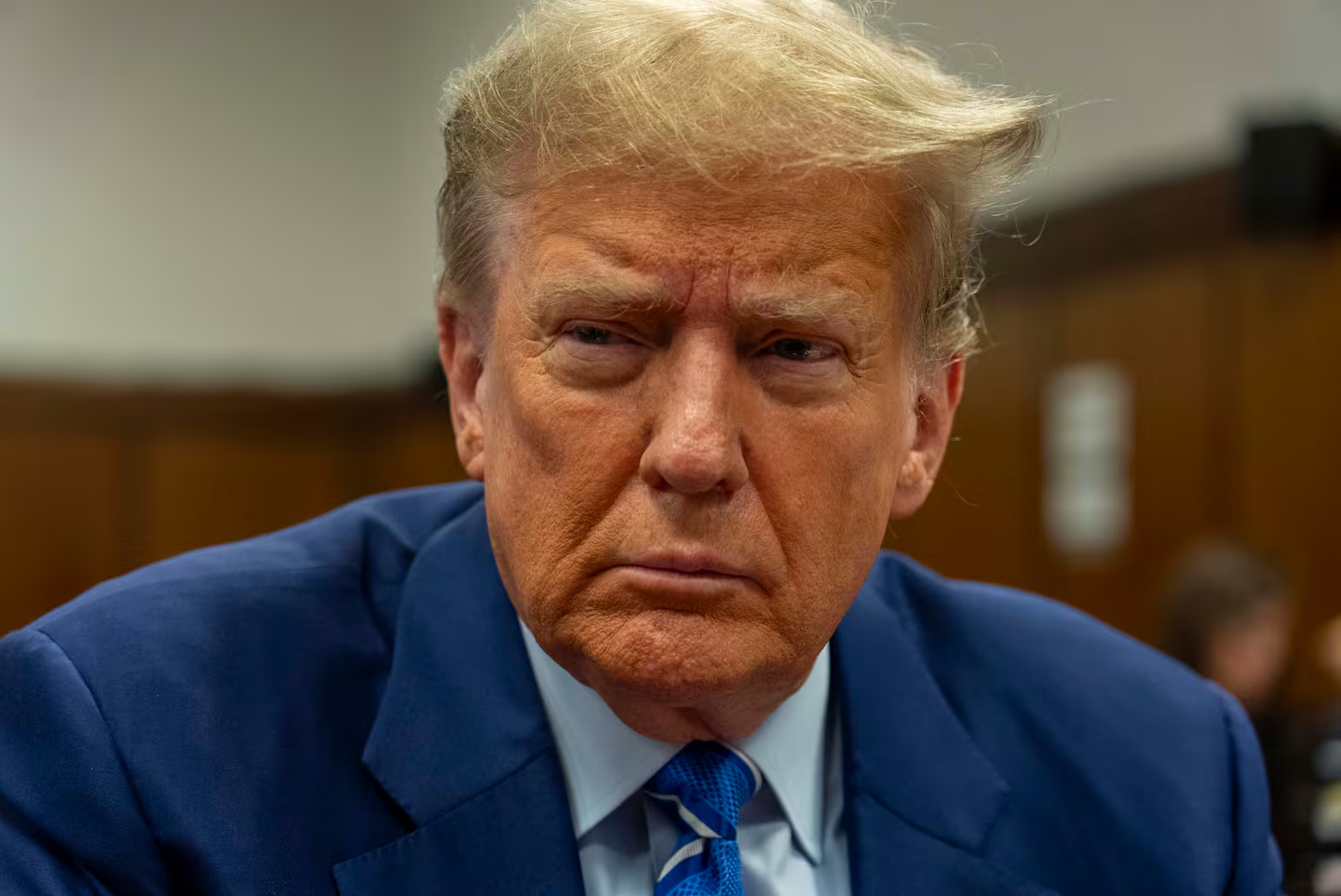
President Donald Trump addressed the shooting during an interview with Fox News, where his comments sparked immediate controversy among gun rights advocates and civil liberties groups.
In discussing Pretti’s death, Trump said he did not like the fact that Pretti was “carrying a gun.” The president went further, describing it as “unusual” that Pretti allegedly had a fully loaded firearm along with two magazines, adding that the nurse “certainly shouldn’t have been carrying a gun.”
While Trump stopped short of explicitly endorsing the shooting, his remarks were widely interpreted as a criticism of Pretti’s decision to be armed, rather than a focus on the actions of the federal agent who fired the shots.
The comments drew particular attention because Pretti was legally permitted to carry a firearm. He was a licensed concealed carry holder under Minnesota law and, according to local officials, had no criminal record that would have prohibited him from possessing a gun.
For many gun rights supporters, Trump’s statements appeared to contradict long-standing Republican and conservative positions on the Second Amendment, as well as his own past rhetoric in support of gun ownership.
NRA and Gun Rights Groups Push Back
Within days of Trump’s remarks, the National Rifle Association issued a formal response defending the right of law-abiding citizens to carry firearms. In a statement released on January 28, the NRA emphasized that the Second Amendment protects the right to keep and bear arms in any place where an individual is legally allowed to be.
“All law-abiding citizens have a right to keep and bear arms anywhere they have a legal right to be,” the statement read, reaffirming the organization’s unwavering commitment to constitutional gun rights.
The NRA’s response framed the issue as one of principle rather than politics, underscoring that legal firearm possession should not, in itself, be viewed as suspicious or provocative. The organization did not directly criticize Trump by name but made clear that it rejected the implication that Pretti’s lawful gun ownership justified or contributed to his death.
Gun Owners of America, another influential gun rights advocacy group, echoed those sentiments. Speaking to Reuters, spokesperson Luis Valdes said that both carrying a firearm and participating in peaceful protests are protected activities under U.S. law.
“You absolutely can walk around with a gun, and you absolutely can peacefully protest while armed,” Valdes said. He added that the practice has deep roots in American history, pointing to events such as the Boston Tea Party as examples of armed civic action during the nation’s founding era.
Local Law Enforcement Weighs In
The debate extended beyond national organizations and into local law enforcement leadership. Minneapolis Police Chief, speaking on CBS’s Face the Nation, affirmed that the Second Amendment guarantees the right to possess firearms and noted that Pretti appeared to be in full compliance with Minnesota law.
“He is not a convicted felon, and he is someone that did have a permit for the handgun to carry it,” the police chief said, emphasizing that Pretti did not violate any known legal restrictions related to firearm ownership.
The remarks highlighted a key tension at the heart of the controversy: while federal officials have argued that carrying a gun at a protest increases risk, local authorities acknowledged that legality and perceived risk are not the same thing.
Federal Officials Defend the Agent’s Actions
Despite the pushback from gun rights advocates, several senior federal officials publicly defended the federal agent involved in the shooting and questioned Pretti’s decision to be armed during a protest.
Homeland Security Secretary Kristi Noem suggested that bringing a firearm to a protest was inherently inconsistent with peaceful demonstration. “I don’t know of any peaceful protester that shows up with a gun and ammunition rather than a sign,” she said during a press conference.
FBI Director Kash Patel voiced a similar position during an appearance on Fox News’s Sunday Morning Futures. “You cannot bring a firearm, loaded, with multiple magazines, to any sort of protest that you want,” Patel said. “It’s that simple.”
These comments underscored a growing divide within the federal government itself, where support for the Second Amendment exists alongside concerns about officer safety and public order during large-scale demonstrations.
White House Response and the Question of Risk
The White House also addressed the incident through Press Secretary Karoline Leavitt, who framed the issue in terms of personal risk rather than legality.
Leavitt told reporters that anyone who chooses to carry a weapon in a volatile environment is “raising the assumption of risk and the risk of force being used against you.” She added that this heightened risk was “unfortunately what took place” in the fatal encounter.
Her remarks were seen by critics as shifting responsibility away from the agent and onto Pretti, while supporters argued they reflected a practical reality about how armed individuals may be perceived by law enforcement during tense situations.
Broader Context and Public Reaction
Pretti’s death came just weeks after another fatal shooting involving federal immigration officers in Minnesota, further intensifying public scrutiny of federal enforcement operations in the state. Protests in Minneapolis have continued, with demonstrators calling for transparency, accountability, and clearer rules governing the use of force by federal agents.
Public opinion remains sharply divided. To some, the shooting represents a tragic example of excessive force and misjudgment by heavily armed agents operating in civilian spaces. To others, it underscores the dangers faced by law enforcement officers in unpredictable protest environments where firearms may be present.
At the center of the debate lies a fundamental question that has long shaped American political discourse: where should the line be drawn between constitutional rights and public safety?
An Unresolved Debate
As investigations into Alex Pretti’s death continue, the political and cultural fallout shows no signs of fading. Trump’s remarks, the NRA’s response, and the competing statements from federal and local officials have transformed a single tragic incident into a national flashpoint.
For gun rights advocates, the case is a reminder that legal firearm ownership must be protected consistently, even when it is politically inconvenient. For federal officials, it raises urgent concerns about how protests are policed and how quickly lawful behavior can be interpreted as a threat.
Until clearer answers emerge about what happened on the streets of Minneapolis that night, the death of Alex Pretti is likely to remain a powerful symbol in the ongoing struggle over guns, policing, and constitutional freedoms in the United States.

Emily Johnson is a critically acclaimed essayist and novelist known for her thought-provoking works centered on feminism, women’s rights, and modern relationships. Born and raised in Portland, Oregon, Emily grew up with a deep love of books, often spending her afternoons at her local library. She went on to study literature and gender studies at UCLA, where she became deeply involved in activism and began publishing essays in campus journals. Her debut essay collection, Voices Unbound, struck a chord with readers nationwide for its fearless exploration of gender dynamics, identity, and the challenges faced by women in contemporary society. Emily later transitioned into fiction, writing novels that balance compelling storytelling with social commentary. Her protagonists are often strong, multidimensional women navigating love, ambition, and the struggles of everyday life, making her a favorite among readers who crave authentic, relatable narratives. Critics praise her ability to merge personal intimacy with universal themes. Off the page, Emily is an advocate for women in publishing, leading workshops that encourage young female writers to embrace their voices. She lives in Seattle with her partner and two rescue cats, where she continues to write, teach, and inspire a new generation of storytellers.