The Democrat Who Wins in Trump Country Is Quietly Making His Case for 2028
on
A prominent Democratic governor is no longer ducking the question that has followed him through cable news panels, donor retreats, and quiet conversations among party strategists. After years of deflection and careful phrasing, he is now leaning into the speculation about his national ambitions—without quite crossing the line into an official declaration.
The signals are subtle but unmistakable. In recent months, his public comments have sharpened, his travel has expanded, and his political operation has begun to look less like that of a state executive winding down a second term and more like that of a figure testing the contours of a national campaign. Allies describe a man who believes his moment may be approaching, and who is increasingly willing to say so—if only indirectly.
Inside Democratic circles, the governor has become a recurring topic of curiosity. Party leaders are searching for a path forward after a bruising decade of polarization, personality-driven politics, and narrow national margins. In that search, some have begun to look beyond the party’s coastal power centers and familiar stars, toward figures who have proven they can win where Democrats are not supposed to.
This governor’s resume, on paper, is unusually well-suited to that argument. He is a Democrat who has not only survived but thrived in deep-red territory, winning statewide office repeatedly in a place where Republican presidential nominees dominate by enormous margins. At a time when elections are often decided by a handful of states and even fewer voters, that fact alone has drawn attention.
The fascination, however, is paired with doubt. Some party insiders quietly question whether he has the intangible qualities—charisma, star power, cultural magnetism—that modern presidential politics seems to demand. In the language of younger voters, the concern is whether he has “rizz.”
Rather than bristle at the critique, the governor has chosen to engage it head-on. Asked directly about the perception, he pushed back with a mix of humor and confidence, pointing to his track record and suggesting that results matter more than vibes. When pressed further, he joked that he might have “a little aura,” a line that landed precisely because it acknowledged the criticism without conceding it.
That blend of self-awareness and resolve has become something of a trademark. He does not present himself as a movement leader or a generational icon. Instead, he frames his appeal around competence, steadiness, and an almost stubborn insistence that winning still counts for something in politics.
Behind the scenes, the posture is becoming more concrete. Advisers close to the governor acknowledge that serious conversations are underway about what a national run would require. He has quietly brought in strategists with presidential experience, people fluent in the rhythms of early primary states and the demands of national fundraising. The infrastructure is not yet a campaign, but it is no longer hypothetical either.
At the core of his emerging case is a single word: electability. He argues that Democratic primary voters, scarred by recent cycles and wary of ideological overreach, will ultimately prioritize one question above all others—who can actually win the general election. In his telling, that question points directly to his own experience.
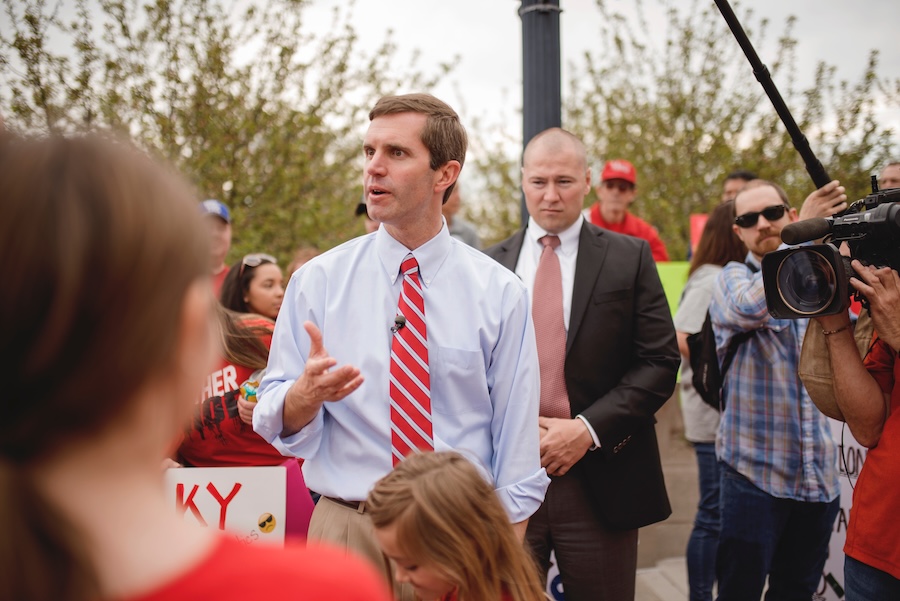
Frankfort, Kentucky- US April 13, 2018 Andy Beshear Attorney General of Kentucky, speaking to the teachers who have gathered at the capitol protesting.
Only midway through any such conversation does he usually spell it out explicitly: Andy Beshear, the 48-year-old, two-term governor of Kentucky, has won three consecutive statewide elections in a state Donald Trump carried by roughly 30 points. First as attorney general, then twice as governor, Beshear has assembled a record that few other Democrats can credibly match.
“I’m a guy who has won three straight statewide elections in a Trump plus-30 state,” Beshear said recently, making the case himself rather than leaving it to surrogates. The contrast he draws is implicit but clear. Many of the Democrats most often mentioned as future presidential contenders govern safely blue states, where the general election is effectively decided in the primary.
That contrast occasionally sharpens into critique. Without naming names, Beshear has suggested that the country may not be eager for a nominee who mirrors the confrontational style and constant combat that has defined the Trump era. Voters, he argues, are exhausted.
“By the time we reach 2028, the country is going to be tired,” he said, predicting a national mood defined less by outrage than by fatigue. In that environment, he believes, a Democrat who offers a calmer, less performative approach could have an advantage. “I don’t believe in responding to Trump like Trump,” Beshear added, warning that endless political yelling leaves people worn out rather than inspired.
Ideologically, Beshear occupies a lane that is familiar but increasingly rare in national Democratic politics. He is socially liberal—he has vetoed anti-transgender legislation, defended abortion rights, and spoken openly about the reality of climate change. At the same time, he is cautious about regulatory overreach and frank about the economic realities of energy-producing states.
“I’m a pro-business, pro-union Democrat,” he likes to say, framing himself as someone comfortable with both labor halls and boardrooms. It is a pitch aimed squarely at voters who feel alienated by ideological purity tests, and at party leaders who worry about losing working-class support.
Chicago, Illinois, August 19, 2024: Kentucky Governor Andy Beshear at the Democratic National Convention.
All of this is unfolding against the backdrop of a wide-open and crowded potential 2028 Democratic field. California Gov. Gavin Newsom is widely viewed as an early frontrunner, buoyed by his national profile and his aggressive posture toward Republicans. Former Vice President Kamala Harris remains a significant figure after her 2024 run, with deep ties to the party’s base.
Transportation Secretary Pete Buttigieg continues to poll well among Democrats, while governors like JB Pritzker of Illinois and Gretchen Whitmer of Michigan are frequently mentioned as well. Pennsylvania Gov. Josh Shapiro has drawn praise for his electoral success in a key swing state, and progressive stalwarts like Rep. Alexandria Ocasio-Cortez loom as potential wild cards.
In that constellation of names, Beshear stands out less for celebrity than for contrast. He does not dominate social media or cable news. He does not lead a national faction of the party. What he offers instead is a story about winning where Democrats usually lose, and about governing without theatrics in a hostile political environment.
For now, Beshear insists he is not officially running for anything. He continues to frame his comments as reflections, not plans, and to emphasize his responsibilities as governor. But his words, his staffing moves, and the deliberate way he is shaping his public argument all point in the same direction.
He may not call it a campaign yet. But he is no longer pretending the question doesn’t apply to him.
Emily Johnson is a critically acclaimed essayist and novelist known for her thought-provoking works centered on feminism, women’s rights, and modern relationships. Born and raised in Portland, Oregon, Emily grew up with a deep love of books, often spending her afternoons at her local library. She went on to study literature and gender studies at UCLA, where she became deeply involved in activism and began publishing essays in campus journals. Her debut essay collection, Voices Unbound, struck a chord with readers nationwide for its fearless exploration of gender dynamics, identity, and the challenges faced by women in contemporary society. Emily later transitioned into fiction, writing novels that balance compelling storytelling with social commentary. Her protagonists are often strong, multidimensional women navigating love, ambition, and the struggles of everyday life, making her a favorite among readers who crave authentic, relatable narratives. Critics praise her ability to merge personal intimacy with universal themes. Off the page, Emily is an advocate for women in publishing, leading workshops that encourage young female writers to embrace their voices. She lives in Seattle with her partner and two rescue cats, where she continues to write, teach, and inspire a new generation of storytellers.