Rising Tensions Between Washington and Ottawa
President Donald Trump has issued a stark warning to Canadian Prime Minister Mark Carney, threatening sweeping economic retaliation if Canada proceeds with a newly announced trade agreement with China. The remarks mark a sharp escalation in tensions between the two neighboring allies and come in the wake of Carney’s highly critical speech at the World Economic Forum in Davos, where he openly challenged key elements of Trump’s foreign policy—particularly the former president’s renewed interest in Greenland and his broader use of tariffs as geopolitical leverage.
Trump’s warning, delivered via his Truth Social platform, framed Canada’s potential deepening of economic ties with Beijing as an existential threat not only to Canadian sovereignty but also to U.S. economic security. The comments underscore how trade, Arctic strategy, and global power competition are becoming increasingly entangled in the rhetoric and policies of both governments.
Carney’s Davos Speech and a Direct Challenge to U.S. Power
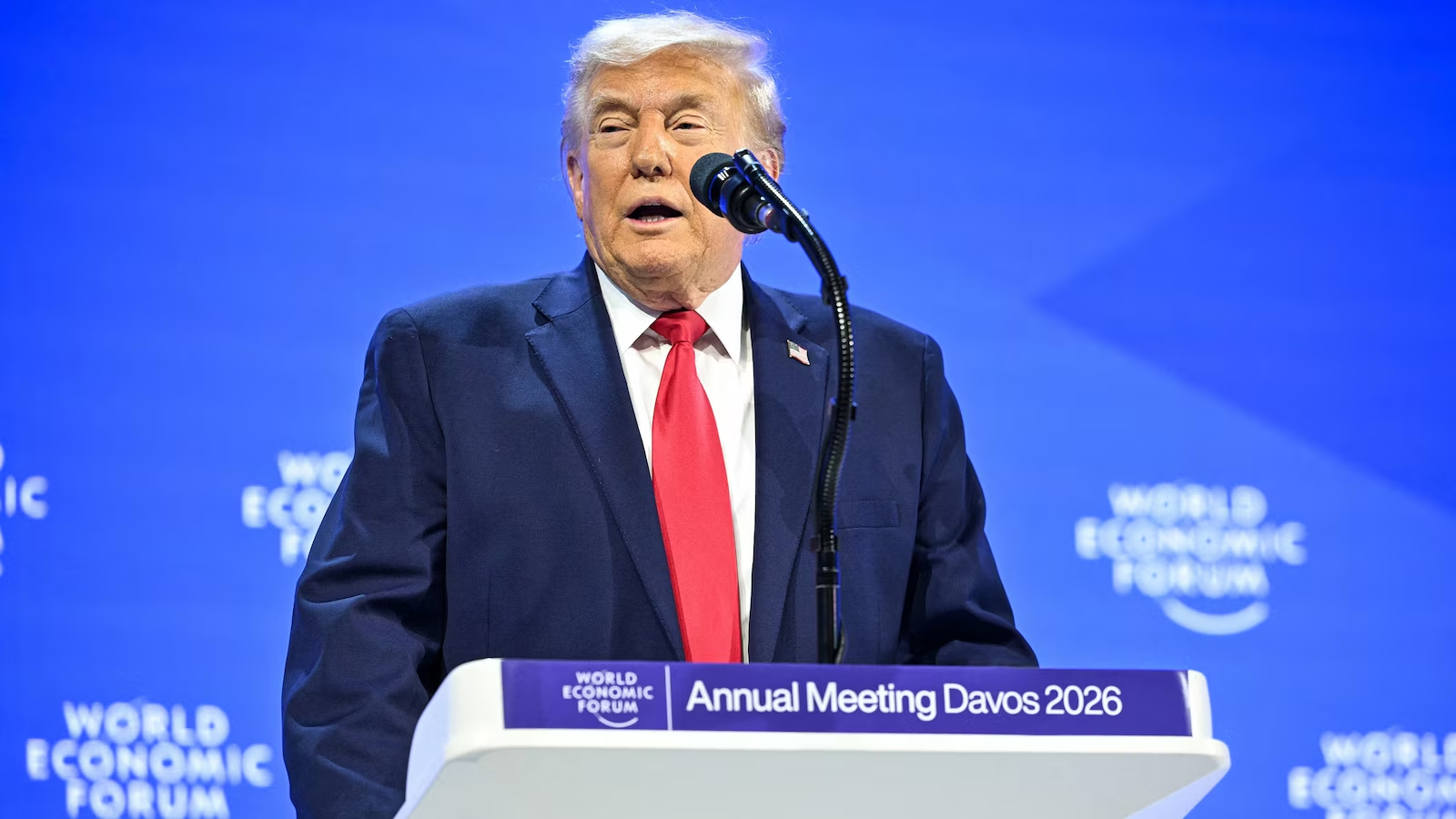
The immediate catalyst for the dispute appears to have been Carney’s address at Davos on Tuesday, January 20, where he delivered a blunt assessment of the current global order and the role of major powers within it. Speaking to an international audience of political and business leaders, Carney argued that the so-called rules-based international system was rapidly eroding under the pressure of great power rivalry.
“It seems that every day we’re reminded that we live in an era of great power rivalry,” Carney said. “The rules-based order is fading, that the strong can do what they can, and the weak must suffer what they must.”
Carney directly addressed the Arctic, a region of growing strategic importance due to climate change, shipping routes, and untapped natural resources. He made clear that Canada opposed Trump’s controversial efforts to acquire Greenland, emphasizing support for Denmark and Greenland’s right to determine their own future.
“On Arctic sovereignty, we stand firmly with Greenland and Denmark,” Carney said. “Canada strongly opposes tariffs over Greenland and calls for focused talks to achieve our shared objectives of security and prosperity in the Arctic.”
In one of the most pointed lines of his speech, Carney rejected nostalgia for past global arrangements. “The old order is not coming back,” he said. “We should not mourn it. Nostalgia is not a strategy.”
A Call for Middle Powers to Act Independently
Beyond criticism of U.S. policy, Carney used his platform to call on “middle powers” such as Canada to rethink their global posture. He urged countries that are neither superpowers nor minor states to stop relying on outdated assumptions about international cooperation and instead focus on strengthening themselves domestically while acting collectively.
He argued that Canada, like many nations, had prospered under a system it believed was governed by predictable rules and shared principles—but that this belief had increasingly proven illusory.
“For decades, countries like Canada prospered under what we called the rules-based international order,” Carney said. He added that while Canada had benefited from the system’s institutions and predictability, it had also ignored the reality that the strongest actors often exempted themselves from the rules when it suited them.
Canada’s Trade Outreach to China
Against this backdrop, Carney’s recent diplomatic engagement with China took on heightened significance. Earlier this month, the Canadian prime minister met with Chinese President Xi Jinping, announcing a trade agreement aimed at easing economic friction between the two countries. According to reporting by the BBC, the deal would see Canada reduce tariffs on Chinese electric vehicles, while China would lower levies on Canadian agricultural exports.
Initially, Trump appeared to react positively, calling the agreement “a good thing.” However, that stance quickly shifted following Carney’s Davos remarks, suggesting that political context—and perceived criticism—may have played a role in Trump’s reversal.
Trump’s Ultimatum and Tariff Threats
In a Truth Social post on Saturday, January 24, Trump adopted a markedly hostile tone, repeatedly referring to Carney as “Governor Carney,” a phrasing widely interpreted as a deliberate provocation. Trump accused Canada of positioning itself as a conduit for Chinese goods entering the U.S. market.
“If Governor Carney thinks he is going to make Canada a ‘Drop Off Port’ for China to send goods and products into the United States, he is sorely mistaken,” Trump wrote.
He went further, issuing a dramatic warning about China’s influence. “China will eat Canada alive, completely devour it, including the destruction of their businesses, social fabric, and general way of life,” he said.
Trump then laid out a blunt ultimatum: if Canada finalizes the deal with China, the United States would impose a 100 percent tariff on all Canadian goods entering the U.S. market. “If Canada makes a deal with China, it will immediately be hit with a 100% Tariff against all Canadian goods and products coming into the U.S.A.,” Trump wrote. “Thank you for your attention to this matter!”
Economic Stakes for Both Countries
The threat carries significant weight given the depth of economic integration between the two nations. The United States is Canada’s largest trading partner by a wide margin, and Canadian industries—from manufacturing to agriculture—are deeply dependent on access to U.S. markets. A blanket tariff of the magnitude Trump described would likely cause severe economic disruption on both sides of the border.
At the same time, Trump framed the issue as one of national survival, asserting that Canada’s prosperity is inseparable from U.S. support. Responding to Carney’s Davos speech, Trump reportedly said, “Canada lives because of the United States. Remember that, Mark, the next time you make your statements.”
Carney’s Broader Critique of Economic Integration
In his Davos remarks, Carney also delivered a sweeping critique of globalization as it has evolved over the past two decades. He argued that a series of global crises—including financial collapses, pandemics, energy shocks, and geopolitical conflicts—had exposed the vulnerabilities of extreme economic integration.
“Great powers have begun using economic integration as weapons,” Carney said. “Tariffs as leverage, financial infrastructure as coercion, supply chains as vulnerabilities to be exploited.”
He warned that countries could no longer pretend that integration automatically produced mutual benefit when it increasingly became a source of dependence and subordination. “You cannot live within the lie of mutual benefit through integration,” he said, “when integration becomes the source of your subordination.”
A Dispute with Global Implications
The clash between Trump and Carney reflects more than a bilateral disagreement. It highlights a broader fracture in global politics over trade, sovereignty, and the future of international cooperation. As major powers increasingly use economic tools to pursue strategic goals, middle powers like Canada are being forced to navigate an increasingly narrow path between competing interests.
Whether Trump’s tariff threat materializes remains uncertain, but the episode has already exposed the fragility of long-standing alliances and the growing role of economic coercion in global diplomacy. For Canada, the challenge lies in balancing its desire for strategic independence with the economic realities of its reliance on the United States. For the United States, the confrontation signals a continued willingness to use trade pressure as a central instrument of foreign policy.
As both sides dig in, the dispute may serve as an early indicator of how global trade and diplomacy will function in an era where economic relationships are increasingly shaped by rivalry rather than cooperation.