


A towering figure who bridged the worlds of professional football and professional wrestling has died at the age of 81, leaving behind a legacy that spanned decades, multiple sports, and some of the most influential eras in American athletics and sports entertainment.
The organization synonymous with modern professional wrestling confirmed the death late Friday evening, issuing a statement honoring a performer remembered for his physical presence, intimidating style, and long-standing reputation as one of the most formidable villains of his generation. No cause of death has been publicly disclosed, and the family has requested privacy.
News of his passing quickly spread through wrestling and sports circles, prompting tributes from fans, historians, and former colleagues who remembered him as a uniquely tough competitor whose career unfolded during a time when the lines between sport and spectacle were far less defined.
From the Gridiron to the Ring
Before he ever stepped into a wrestling ring, the Texas native built his athletic foundation on the football field. Standing well over six feet tall and weighing close to 300 pounds in his prime, he was the kind of physical specimen that naturally drew attention from coaches and scouts.
After playing college football at a West Texas university that would later become famous for producing both football standouts and wrestling icons, he entered the professional ranks when he was selected in the 1967 NFL Draft. His opportunity came with the St. Louis Cardinals, where he briefly tasted life in professional football during the late 1960s.
Though his time in the NFL was short — appearing in only a handful of games — the experience left a lasting imprint. Those who knew him later in life often said that the discipline, toughness, and physical punishment of football shaped the persona he would eventually bring to wrestling.
A Different Kind of Career Takes Shape
Following his departure from football, the former lineman found a new calling in professional wrestling, an industry that at the time thrived on regional territories, gritty realism, and performers who could convincingly project danger.
It was here that his imposing size, legitimate athletic background, and intimidating demeanor proved invaluable. He quickly established himself as a feared antagonist, known in wrestling parlance as a “heel,” whose presence alone was enough to unsettle audiences.
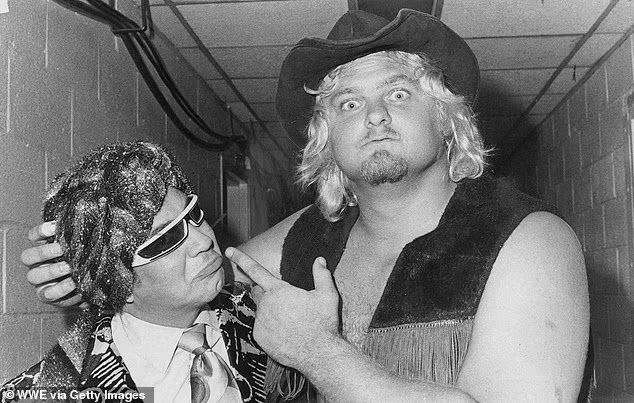
He adopted the persona of a rough-edged Texas cowboy, leaning into his roots and amplifying them for maximum effect. In an era before elaborate entrances and scripted promos dominated the business, his authenticity was his greatest asset.
Crowds didn’t just watch him — they reacted to him.
A Reputation Forged in Violence and Charisma
Throughout the 1970s and into the 1980s, he became synonymous with hard-hitting, chaotic brawls that blurred the line between performance and real combat. His matches were often described as brutal, with a physicality that reflected both his football background and the unpolished style of wrestling’s territorial days.
Promoters leaned heavily into his ability to draw heat from fans. He taunted crowds with slow, deliberate insults delivered in a thick Texas drawl, often punctuating his remarks with folksy catchphrases that made him instantly recognizable.
Opponents respected him not just for his size, but for his ring awareness and movement. Despite his massive frame, he was known to move with surprising agility — a trait that former managers and bookers frequently praised.
It was during this period that Bobby Duncum Sr. became a household name among wrestling fans across the country.
Battles With Wrestling Royalty
As his reputation grew, so did the caliber of opponents he faced. He shared the ring with some of the most iconic champions in wrestling history, engaging in long-running feuds that helped define promotions during wrestling’s golden era.
He fought against legends who were central to the industry’s expansion, often positioned as the obstacle that heroic fan favorites had to overcome. Win or lose, his role was crucial: he made others look brave, resilient, and victorious — the mark of a truly effective villain.
Later in his career, he aligned himself with one of wrestling’s most infamous factions, managed by a Hall of Fame figure known for his sharp tongue and manipulative brilliance. The association further cemented his place in wrestling history and introduced him to a new generation of fans.
Tributes Pour In
Following the announcement of his death, tributes flooded social media from wrestling insiders, journalists, and longtime fans. Many highlighted his toughness, professionalism, and influence on the wrestlers who followed.
One veteran wrestling manager described him as “a super talent who moved like a cat,” while another historian called him “a top heel across three decades” who was widely respected behind the scenes.
Others pointed to his quiet mentorship, noting that while he portrayed a villain on television, he was known as a straightforward, no-nonsense presence backstage.
A Legacy Continued — and a Tragedy Remembered
Duncum’s influence extended beyond his own career. His son followed in his footsteps, first as a college football player at a major Texas university and later as a professional wrestler who competed both in the United States and abroad.
However, that legacy was marked by tragedy. His son died in 2000 at the age of 34, a loss that devastated the family and cast a long shadow over Duncum’s later years. An autopsy later revealed the younger man had died from a fatal combination of substances.
Friends have said the loss deeply affected the elder Duncum, though he rarely spoke publicly about it.
Remembering an Era
Bobby Duncum Sr.’s death marks the passing of another figure from a generation of athletes who lived at the crossroads of legitimate sport and theatrical performance. He belonged to a time when wrestlers were expected to look dangerous, endure real punishment, and convince audiences that what they were seeing might not be entirely staged.
At 6-foot-7 and nearly 300 pounds, he embodied that philosophy.
While modern wrestling has evolved into a global, multimedia spectacle, veterans and fans alike continue to look back on performers like Duncum as reminders of a grittier, more grounded era.
WWE concluded its statement by extending condolences to his family, friends, and fans — a sentiment echoed across the wrestling world.
His name may no longer appear on marquees or highlight reels, but his impact remains etched into the foundations of professional wrestling history.

Emily Johnson is a critically acclaimed essayist and novelist known for her thought-provoking works centered on feminism, women’s rights, and modern relationships. Born and raised in Portland, Oregon, Emily grew up with a deep love of books, often spending her afternoons at her local library. She went on to study literature and gender studies at UCLA, where she became deeply involved in activism and began publishing essays in campus journals. Her debut essay collection, Voices Unbound, struck a chord with readers nationwide for its fearless exploration of gender dynamics, identity, and the challenges faced by women in contemporary society. Emily later transitioned into fiction, writing novels that balance compelling storytelling with social commentary. Her protagonists are often strong, multidimensional women navigating love, ambition, and the struggles of everyday life, making her a favorite among readers who crave authentic, relatable narratives. Critics praise her ability to merge personal intimacy with universal themes. Off the page, Emily is an advocate for women in publishing, leading workshops that encourage young female writers to embrace their voices. She lives in Seattle with her partner and two rescue cats, where she continues to write, teach, and inspire a new generation of storytellers.