



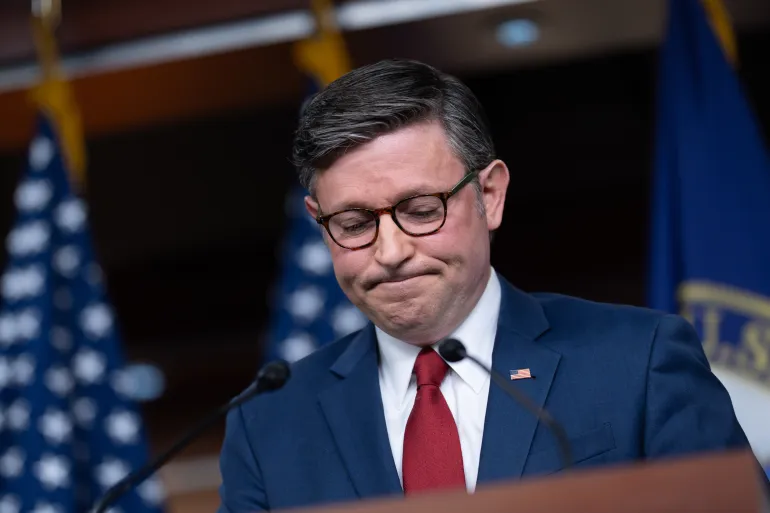
House Speaker Mike Johnson has publicly endorsed initiating impeachment proceedings against two federal judges, escalating tensions between congressional Republicans and the federal judiciary. Johnson framed the move as a necessary step to preserve accountability and restore public confidence in the impartiality of the courts.
In a press briefing on Wednesday, the Speaker expressed concern over what he described as repeated instances of judicial overreach and partisan rulings that undermine the legislative branch’s authority. While he did not disclose the names of the judges involved in the preliminary remarks, Johnson emphasized that congressional oversight is essential when judges act in ways that compromise the rule of law.
“Congress has a duty to ensure that the judiciary remains impartial and accountable,” Johnson stated. “When judges consistently overstep their constitutional boundaries, it falls to elected representatives to take action to protect the integrity of our institutions.”
Background of the Judicial Controversies
The two federal judges at the center of Johnson’s announcement have come under scrutiny for rulings that some Republican lawmakers claim have exceeded their legal authority. While supporters of the judges argue their decisions are consistent with judicial interpretation and precedent, critics contend that several rulings have interfered with legislative priorities or executive actions, raising questions about impartiality.
In particular, congressional Republicans have pointed to high-profile cases where judicial decisions temporarily blocked legislation or executive directives. These rulings, according to Johnson, exemplify a growing pattern of courts effectively nullifying policies enacted by Congress, which he describes as “an alarming departure from constitutional norms.”
“This is not about disagreement over legal interpretation,” Johnson explained. “This is about judges acting outside the boundaries of their authority and creating consequences that affect every American.”
The Impeachment Mechanism
Impeachment of federal judges is a constitutional process reserved for “high crimes and misdemeanors,” a standard intentionally broad to include serious misconduct, abuse of power, or behavior incompatible with judicial office. The House of Representatives holds the sole authority to initiate impeachment, while the Senate conducts the trial and votes on whether to remove the official from office.
Historically, impeachment of federal judges is rare, and successful removals are even rarer. Critics of Johnson’s announcement caution that moving forward could be politically charged and potentially set a precedent that blurs the line between legitimate oversight and partisan retaliation.
“Impeachment should not be treated as a tool for political leverage,” said one former lawmaker familiar with congressional judicial oversight. “It’s designed for clear cases of misconduct, not ideological disagreements.”
Johnson, however, framed the effort as both lawful and necessary. According to the Speaker, Congress must act decisively when judges’ actions threaten the balance of powers envisioned in the Constitution.
Political Context
The timing of Johnson’s announcement coincides with broader tensions between Republican-controlled House committees and the federal judiciary, particularly in areas involving election law, executive authority, and federal agency oversight. In recent months, Republicans have criticized courts for issuing temporary injunctions or blocking enforcement of policies favored by the majority party.
House leadership argues that these interventions delay policy implementation, undermine legislative intent, and create legal uncertainty for both federal and state agencies. Johnson suggested that in cases where judicial rulings repeatedly obstruct congressional authority, impeachment may be the only remedy to uphold accountability.
“This isn’t about partisanship,” Johnson said. “It’s about ensuring that no branch of government is placed above the law.”
Legal Experts Weigh In
Legal scholars note that while impeachment is constitutionally permissible, it remains a high-stakes maneuver. Experts emphasize that Congress must carefully document instances of misconduct or abuse of power to justify removal. Failure to present clear evidence could be viewed as an overreach, potentially fueling claims that impeachment is being used as a political weapon.
“Impeachment is the ultimate check on federal officials,” explained a constitutional law professor. “But it’s also fraught with risk. Legislators must clearly demonstrate that the judges in question engaged in conduct incompatible with their duties.”
Some analysts also point out that the announcement signals a strategic shift in how congressional Republicans plan to exert influence over the judiciary. By publicly supporting impeachment, Johnson is sending a message to both the courts and the public that the House intends to assert its oversight powers vigorously.
Reactions From Democrats and Judicial Advocates
Democratic lawmakers and judicial advocacy groups have criticized Johnson’s remarks as politically motivated. They argue that the Speaker’s comments could undermine judicial independence by creating a perception that judges may face removal for decisions that displease Congress.
“Judges must be free to interpret the law without fear of political retaliation,” said one Democratic representative. “Threatening impeachment for rulings that happen to conflict with one party’s agenda sets a dangerous precedent for our democracy.”
Advocates for judicial independence warn that excessive politicization of impeachment could erode public confidence in the courts and weaken the judiciary’s role as a neutral arbiter of the law. They also point out that impeachment proceedings require substantial evidence and a rigorous process, which cannot be bypassed by public statements alone.
Next Steps in the Process
Johnson indicated that the House Judiciary Committee and other relevant committees will begin reviewing the judges’ conduct to determine whether formal articles of impeachment are warranted. The review will involve collecting records, examining rulings, and assessing whether each judge’s behavior meets the constitutional standard for removal.
If the committees find sufficient grounds, articles of impeachment would be drafted and presented to the full House for a vote. A simple majority in the House would be required to approve the articles and send the case to the Senate for trial. Conviction and removal from office in the Senate would require a two-thirds majority.
Johnson emphasized that the process will be carried out “methodically and transparently” to ensure fairness. “We will follow the Constitution and due process at every stage,” he said.
Potential Implications
The announcement of support for impeachment has significant political and legal implications. For the Republican Party, it signals a willingness to use all constitutional tools to challenge judges perceived as obstructing policy priorities. For the courts, it may raise concerns about maintaining independence while under heightened scrutiny from a politically aligned House.
Observers also note that the case could influence public perception of both the legislative and judicial branches. How Congress handles impeachment proceedings—especially if politically controversial—could affect confidence in the balance of powers and set a precedent for future interactions between lawmakers and federal judges.
“This could be a turning point in how Congress interacts with the judiciary,” said a political analyst. “It’s rare, and it’s serious. The way this unfolds will be studied for decades.”
Broader National Debate
The discussion surrounding impeachment of federal judges highlights a broader national debate over the separation of powers, accountability, and the limits of political influence. Americans are increasingly attuned to disputes between branches of government, especially as courts continue to play pivotal roles in contentious policy areas.
Johnson’s remarks reflect a growing assertiveness among congressional Republicans in asserting oversight authority and pursuing accountability mechanisms beyond routine legislative checks. Whether the move results in formal impeachment or serves primarily as a political statement remains to be seen.
Conclusion
Speaker Mike Johnson’s public backing of impeachment proceedings against two federal judges marks a rare and highly consequential step in congressional oversight. By invoking the Constitution’s provisions for removing federal officials, Johnson is signaling that the House is prepared to assert its authority when it believes judicial conduct threatens the balance of powers.
While legal scholars caution that impeachment must be approached with care and based on substantial evidence, the Speaker maintains that the action is necessary to protect institutional integrity and restore public confidence in the rule of law. As committees begin reviewing the judges’ records and decisions, all eyes will be on how the House balances accountability, fairness, and political pressure in what could be one of the most significant challenges to judicial independence in recent memory.
Whether this initiative culminates in formal impeachment or becomes primarily a strategic signal, it underscores the ongoing tension between legislative oversight and judicial authority, and it raises fundamental questions about how America preserves the delicate equilibrium envisioned by its Constitution.

Emily Johnson is a critically acclaimed essayist and novelist known for her thought-provoking works centered on feminism, women’s rights, and modern relationships. Born and raised in Portland, Oregon, Emily grew up with a deep love of books, often spending her afternoons at her local library. She went on to study literature and gender studies at UCLA, where she became deeply involved in activism and began publishing essays in campus journals. Her debut essay collection, Voices Unbound, struck a chord with readers nationwide for its fearless exploration of gender dynamics, identity, and the challenges faced by women in contemporary society. Emily later transitioned into fiction, writing novels that balance compelling storytelling with social commentary. Her protagonists are often strong, multidimensional women navigating love, ambition, and the struggles of everyday life, making her a favorite among readers who crave authentic, relatable narratives. Critics praise her ability to merge personal intimacy with universal themes. Off the page, Emily is an advocate for women in publishing, leading workshops that encourage young female writers to embrace their voices. She lives in Seattle with her partner and two rescue cats, where she continues to write, teach, and inspire a new generation of storytellers.