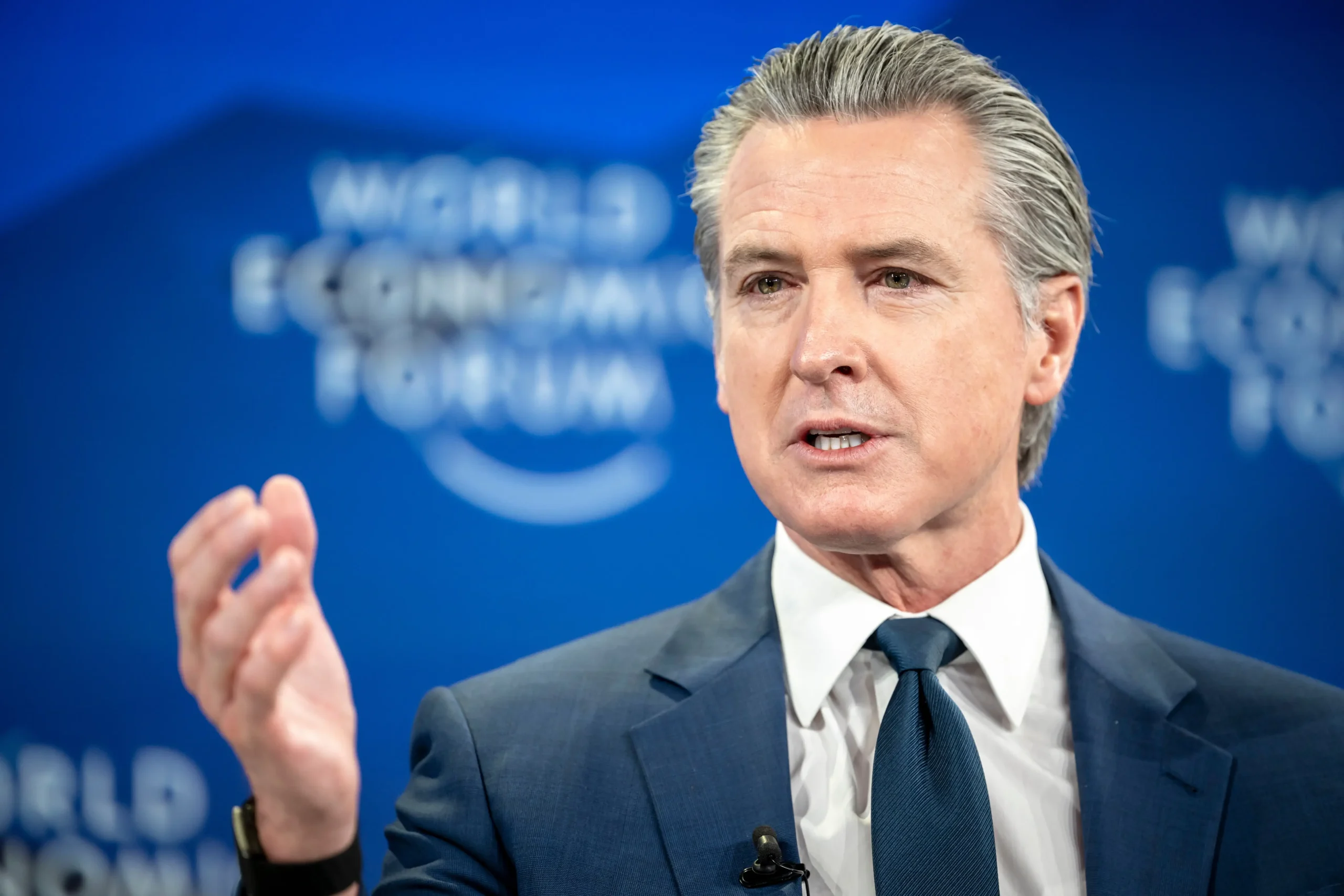
California Governor Gavin Newsom issued one of his strongest rebukes yet of President Donald Trump this week, warning that the United States is experiencing a level of corruption he says is unprecedented in modern history. In a wide-ranging critique, Newsom accused the president of weaponizing federal institutions against political opponents, blurring ethical boundaries for personal gain, and testing the public’s tolerance for democratic erosion.
Speaking during a public appearance and in follow-up remarks circulated online, Newsom argued that the scale and brazenness of what he described as corruption under Trump far exceeds previous controversies in American political life. He questioned how such conduct has become normalized and why public outrage appears muted despite repeated allegations involving the presidency.
“What we are witnessing right now is corruption at a scale this country has never seen,” Newsom said. “The open use of government power to punish enemies and reward allies is something Americans should not accept as business as usual.”
A Broader Warning About Democratic Norms
Newsom framed his criticism not as a partisan attack, but as a broader warning about democratic norms and institutional integrity. According to the governor, the danger lies not only in specific actions taken by the president, but in the cumulative effect of repeated challenges to long-standing safeguards designed to prevent abuse of power.
He accused the Trump administration of eroding the independence of federal agencies, undermining the credibility of law enforcement and regulatory bodies, and transforming institutions meant to serve the public into tools for political leverage.
“This is about whether we still believe the presidency is a public trust,” Newsom said. “Or whether we’ve decided it’s just another asset to be exploited.”
Allegations of Weaponization
Central to Newsom’s critique was the claim that federal institutions are being used selectively to target perceived enemies of the administration. He pointed to legal actions, regulatory pressure, and public threats directed at political rivals, media organizations, and state officials as evidence of what he called a systematic effort to intimidate dissent.
While Newsom did not cite individual cases in detail, his remarks echoed long-standing concerns raised by Democrats and some legal scholars about politicization within the Department of Justice and other federal agencies. Critics argue that even the perception of selective enforcement can weaken public trust and blur the line between legitimate governance and personal vendettas.
Newsom warned that once institutions are viewed as partisan weapons rather than neutral arbiters, restoring credibility becomes exponentially harder.
“When people stop believing the rules apply equally, the system starts to crack,” he said.
Claims of Personal Enrichment
In addition to allegations of institutional abuse, Newsom accused Trump of profiting directly from the presidency in ways he described as ethically unacceptable. He argued that Trump’s continued business interests, branding activities, and financial relationships represent a conflict between private gain and public duty.
“These aren’t abstract ethics debates,” Newsom said. “This is about whether decisions are being made in the public interest or for personal benefit.”
The Trump administration has consistently rejected such accusations, maintaining that the president has complied with legal requirements and that many criticisms are politically motivated. Trump allies argue that scrutiny of his finances is disproportionate compared to previous presidents and reflects partisan hostility rather than genuine concern.
Still, Newsom contended that the sheer volume of controversies demands greater public attention.
“At some point, frequency becomes a signal,” he said. “You can’t just wave it away.”
Questioning Public Tolerance
Perhaps the most striking element of Newsom’s remarks was his open questioning of public complacency. He expressed frustration that, despite repeated scandals and investigations, Trump continues to maintain strong support among his base and remains politically viable.
“How are we putting up with this?” Newsom asked. “How did this become acceptable?”
He suggested that constant exposure to controversy may have desensitized voters, leading to what he described as a dangerous erosion of accountability. When scandal becomes routine, he argued, outrage loses its power.
Political analysts note that this dynamic has reshaped modern politics, with voters increasingly sorting information through partisan lenses and dismissing allegations against favored leaders as attacks from hostile opponents.
Newsom acknowledged this reality but warned against its long-term consequences.
“If everything is partisan, then nothing is sacred,” he said. “That’s how democracies weaken from the inside.”
A National Political Subtext
Although Newsom did not explicitly reference his own political ambitions, his comments come amid growing speculation about his future on the national stage. As a high-profile Democratic governor with a national media presence, Newsom is frequently mentioned as a potential presidential contender in upcoming election cycles.
His increasingly direct criticism of Trump has been interpreted by some observers as positioning himself as a leading voice of opposition, particularly as Democrats search for figures capable of articulating a clear contrast with the former and current president.
Supporters argue that Newsom’s willingness to confront Trump head-on demonstrates leadership and clarity. Critics counter that his rhetoric risks deepening polarization and alienating voters weary of constant political conflict.
Republican Response
Republican officials and conservative commentators dismissed Newsom’s remarks as hypocritical and politically motivated. They accused the California governor of ignoring problems in his own state while launching broadside attacks against the president.
Some also argued that accusations of corruption are routinely weaponized in modern politics and that Trump has been subject to unprecedented scrutiny since first entering office.
“The American people have heard these claims before,” one Republican strategist said. “They’ve also seen investigations collapse and allegations fail to stick.”
Trump himself has frequently framed criticism as evidence of a political establishment attempting to undermine him, a narrative that continues to resonate strongly with his supporters.
A Reflection of a Larger Divide
Newsom’s remarks underscore the deep divisions shaping American political discourse. To his supporters, his warnings reflect a necessary defense of democratic norms at a time of heightened risk. To his critics, they represent exaggerated rhetoric that fuels distrust and deepens partisan animosity.
What is clear is that debates over corruption, institutional integrity, and executive power are no longer confined to academic or legal circles. They have become central themes in public political messaging, shaping how leaders communicate and how voters interpret events.
Whether Newsom’s message resonates beyond Democratic audiences remains an open question. But his comments reflect a broader anxiety within segments of the electorate about the durability of democratic institutions and the standards to which leaders are held.
Looking Ahead
As the country moves deeper into another politically charged election cycle, the tension between accountability and polarization is unlikely to ease. Allegations of corruption, counter-allegations of persecution, and disputes over the legitimacy of institutions will continue to dominate headlines.
For Newsom, the challenge will be translating moral outrage into persuasive argument—one that convinces voters not just that something is wrong, but that it demands action.
For the nation, the stakes are larger. The debate Newsom has reignited is ultimately about expectations: what Americans demand from those in power, and how much they are willing to tolerate before insisting on change.
Whether his warning becomes a rallying cry or fades into the noise of modern politics may say as much about the public as it does about the leaders being criticized.

Emily Johnson is a critically acclaimed essayist and novelist known for her thought-provoking works centered on feminism, women’s rights, and modern relationships. Born and raised in Portland, Oregon, Emily grew up with a deep love of books, often spending her afternoons at her local library. She went on to study literature and gender studies at UCLA, where she became deeply involved in activism and began publishing essays in campus journals. Her debut essay collection, Voices Unbound, struck a chord with readers nationwide for its fearless exploration of gender dynamics, identity, and the challenges faced by women in contemporary society. Emily later transitioned into fiction, writing novels that balance compelling storytelling with social commentary. Her protagonists are often strong, multidimensional women navigating love, ambition, and the struggles of everyday life, making her a favorite among readers who crave authentic, relatable narratives. Critics praise her ability to merge personal intimacy with universal themes. Off the page, Emily is an advocate for women in publishing, leading workshops that encourage young female writers to embrace their voices. She lives in Seattle with her partner and two rescue cats, where she continues to write, teach, and inspire a new generation of storytellers.