

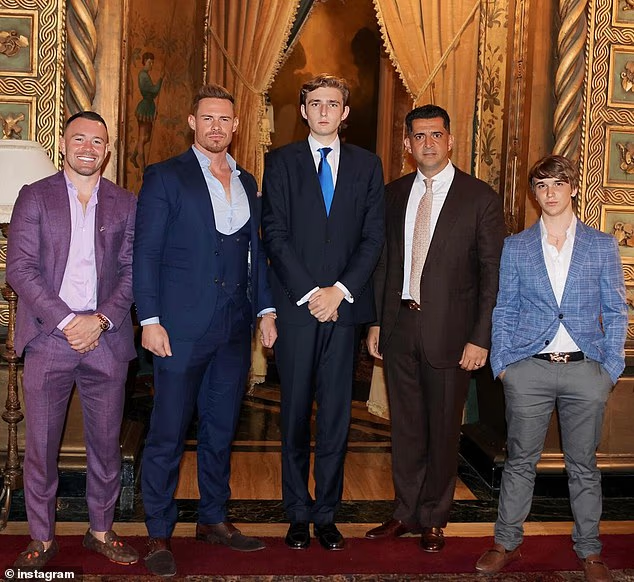
Reports from London indicate that Barron Trump, the 19-year-old son of former President Donald Trump, may have played a crucial role in alerting authorities during a violent assault earlier this year, potentially leading to a woman’s rescue, according to testimony and court exhibits in an ongoing trial. The dramatic incident — part of testimony before Snaresbrook Crown Court in east London — centers on a 999 emergency call that the President’s son made after witnessing violence during a video call with the alleged victim.
Prosecutors say the assault occurred on January 18, 2025, when the woman, whose name has not been publicly released, was allegedly attacked in a flat in the Poplar area of east London by her ex-boyfriend, identified in court records as 22-year-old Matvei Rumiantsev. Rumiantsev has pleaded not guilty to charges including assault, actual bodily harm, intentional strangulation, perverting the course of justice, and two counts of rape, all of which he denies.
Series of events leading to the emergency call
During her testimony and through evidence presented in court, it was explained that the woman reached out to Barron Trump through a video calling app while she was allegedly being assaulted. Jurors were played part of the emergency call Trump placed to British police at 2:23 a.m. on that date. On the call, Trump can be heard telling the operator, “I just got a call from a girl I know. She’s getting beaten up,” and providing the address where the incident was taking place.
Because the call was made from the United States, Trump first had to work out how to reach the correct emergency number in the UK — 999 — and communicate details of the assault. Prosecutors showed the court the transcript of the exchange with the call handler, during which the operator pressed Trump for more precise information and asked standard intake questions about who he was and how he knew the alleged victim.
At one point, the operator admonished Trump to “stop being rude and actually answer my questions,” saying, “If you want to help the person, you’ll answer my questions clearly and precisely, thank you. So how do you know her?” Trump ultimately explained that he had met the woman on social media and apologised, saying, “So sorry for being rude.”
Police response and arrival
Following the 999 call, officers attended the address in Poplar, where they found the woman in distress. Body-worn camera footage played to the court showed police asking the woman to verify that someone had called from the United States regarding the attack. In that footage, she reportedly told officers that she was friends with Barron Trump, adding, “I am friends with Barron Trump, Donald Trump’s son.” An officer is captured on video saying to a colleague, “So apparently this informant from America is likely to be Donald Trump’s son.”
Prosecutors told the court that there were two separate calls to emergency services that night: one from the woman herself, and one from Trump after he received the distressing video call. When police spoke with the woman following their arrival, she said that the earlier contact had likely contributed to saving her life. “He helped save my life. That call was like a sign from God at that moment,” she told officers, according to testimony quoted in British media reports.
Allegations and defenses in the trial
The alleged attacker, Rumiantsev, a Russian national, was said by prosecutors to have been motivated by jealousy over the woman’s communication with Trump. While in custody before trial, Rumiantsev allegedly made additional attempts to influence the situation, including tricking officers into letting him phone the woman and later sending a letter through a third party asking her to withdraw her statement, the court heard.
The defence in the case has challenged the woman’s account of events, with defence attorney Sasha Wass KC asserting that the allegations of rape and other serious violence were fabricated. In cross-examination, Wass described aspects of the woman’s story as untrue, to which the alleged victim responded emphatically that she had not invented her testimony and pointed out that falsifying such claims would be “completely evil and disgraceful” to people who have been in violent situations.
Details from the emergency call
Multiple news reports describe the 999 call as brief but urgent. Trump reportedly told the operator that he had just received the distressing video call and emphasised the need for immediate action, saying, “It’s really an emergency, please. I got a call from her with a guy beating her up.”
In his account later shared with police, Trump said that the video call had only lasted about 10 to 15 seconds before cutting off, but that he could hear screaming and crying in the background. He told officers that he had first picked up the video call expecting a friendly conversation, but instead witnessed disturbing sounds and imagery. “I called you guys — that was the best thing I could do,” he said when speaking with responding officers. “I wasn’t going to call back and threaten things to him because that would just make the situation worse.”
Perspective from the court and alleged victim
In her own words to the court, the woman described feeling trapped and in danger before the call was placed. She said that after Trump’s emergency call initiated a police response, she was able to survive the assault. She also testified that prior to the incident, she had been attacked by Rumiantsev in a jealous rage and that during the same period she had also been raped on two occasions, allegations that form part of the broader charges against him. Rumiantsev denies all accusations.
The court continues to hear evidence on these serious charges. Because the trial is ongoing, no finding of fact has been made regarding the allegations. During the proceedings, both prosecution and defence have presented competing narratives about the events of that night and the relationship between the individuals involved.
Context and public response
The case has drawn considerable media attention, partly because of the involvement of a high-profile figure — even though Trump’s role was limited to making an emergency call from abroad. Coverage has cited both the dramatic nature of the incident and the unusual circumstances of an emergency call being placed transatlantically. News outlets have published portions of the call transcript and body-camera footage from the responding officers as part of their reporting.
Supporters of Trump’s intervention have praised his quick action in contacting police after witnessing what he perceived to be an urgent threat to someone’s life. Others have raised questions about the circumstances of the relationship between Trump and the woman he called about, as well as procedural questions about the exchange with the emergency operator.
Ongoing legal process
As testimony continues, jurors will weigh the evidence presented by both prosecution and defence. The charges against Rumiantsev are serious and carry significant potential penalties if he is convicted, including for offences of assault and rape under U.K. criminal law.
The emergency call itself is only one part of the broader case, but it has emerged as a focal point in media accounts because it reflects a cross-jurisdictional interaction in which someone outside the jurisdiction — in another country entirely — sought to prompt a police response through an emergency services line.
Because the trial remains underway, no determination has been made as to the veracity of all claims or the ultimate outcome. Update reports will follow as the court reaches further rulings and the evidence phase concludes.

Emily Johnson is a critically acclaimed essayist and novelist known for her thought-provoking works centered on feminism, women’s rights, and modern relationships. Born and raised in Portland, Oregon, Emily grew up with a deep love of books, often spending her afternoons at her local library. She went on to study literature and gender studies at UCLA, where she became deeply involved in activism and began publishing essays in campus journals. Her debut essay collection, Voices Unbound, struck a chord with readers nationwide for its fearless exploration of gender dynamics, identity, and the challenges faced by women in contemporary society. Emily later transitioned into fiction, writing novels that balance compelling storytelling with social commentary. Her protagonists are often strong, multidimensional women navigating love, ambition, and the struggles of everyday life, making her a favorite among readers who crave authentic, relatable narratives. Critics praise her ability to merge personal intimacy with universal themes. Off the page, Emily is an advocate for women in publishing, leading workshops that encourage young female writers to embrace their voices. She lives in Seattle with her partner and two rescue cats, where she continues to write, teach, and inspire a new generation of storytellers.