



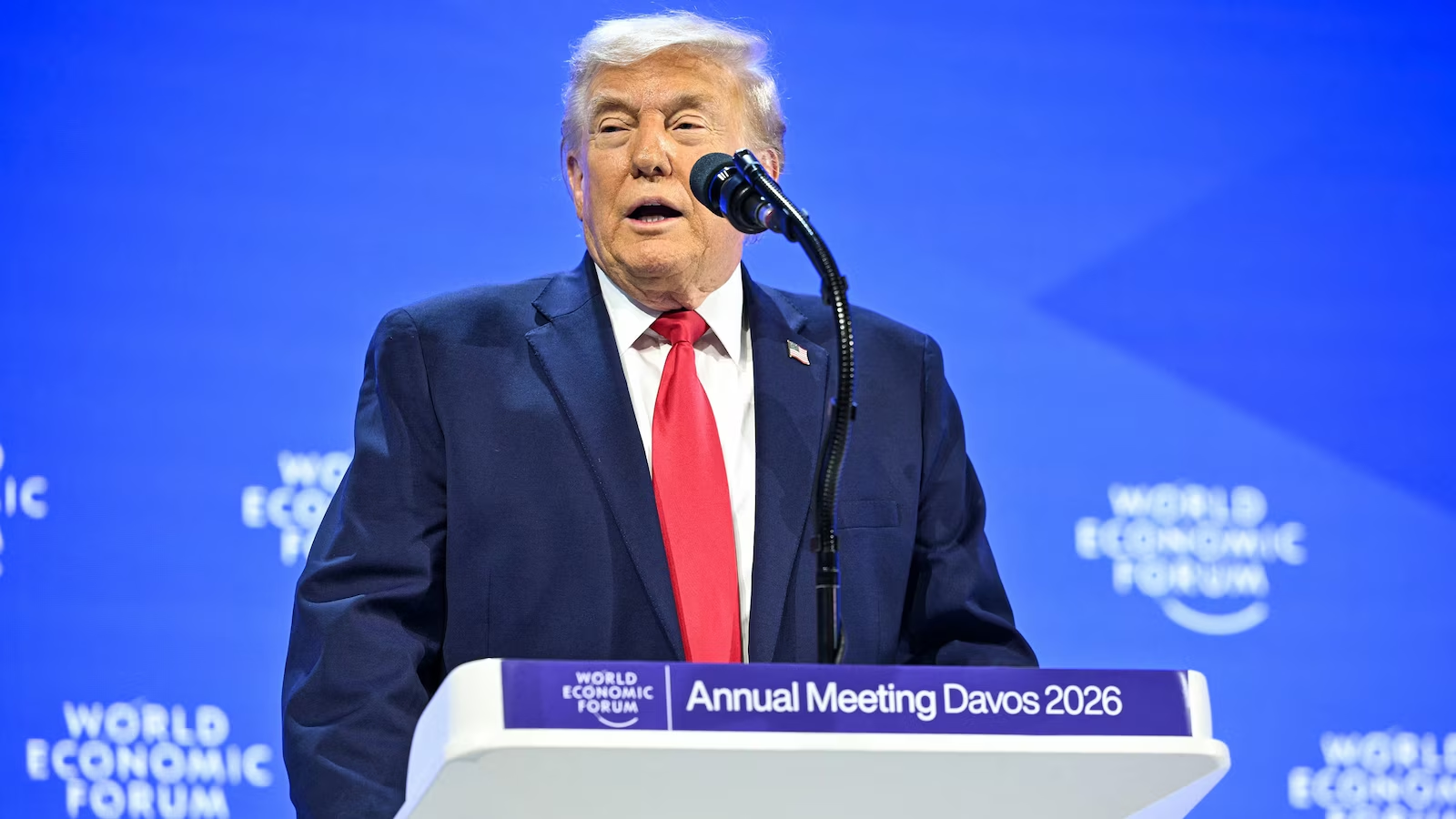
Former President Donald Trump reignited international controversy during a recent speech in which he sharply criticized European leaders, questioned NATO’s posture toward the United States, and doubled down on his long-standing assertion that Washington should take control of Greenland. The remarks, delivered at the World Economic Forum’s annual meeting, combined geopolitical demands with characteristically provocative language that drew swift attention across diplomatic and political circles.
Trump’s speech focused heavily on what he described as an imbalance in the U.S.–Europe relationship, particularly within NATO. Framing the United States as a guarantor of European security that has received insufficient respect in return, Trump argued that European nations must make a clear choice about whether they intend to align with American strategic priorities.
“They have a choice,” Trump said, referring to European allies. “You can say yes, and we will be very appreciative. Or you can say no, and we will remember.”
At the center of Trump’s renewed critique was Greenland, the vast Arctic territory that remains an autonomous region under Danish sovereignty. Trump has previously suggested that the United States should acquire Greenland for national security reasons, an idea that was widely dismissed by European leaders when he raised it during his presidency. In his latest remarks, Trump portrayed the proposal as both practical and restrained.
“We want a piece of ice for world protection, and they won’t give it,” he said. “We’ve never asked for anything else. We could have kept that piece of land and we didn’t.”
Trump did not elaborate on how the United States might legally or diplomatically pursue such an acquisition, nor did he acknowledge Denmark’s repeated and unequivocal rejection of the idea. Instead, he framed the issue as a test of loyalty and gratitude from European allies who, he argued, have benefited disproportionately from U.S. military protection.
Throughout the speech, Trump cast himself as a leader who once enjoyed broad admiration from European officials — admiration he claimed evaporated when he began pressing harder on strategic demands. In one of the more eyebrow-raising moments of the address, Trump asserted that European leaders used to refer to him as “daddy,” a remark that drew immediate attention for both its tone and its implications.
“In an odd way, they loved me,” Trump said. “They called me ‘daddy.’ A very smart man said, ‘He is our daddy.’ I was running it. Then I went from running it to being a terrible human being.”
Trump appeared to conflate multiple geopolitical references during the anecdote, at one point mentioning Iceland while discussing Greenland, adding to confusion about what he meant to convey. He described his current request — U.S. control over part of Greenland — as modest, referring to it as “a piece of ice, cold and poorly located.”
The “daddy” reference appears to trace back to remarks made last year by NATO Secretary General Mark Rutte during a discussion about tensions involving Iran and Israel. At the time, Trump had used strong language when criticizing both countries for violating a ceasefire agreement. Rutte, attempting to contextualize Trump’s approach, remarked that “Daddy has to sometimes use strong language to get them to stop,” a comment meant metaphorically but one that quickly circulated in global media.
Trump resurrected the remark during his speech, presenting it as evidence that European leaders once viewed him as a dominant and decisive figure. However, following renewed scrutiny, Rutte later clarified that he was not personally referring to Trump as “daddy,” nor was he endorsing such a characterization.
Speaking to Reuters after the comments resurfaced, Rutte explained that he was describing a broader dynamic in international relations, not praising or infantilizing world leaders. “The ‘daddy’ thing — I didn’t call him ‘daddy,’” Rutte said. “In Europe, I hear sometimes countries saying, ‘Hey, will the U.S. stay with us?’ And I said that sounds like a small child asking his daddy, ‘Are you still staying with the family?’”
Rutte emphasized that the metaphor was intended to illustrate dependency concerns among European nations, not to elevate Trump personally. “In that sense, I used ‘daddy,’ not that I was calling President Trump ‘daddy,’” he added.
Despite the clarification, Trump’s decision to revive the phrase underscored his broader message: that Europe relies heavily on American power while resisting U.S. demands. His comments echoed themes he has repeated for years — that NATO allies do not contribute enough to their own defense and that the United States has been taken advantage of economically and militarily.
Trump’s renewed focus on Greenland also signals that the issue remains a symbolic pillar of his foreign policy worldview. He has consistently framed territorial control, resource access, and geographic positioning as essential to national strength. Greenland’s strategic location in the Arctic, amid growing competition with Russia and China, has made it an area of increased interest for U.S. defense planners — though not in the manner Trump has proposed.
European leaders and Danish officials have long rejected any suggestion of selling or transferring Greenland, stressing that the territory is not for sale and that its future rests with its residents. Greenland’s own government has also emphasized its autonomy and right to self-determination, pushing back against being treated as a bargaining chip in great-power politics.
Trump’s speech did little to ease those concerns. Instead, it reinforced perceptions among critics that his approach to diplomacy is transactional, confrontational, and dismissive of long-standing alliances. Supporters, however, argue that Trump is merely stating uncomfortable truths about global power dynamics and forcing allies to confront realities they prefer to avoid.
The remarks come at a time when NATO faces renewed uncertainty amid shifting U.S. political leadership, ongoing conflict in Eastern Europe, and debates over defense spending. Trump’s suggestion that Europe’s response to the Greenland issue could affect future U.S. attitudes toward NATO is likely to fuel anxiety among alliance members already wary of American unpredictability.
While Trump no longer holds office, his words continue to carry significant weight, particularly as he remains a dominant figure in U.S. politics. His speech at the World Economic Forum signals that, should he return to power, his foreign policy priorities — including skepticism toward NATO and aggressive assertions of U.S. interests — would likely resume with renewed intensity.
For now, European officials have largely responded with restraint, declining to engage directly with Trump’s rhetoric. Whether his comments will translate into concrete policy proposals or remain rhetorical flashpoints remains uncertain. What is clear, however, is that Trump’s vision for America’s role in the world — blunt, hierarchical, and unapologetically transactional — remains unchanged.
As debates over global security, Arctic strategy, and alliance cohesion continue, Trump’s remarks serve as a reminder that the question of how the United States relates to its allies is far from settled — and that the language used to frame that relationship can be as consequential as the policies themselves.

Emily Johnson is a critically acclaimed essayist and novelist known for her thought-provoking works centered on feminism, women’s rights, and modern relationships. Born and raised in Portland, Oregon, Emily grew up with a deep love of books, often spending her afternoons at her local library. She went on to study literature and gender studies at UCLA, where she became deeply involved in activism and began publishing essays in campus journals. Her debut essay collection, Voices Unbound, struck a chord with readers nationwide for its fearless exploration of gender dynamics, identity, and the challenges faced by women in contemporary society. Emily later transitioned into fiction, writing novels that balance compelling storytelling with social commentary. Her protagonists are often strong, multidimensional women navigating love, ambition, and the struggles of everyday life, making her a favorite among readers who crave authentic, relatable narratives. Critics praise her ability to merge personal intimacy with universal themes. Off the page, Emily is an advocate for women in publishing, leading workshops that encourage young female writers to embrace their voices. She lives in Seattle with her partner and two rescue cats, where she continues to write, teach, and inspire a new generation of storytellers.