The world of martial arts cinema is mourning the loss of a towering figure whose presence shaped an entire era of kung fu films. Revered by fans, respected by peers, and remembered for a screen intensity that few could rival, the legendary actor passed away at the age of 77, leaving behind a legacy that stretches across generations and continents.
For decades, his work defined what it meant to be formidable on screen. He belonged to a rare class of performers who did not merely act as fighters, but were fighters — men whose movements were born from real discipline rather than choreography alone. In an industry built on illusion, he brought authenticity. Every strike, every stance, every moment of stillness carried weight.
His career began long before martial arts films became a global phenomenon. Raised in an environment rooted in traditional kung fu, he trained from childhood, absorbing not only technique but philosophy. Martial arts, for him, were not about spectacle. They were about mastery, restraint, and inner balance. That foundation shaped his screen persona and set him apart from countless imitators who followed.
During the golden age of kung fu cinema in the 1970s and 1980s, he appeared in dozens of films, often cast as disciplined warriors, rival masters, or imposing antagonists. He was part of a generation that transformed martial arts movies into a cultural force. These films were not just entertainment; they carried identity, pride, and tradition far beyond Asia, reaching audiences around the world.
Among his contemporaries, he was spoken of with reverence. Within the industry, he was frequently grouped alongside the giants of the genre — performers whose influence reshaped cinema itself. Yet unlike some of his peers, he never chased global celebrity. His power came from presence rather than publicity. He commanded attention not through noise, but through authority.
Then, at the height of his career, he stepped away.
At a time when many expected him to continue dominating the screen, he chose a quieter path, moving into business and largely disappearing from public view. For years, fans assumed his story in film had ended. The genre itself began to shift, and the era he helped define faded into memory.
Everything changed in 2004.
A new generation was introduced to the spirit of classic kung fu cinema through Stephen Chow’s Kung Fu Hustle — a film that blended comedy, fantasy, and reverence for the old masters. At the heart of its most unforgettable moments stood a figure whose presence instantly eclipsed the chaos around him. Cast as the fearsome villain known as “Beast,” the actor returned to the screen with devastating effect.
Midway through the film, audiences encountered something rare: a performance that felt timeless. No elaborate backstory was needed. No excess dialogue. With a single look and a handful of movements, he reasserted what true cinematic authority looked like.
That moment marked the triumphant return of Bruce Leung.
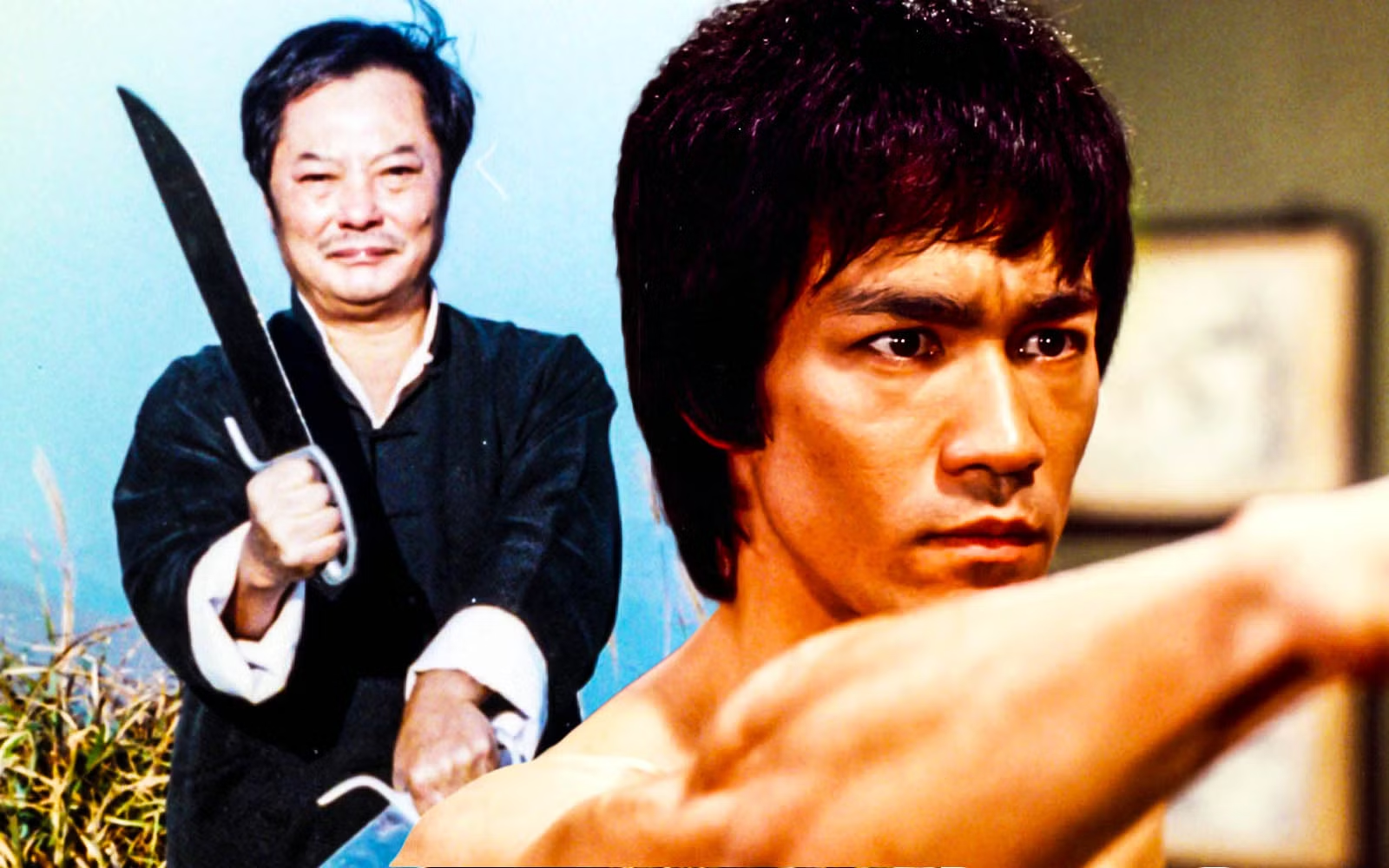
Older, quieter, yet more powerful than ever, Leung transformed “Beast” into one of the most iconic villains in modern martial arts cinema. He did not play the role with exaggeration. He played it with calm certainty — the kind that suggests danger without needing to prove it. For younger viewers, Kung Fu Hustle became their first encounter with a legend. For longtime fans, it was a reminder of what had been missing.
The performance redefined his career. It proved that martial mastery does not fade with age. If anything, it deepens. Leung’s Beast was not merely a character. It was a statement: that authenticity still mattered, that discipline still commanded respect, and that the old masters still had something to teach.
News of his passing on January 14 sent shockwaves through the entertainment world. Tributes poured in from across the industry, led by Jackie Chan, who worked alongside Leung in the 1978 film Magnificent Bodyguards. Chan described him as a true kung fu master, proficient in multiple traditional styles, and praised his lifelong devotion to film and television.
“He created so many classic roles, loved by audiences and admired by colleagues,” Chan said. He concluded with a poetic farewell: “Brother Leung, it’s snowing in Beijing. The sky is grey. I miss you.”
Stephen Chow also paid tribute, writing simply, “Forever remembering Mr. Leung Siu-lung.”
A message appeared on Leung’s own social media account following the announcement of his death, reading like a final scene written by the man himself:
“I’ve gone to a faraway place to make a film. Please forgive me for leaving without saying goodbye. Just think of it as me going to a faraway place to make a film. Live well on my behalf. Love is always there. Remember that I love you.”
It was a farewell both tender and cinematic — fitting for someone who spent his life turning movement into poetry.
Beyond the screen, Leung was a devoted family man. He was married twice and was the father of three children. Those who knew him personally described a man of discipline and humility, far removed from the ferocity he projected on screen. The same qualities that made him formidable as an actor — focus, restraint, loyalty — defined him in private life.
His death marks the passing of one of the last bridges to a purer era of martial arts cinema. In a time when action is increasingly shaped by digital effects and accelerated editing, Leung stood for something different. His performances were grounded in reality. His power came from control, not chaos. He reminded audiences that the most intimidating force is often the calmest one in the room.
The generation he belonged to did more than entertain. They exported culture. They carried tradition into theaters across the world. They taught audiences that martial arts were not merely about combat, but about philosophy, honor, and self-mastery.
Leung embodied that spirit.
To many, he will forever be remembered as the silent, unstoppable Beast. To those who followed his career, he remains something far greater: a master who helped define what kung fu cinema could be, and whose influence will continue to shape the genre long after the final frame fades.
He did not simply act in martial arts films.
He was martial arts cinema.

Emily Johnson is a critically acclaimed essayist and novelist known for her thought-provoking works centered on feminism, women’s rights, and modern relationships. Born and raised in Portland, Oregon, Emily grew up with a deep love of books, often spending her afternoons at her local library. She went on to study literature and gender studies at UCLA, where she became deeply involved in activism and began publishing essays in campus journals. Her debut essay collection, Voices Unbound, struck a chord with readers nationwide for its fearless exploration of gender dynamics, identity, and the challenges faced by women in contemporary society. Emily later transitioned into fiction, writing novels that balance compelling storytelling with social commentary. Her protagonists are often strong, multidimensional women navigating love, ambition, and the struggles of everyday life, making her a favorite among readers who crave authentic, relatable narratives. Critics praise her ability to merge personal intimacy with universal themes. Off the page, Emily is an advocate for women in publishing, leading workshops that encourage young female writers to embrace their voices. She lives in Seattle with her partner and two rescue cats, where she continues to write, teach, and inspire a new generation of storytellers.