



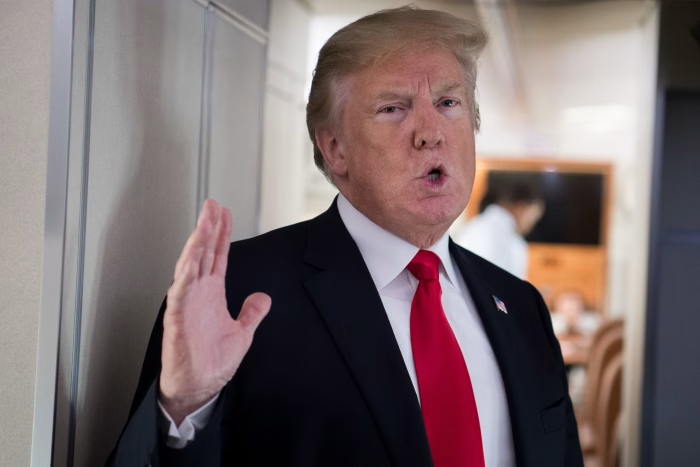
A recently leaked letter sent to Norway’s prime minister has intensified diplomatic unease across Europe, shedding new light on growing strains between the United States and its NATO allies. The document, which circulated quietly among European diplomatic circles before becoming public, reflects mounting frustration inside the White House over Arctic security, alliance burden-sharing, and international recognition.
The letter’s contents, described by officials as unusually blunt for communications between allied nations, touch on Greenland’s strategic importance, NATO obligations, and what appears to be personal resentment tied to global prestige. Its disclosure comes at a time when relations between Washington and several European capitals are already under pressure due to trade disputes and disagreements over Arctic military posture.
A Message That Alarmed European Capitals
According to multiple officials familiar with the correspondence, the letter was first shared internally among embassies before being obtained by journalists. Diplomats described the tone as confrontational and unorthodox, particularly given Norway’s status as a longstanding NATO partner and close U.S. ally.
In the opening passage, the author suggested that recent decisions by Norway had altered his approach to foreign policy, stating that he no longer felt obligated to “think purely of peace,” a phrase that immediately drew concern from European officials accustomed to more carefully calibrated language in alliance communications.
While the letter does not announce any specific military action, its rhetoric alone was enough to trigger internal discussions within NATO about alliance cohesion and the risks of escalating tensions in the Arctic region.
Greenland at the Center of the Dispute
A significant portion of the letter focuses on Greenland, the vast Arctic island that remains an autonomous territory within the Kingdom of Denmark. For years, Greenland has drawn increased attention from global powers due to its strategic location, natural resources, and proximity to key transatlantic routes.
In the document, the U.S. leader reiterated his long-standing view that Denmark lacks the capacity to adequately defend Greenland against growing Russian and Chinese activity in the Arctic. He argued that U.S. control of the territory would better ensure regional and global security, framing the issue as one of necessity rather than expansion.
The letter also questioned Denmark’s historical claim to Greenland, dismissing it as based on ancient maritime landings rather than modern strategic realities. That characterization has drawn criticism from European historians and officials, who note that Danish settlement of Greenland predates the founding of the United States by more than half a century.
Personal Grievances Enter Diplomatic Space
What has drawn particular scrutiny is the letter’s reference to the Nobel Peace Prize. The author expressed anger that Norway had “decided not to give” him the award, citing his role in resolving multiple international conflicts.
In reality, the Nobel Peace Prize is not awarded by the Norwegian government but by an independent committee appointed by Norway’s parliament. This distinction has been repeatedly emphasized by Norwegian officials, who privately expressed frustration that their country was being blamed for a decision over which it has no direct control.
By introducing the Nobel Prize into a discussion of NATO obligations and Arctic security, the letter blurred the line between personal grievance and state policy, a move diplomats say complicates already sensitive negotiations.
Revealing the Author
Midway through the letter, the identity of its author becomes unmistakable: President Donald Trump.
Trump has long voiced dissatisfaction with NATO burden-sharing and has repeatedly argued that the United States shoulders an unfair share of the alliance’s military and financial responsibilities. In the letter, he reiterated claims that he had done more for NATO than any leader since its founding, and argued that the alliance now owed the United States tangible concessions in return.
Among those concessions, he explicitly listed Greenland.
European Pushback and Growing Friction
The letter surfaced amid a broader deterioration in U.S.–European relations. In recent weeks, Washington imposed new trade tariffs on several allies, including the United Kingdom and European Union member states, citing their opposition to U.S. ambitions regarding Greenland.
European leaders have responded forcefully. At a press conference following the tariff announcement, UK Prime Minister Sir Keir Starmer criticized the use of economic pressure against allies, calling it “completely wrong” and counterproductive to collective security.
Meanwhile, Denmark and Greenland have both rejected any notion of transferring sovereignty. Protests erupted across Greenland over the weekend, with demonstrators braving icy conditions to declare that the island is “not for sale.”
NATO and the Arctic Question
Behind the political drama lies a genuine strategic debate. The Arctic is rapidly becoming a focal point of global competition as melting ice opens new shipping routes and access to untapped resources. Russia has expanded its Arctic military infrastructure, while China has declared itself a “near-Arctic state” and invested heavily in the region.
The United States already maintains a military presence in Greenland under agreements dating back to the Cold War, including key radar and missile defense installations. European officials argue that these arrangements demonstrate effective cooperation without requiring changes to sovereignty.
Trump’s letter, however, suggests a belief that existing frameworks are insufficient and that full U.S. control would provide clearer authority and faster decision-making.
Diplomatic Norms Under Strain
Foreign policy experts say the episode underscores a broader shift in diplomatic style. Traditionally, disagreements among allies are handled through private negotiations and carefully worded communiqués. The leaked letter, by contrast, reads more like a public ultimatum than a confidential exchange.
“This is not how allies typically communicate,” said one former NATO official, speaking on condition of anonymity. “Even when there are serious disagreements, the language is usually measured. This letter departs from that norm.”
The concern, analysts say, is not only about Greenland, but about the precedent such communications set for alliance management.
What Comes Next
Norway has not formally responded to the letter publicly, and officials there have sought to downplay its significance, emphasizing their continued commitment to NATO and transatlantic cooperation.
Behind the scenes, however, European diplomats are working to contain the fallout. Emergency consultations within NATO have focused on reaffirming alliance unity and preventing bilateral disputes from undermining collective defense.
Whether the letter leads to concrete policy changes remains unclear. What is clear is that it has exposed deep frustrations and competing visions for the future of NATO, Arctic security, and U.S.–European relations.
As global power competition intensifies, the challenge for allies will be balancing legitimate security concerns with the need for trust, coordination, and diplomatic restraint—qualities that many fear are increasingly in short supply.

Emily Johnson is a critically acclaimed essayist and novelist known for her thought-provoking works centered on feminism, women’s rights, and modern relationships. Born and raised in Portland, Oregon, Emily grew up with a deep love of books, often spending her afternoons at her local library. She went on to study literature and gender studies at UCLA, where she became deeply involved in activism and began publishing essays in campus journals. Her debut essay collection, Voices Unbound, struck a chord with readers nationwide for its fearless exploration of gender dynamics, identity, and the challenges faced by women in contemporary society. Emily later transitioned into fiction, writing novels that balance compelling storytelling with social commentary. Her protagonists are often strong, multidimensional women navigating love, ambition, and the struggles of everyday life, making her a favorite among readers who crave authentic, relatable narratives. Critics praise her ability to merge personal intimacy with universal themes. Off the page, Emily is an advocate for women in publishing, leading workshops that encourage young female writers to embrace their voices. She lives in Seattle with her partner and two rescue cats, where she continues to write, teach, and inspire a new generation of storytellers.