


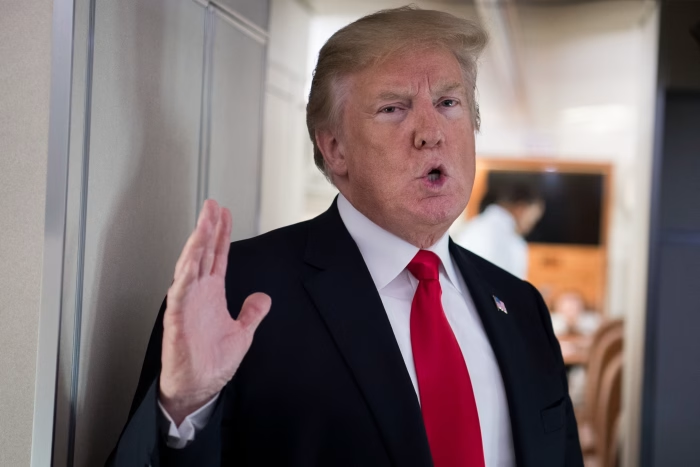
President Donald Trump escalated tensions on January 15, 2026, by threatening to invoke the Insurrection Act, a federal law that allows the president to deploy U.S. military forces within the country under certain circumstances. His warning came in response to growing unrest in Minneapolis, Minnesota, where demonstrations against federal immigration enforcement, particularly Immigration and Customs Enforcement (ICE), have persisted for more than a week.
Trump issued a statement on his social media platform, stating that if local officials in Minnesota failed to control what he described as “professional agitators and insurrectionists” attacking federal agents, he would authorize the use of the Insurrection Act. The president characterized federal officers deployed in the state as “patriots of ICE,” insisting that they were only performing their duties.
What Is the Insurrection Act?
The Insurrection Act of 1807 provides the president with authority to deploy the military domestically to suppress insurrection, domestic violence, or other situations that make it impracticable to enforce federal law through ordinary judicial and law enforcement channels. It is one of the few legal exceptions to the Posse Comitatus Act, which generally limits the use of the U.S. military in domestic law enforcement. Historically, the Act has been invoked sporadically, including during the 1992 Los Angeles riots, to maintain order when local authorities could not manage widespread unrest.
Legal experts note that the use of the Act without state consent is rare and carries significant constitutional implications. Deploying the military in this context would effectively place armed federal forces in a law enforcement role, which could raise questions regarding civil liberties, state sovereignty, and oversight.
Context: Minneapolis Protests and ICE Operations
Trump’s announcement follows a week of heightened tensions in Minneapolis after two separate incidents involving ICE agents. The first incident occurred on January 7, when Renee Nicole Good, a 37-year-old U.S. citizen and mother of three, was fatally shot by ICE officer Jonathan Ross during federal immigration operations. Video footage of the incident and subsequent public scrutiny ignited nationwide protests and drew criticism of federal enforcement policies.
Just days later, another ICE operation resulted in the shooting of a Venezuelan national during a traffic stop. The Department of Homeland Security reported that the individual fled the scene, crashed into a parked vehicle, and was then confronted by federal officers. Two additional individuals reportedly attempted to attack the officer, prompting the use of defensive gunfire. The individual sustained non-life-threatening injuries and was hospitalized.
Protesters have gathered daily in Minneapolis, with demonstrations ranging from peaceful marches to confrontations with federal agents. Local authorities, including Governor Tim Walz and Mayor Jacob Frey, have urged protesters to remain peaceful while criticizing the federal response as heavy-handed and disruptive.
Federal and White House Response
The Trump administration has framed its actions as necessary to protect federal employees and enforce U.S. law. Homeland Security officials stated that officers have faced assaults during enforcement activities, which have included protesters physically confronting agents. DHS confirmed that arrests have been made in connection with these clashes, but emphasized that the agency’s personnel were only responding to threats.
Secretary of Homeland Security Kristi Noem expressed support for Trump’s approach, noting that federal presence in Minneapolis was warranted given the conditions on the ground. While she acknowledged discussions about invoking the Insurrection Act, Noem did not confirm whether formal steps had been taken.
Local Government Reactions
Minnesota state leaders have expressed concern about the potential for further escalation. Governor Walz called for calm and encouraged protests to remain lawful. He highlighted the emotional toll on residents and stressed that the state is committed to ensuring public safety while respecting citizens’ right to assemble.
Mayor Frey echoed these concerns, describing the situation as “unsustainable” and emphasizing the difficulty of coordinating law enforcement efforts with federal officers present. Both officials have been critical of the Trump administration’s decision to deploy federal agents, warning that the presence of uniformed personnel in civilian areas has heightened tensions rather than restored order.
Public Reaction
Public response to Trump’s threat has been sharply divided. Supporters of the president argue that federal agents face real threats from violent protesters and that the use of the Insurrection Act is justified to protect personnel and enforce immigration laws. Critics, however, view the threat as an unprecedented escalation, with some calling it a misuse of federal authority against U.S. citizens exercising their constitutional rights to protest.
Civil liberties groups have warned that deploying military forces domestically in response to protest activity sets a dangerous precedent. They contend that it could erode public trust in law enforcement, create additional conflict, and infringe on protections guaranteed under the First and Fourth Amendments.
National Implications
The situation in Minneapolis is part of a larger national debate over immigration enforcement, federal authority, and the proper response to civil unrest. The Trump administration’s aggressive stance on immigration has included multiple federal deployments in other cities, often sparking demonstrations and clashes with local law enforcement. The use of the Insurrection Act, even as a threat, has intensified discussions regarding the balance between federal power and local autonomy.
Legal scholars note that if Trump were to invoke the Act, courts could see challenges regarding constitutionality and limits of executive authority. Historically, judicial review has tempered the scope of the Insurrection Act, and any deployment of the military within Minnesota would likely face scrutiny from both the courts and Congress.
Historical Precedent
Since its enactment in the early 19th century, the Insurrection Act has been invoked sporadically in times of domestic crisis. Some notable examples include the deployment of federal troops during Reconstruction, civil rights unrest in the 1950s and 1960s, and the Los Angeles riots in 1992. Each use has generated debate over the proper role of the military in civilian life, and the Minneapolis situation is no exception.
Experts caution that invoking the Act for political demonstrations, even amid violent confrontations, could deepen societal divisions and invite legal challenges. The presence of active-duty military in domestic law enforcement functions is highly unusual in U.S. history, and any action would likely be unprecedented in scope and consequence.
Looking Ahead
As of now, Trump’s threat has not been executed, and local, state, and federal officials remain engaged in tense negotiations regarding how to manage protests and federal enforcement operations. With daily demonstrations continuing, the situation in Minneapolis remains volatile, and all parties are weighing the risks of further escalation.
Observers are closely monitoring developments, particularly the potential invocation of the Insurrection Act, the response of Minnesota officials, and the actions of protesters in the coming days. The decisions made could have significant implications for civil liberties, federal authority, and the broader political landscape as the country navigates the intersecting issues of immigration, law enforcement, and public safety.
Conclusion
President Trump’s warning to use the Insurrection Act represents a rare and extraordinary step in domestic governance, highlighting the tensions between federal authority and local control. While aimed at protecting federal officers and enforcing immigration law, the threat has sparked concerns about civil liberties, constitutional limits, and the militarization of domestic disputes. As Minnesota continues to witness daily protests and clashes, the potential for legal, political, and social ramifications grows, making this one of the most closely watched domestic crises in recent U.S. history.

Emily Johnson is a critically acclaimed essayist and novelist known for her thought-provoking works centered on feminism, women’s rights, and modern relationships. Born and raised in Portland, Oregon, Emily grew up with a deep love of books, often spending her afternoons at her local library. She went on to study literature and gender studies at UCLA, where she became deeply involved in activism and began publishing essays in campus journals. Her debut essay collection, Voices Unbound, struck a chord with readers nationwide for its fearless exploration of gender dynamics, identity, and the challenges faced by women in contemporary society. Emily later transitioned into fiction, writing novels that balance compelling storytelling with social commentary. Her protagonists are often strong, multidimensional women navigating love, ambition, and the struggles of everyday life, making her a favorite among readers who crave authentic, relatable narratives. Critics praise her ability to merge personal intimacy with universal themes. Off the page, Emily is an advocate for women in publishing, leading workshops that encourage young female writers to embrace their voices. She lives in Seattle with her partner and two rescue cats, where she continues to write, teach, and inspire a new generation of storytellers.