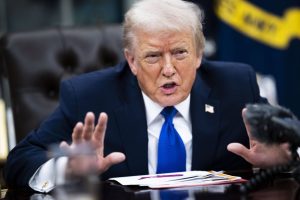


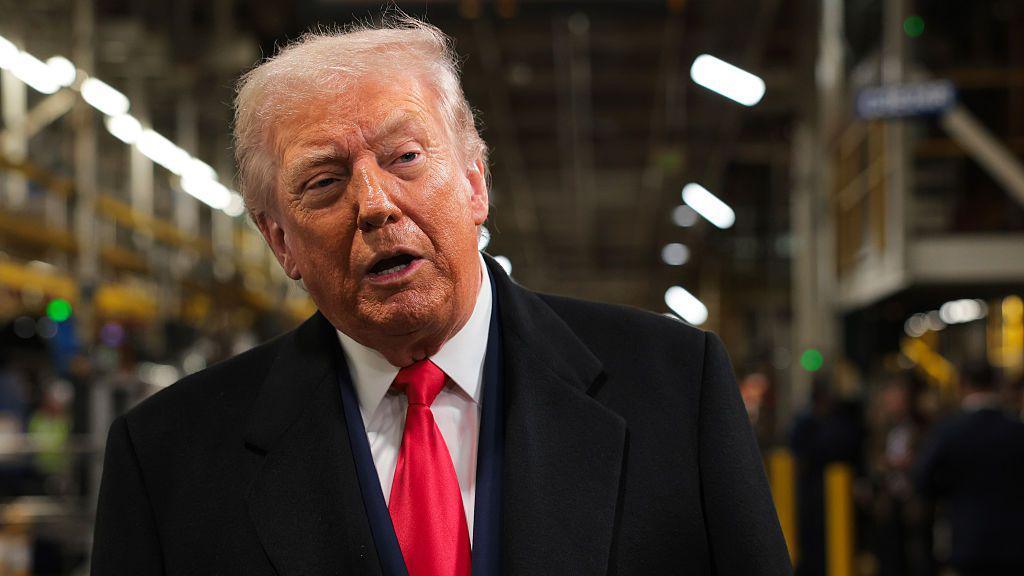
The Ford worker who found himself at the center of a viral confrontation with President Donald Trump during a factory visit in Michigan has broken his silence after being suspended from his job. The moment, captured on video and rapidly shared across social media, shows Trump appearing to mouth an expletive and raise his middle finger toward a heckler in the crowd.
The White House later defended the president’s response as “appropriate,” framing the exchange as a reaction to what it described as a hostile outburst. But the man at the center of the storm, identified by multiple outlets as 40-year-old TJ Sabula, says he has “no regrets” about what he said and believes he was punished for embarrassing the president in public.
Sabula, who had worked at the Ford facility, says the encounter was not premeditated. Instead, he described it as a rare moment when he felt compelled to speak directly to power.
“I don’t feel as though fate looks upon you often,” he said in an interview. “And when it does, you better be ready to seize the opportunity. I think I did that.”
The confrontation unfolded during Trump’s tour of the Ford manufacturing plant, a highly choreographed event meant to highlight American industry and economic growth under the administration. Workers lined the walkways as the president moved through the facility, shaking hands, smiling for cameras, and exchanging brief remarks with employees.
Then, from the crowd, a voice rang out.
What was said in full remains unclear from the footage, but witnesses and later reporting indicate that the remark referenced Trump’s handling of the long-running controversy surrounding the Jeffrey Epstein case and the release of related files. The comment was sharp, personal, and unmistakably critical.
Trump stopped, pointed toward the speaker, appeared to mouth an insult, and raised his middle finger before continuing on.
The clip spread rapidly online, generating millions of views within hours. Supporters of the president praised his reaction as authentic and forceful. Critics argued that it was unbecoming of a head of state and symbolized a breakdown in presidential decorum.
Ford quickly issued a statement distancing the company from the exchange.
“We had a great event today and we’re proud of how our employees represented Ford,” said David Tovar, the company’s executive director of corporate communications. “One of our core values is respect, and we don’t condone anyone saying anything inappropriate like that within our facilities. When that happens, we have a process to deal with it, but we don’t get into specific personnel matters.”
That “process,” Sabula says, resulted in his suspension and eventual termination.
He believes the discipline was not merely about workplace conduct, but about political pressure.
“I was targeted for retribution,” he said. “I embarrassed him in front of his friends. That’s what this is about.”
Ford has not publicly confirmed whether Sabula was fired or remains suspended, citing privacy policies. The company has maintained that it does not tolerate disruptive or inappropriate behavior in its facilities, regardless of political context.
Still, the optics have fueled debate about free speech, workplace rights, and the unique tension that arises when a sitting president enters a private workplace.
For Sabula, the consequences were immediate and personal. Overnight, he became a recognizable figure across the internet. Strangers debated his motives, his character, and whether his actions were courageous or reckless. Some hailed him as a symbol of speaking truth to power. Others accused him of seeking attention or violating basic professional norms.
A crowdfunding page appeared within days, aimed at helping him cover expenses while out of work. Messages of support poured in alongside criticism.
“Losing a job is a small price to pay for that moment,” one commenter wrote. “That’s a story he’ll tell forever.”
Others were less sympathetic, arguing that no matter one’s political beliefs, a workplace visit by the president is not the venue for confrontation.
The White House took a firm stance.
“A lunatic was wildly screaming expletives in a complete fit of rage,” said Communications Director Steven Cheung in a statement. “The President gave an appropriate and unambiguous response.”
The language signaled that the administration viewed the incident not as a political disagreement, but as an act of disorder warranting a blunt reply.
The episode lands at a moment when tensions around the Epstein files remain high. Trump has faced pressure from both sides of the political spectrum to release more material connected to the late financier, whose crimes and network of associates continue to provoke public outrage.
The Justice Department recently released a tranche of documents, but many were heavily redacted. That decision sparked criticism from transparency advocates and lawmakers alike. Even figures who appear in the files have called for broader disclosure, arguing that sunlight is the only way to end speculation.
Against that backdrop, Sabula’s outburst tapped into a wider public frustration. For him, the factory floor became an unlikely stage for protest.
He says he was positioned roughly 60 feet from the president when he spoke, close enough to be heard clearly over the ambient noise of the plant.
“I knew he would hear me,” Sabula said. “And he did.”
What followed, in his view, validated the moment.
“The reaction told me everything,” he said. “It meant I got through.”
The incident has reignited long-standing questions about the boundaries between politics and employment. In theory, private companies can discipline workers for conduct that violates internal policies, even if that conduct is political in nature. Free speech protections limit government action, not corporate decisions.
Yet the optics become complicated when the discipline follows an exchange with the most powerful elected official in the country.
Labor advocates argue that employees should not be punished for expressing political views, especially in extraordinary circumstances. Corporate leaders counter that workplaces must remain safe, respectful environments, free from confrontation that could disrupt operations or endanger others.
Ford, for its part, has emphasized that the issue is not ideology but behavior.
Still, the perception of political overtones has proven difficult to dispel.
Sabula’s supporters frame him as an ordinary worker who spoke his mind and paid the price. His critics see someone who knowingly violated workplace norms for a moment of notoriety.
The truth may lie somewhere between.
There is no indication that Sabula planned the encounter in advance or sought to build a media profile. By his own account, he reacted instinctively. Yet he also acknowledges that he understood the risk.
“I knew there could be consequences,” he said. “But some things matter more than comfort.”
The president’s response, meanwhile, reflects the broader style that has defined Trump’s public persona. Supporters often praise his willingness to confront critics directly, seeing it as authenticity. Opponents argue that such moments erode the dignity of the office.
In previous eras, a president making a vulgar gesture toward a citizen would have dominated headlines for weeks. In the current climate, it became another flashpoint in a constant stream of political theater.
What makes this incident distinct is that it occurred not at a rally or campaign event, but inside a private workplace, among employees who did not choose to attend a political gathering.
For many Ford workers, the visit was a chance to see a president in person, not to be drawn into a national controversy. Some reportedly felt uncomfortable that a colleague’s outburst had overshadowed the event.
Others quietly expressed admiration.
The company now finds itself balancing corporate neutrality with the reality that its facilities have become stages for political symbolism.
For Sabula, the outcome is already life-altering. He is no longer employed at the plant. His name is permanently attached to a viral moment. His future career may be shaped by a few seconds of video.
And yet, he remains defiant.
“As far as calling him out,” he said, “no regrets whatsoever.”
Whether history remembers him as a troublemaker, a whistleblower, or simply a footnote in a chaotic political era remains to be seen. What is clear is that a brief exchange on a factory floor has become a prism through which broader questions are being asked: about power and protest, about speech and consequence, and about what it means to confront authority in an age when every moment can be broadcast to the world.
In a country already strained by division, the episode underscores how thin the line has become between personal expression and professional risk. It also highlights the degree to which politics now intrudes into spaces once considered neutral.
A factory visit meant to celebrate manufacturing turned into a national debate about decorum, dissent, and the price of speaking out.
For one man, it cost a job.
For the president, it became another emblem of a governing style that thrives on confrontation.
And for the public, it offered yet another reminder that in modern America, even a workplace can become a battleground for the culture war—often in the span of a single, unguarded moment.

Emily Johnson is a critically acclaimed essayist and novelist known for her thought-provoking works centered on feminism, women’s rights, and modern relationships. Born and raised in Portland, Oregon, Emily grew up with a deep love of books, often spending her afternoons at her local library. She went on to study literature and gender studies at UCLA, where she became deeply involved in activism and began publishing essays in campus journals. Her debut essay collection, Voices Unbound, struck a chord with readers nationwide for its fearless exploration of gender dynamics, identity, and the challenges faced by women in contemporary society. Emily later transitioned into fiction, writing novels that balance compelling storytelling with social commentary. Her protagonists are often strong, multidimensional women navigating love, ambition, and the struggles of everyday life, making her a favorite among readers who crave authentic, relatable narratives. Critics praise her ability to merge personal intimacy with universal themes. Off the page, Emily is an advocate for women in publishing, leading workshops that encourage young female writers to embrace their voices. She lives in Seattle with her partner and two rescue cats, where she continues to write, teach, and inspire a new generation of storytellers.