


A widespread Verizon outage left hundreds of thousands of Americans struggling to make calls, send messages, or access mobile data on Wednesday, after phones across the country abruptly dropped their connections and switched into “SOS” mode. The disruption, which began shortly after noon Eastern Time, triggered an immediate surge of complaints from customers who found themselves suddenly cut off from normal service.
By early afternoon, more than 180,000 reports had been logged on Downdetector, a website that tracks user-reported outages across major platforms and utilities. The number fluctuated throughout the day, but remained well above typical levels for Verizon, indicating a broad and sustained network failure rather than a localized issue.
Verizon confirmed the problem in public statements, acknowledging that some customers were experiencing disruptions to both voice and data services.
“We are aware of an issue impacting wireless voice and data services for some customers,” a company spokesperson said. “Our engineers are engaged and are working to identify and solve the issue quickly. We understand how important reliable connectivity is and apologize for the inconvenience.”
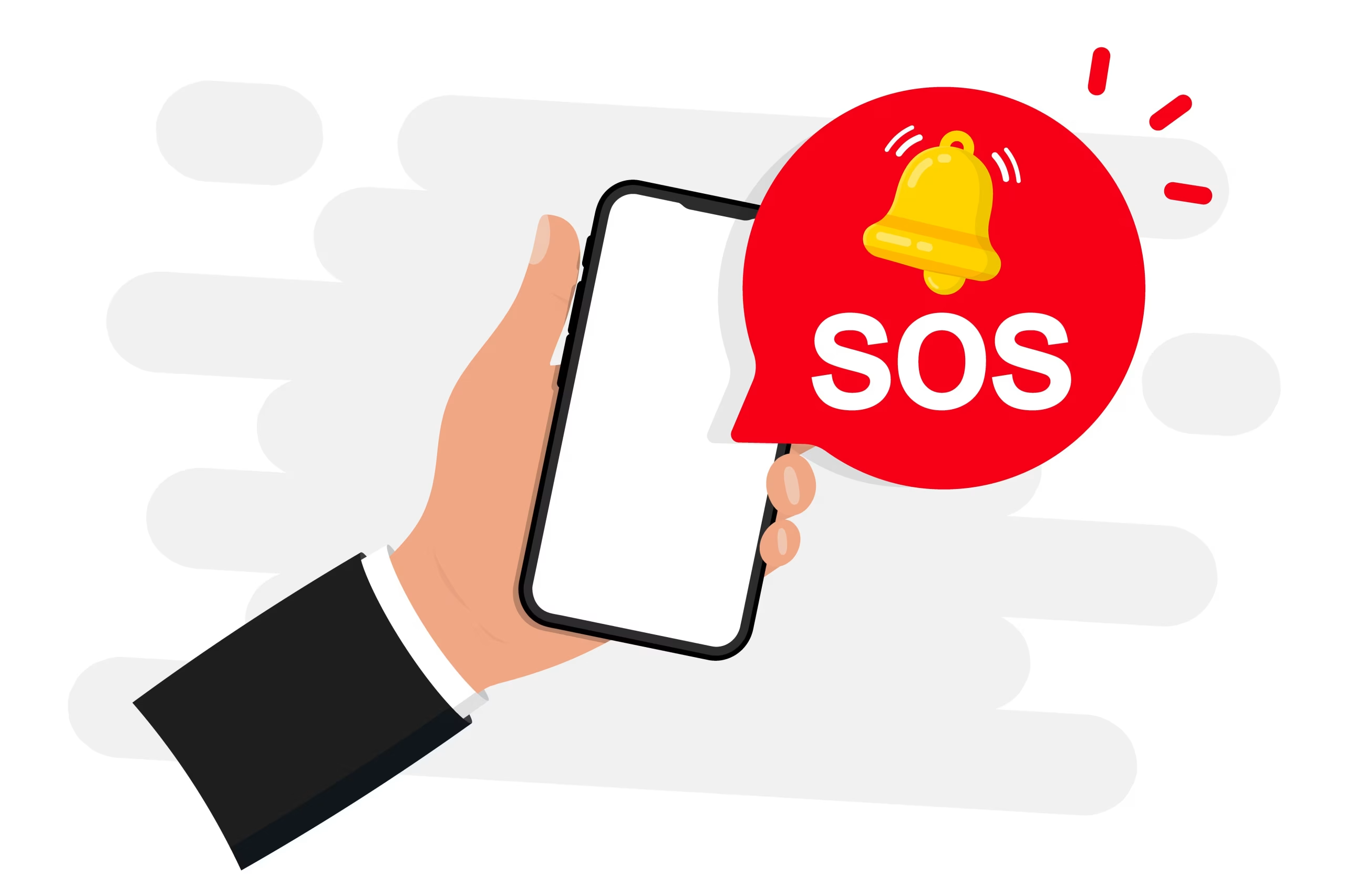
For many users, the most alarming aspect of the outage was the way their devices behaved. Phones did not simply lose signal; instead, they entered “SOS” mode—a setting typically reserved for emergencies when a device cannot connect to its primary carrier but can still attempt to place emergency calls using any available network.
On iPhones, the “SOS” indicator replaces the usual carrier name and signal bars, signaling that normal service is unavailable. On Android devices, similar warnings appeared, leaving users confused and concerned about whether their phones were still functional.
“I thought something was wrong with my phone at first,” said one Verizon customer in Chicago. “Then I looked online and realized everyone else was dealing with the same thing. No calls, no texts, no data. It was like the network just vanished.”
Across social media platforms, customers shared screenshots of their phones showing “SOS” at the top of their screens, often accompanied by messages of frustration, disbelief, and anxiety. Some reported being unable to contact family members, employers, or medical providers. Others worried about what would happen if they needed help during the outage.
“I’m on call for work and I can’t receive any messages,” one user wrote. “This isn’t just inconvenient—it’s dangerous.”
The outage appeared to affect users nationwide, though Verizon did not provide a detailed breakdown of impacted regions. The company’s own Network Status map showed no obvious spikes or regional anomalies earlier in the day, adding to the confusion about what exactly had gone wrong.
While Verizon was the carrier most heavily impacted based on reports, customers from other major providers, including AT&T and T-Mobile, also began logging issues around the same time. Those reports were significantly fewer, however, suggesting that Verizon bore the brunt of the disruption.
Experts caution that Downdetector numbers do not directly translate into the total number of affected customers. The platform relies on voluntary reports, meaning the true scale of the outage could be much larger—or, in some areas, smaller—than the raw figures suggest. Still, a spike of more than 180,000 reports in a short window is typically indicative of a major incident.
For many, the event revived memories of a nationwide Verizon outage in late 2024 that left more than 100,000 users without service at its peak. During that incident, iPhones also became stuck in “SOS” mode, prompting similar confusion and concern.
Those earlier disruptions were eventually traced to internal network issues, though Verizon never released a detailed technical explanation for public consumption. Customers now wonder whether the company has resolved the underlying vulnerabilities that allowed such failures to occur.
“Once is understandable,” said a small business owner in Texas. “Twice starts to feel like a pattern. My business depends on my phone. If I can’t rely on it, that’s a serious problem.”
Modern life is deeply intertwined with mobile connectivity. Smartphones serve as navigation tools, payment devices, workstations, and lifelines in emergencies. When a carrier the size of Verizon—one of the largest wireless providers in the United States—experiences a significant outage, the ripple effects extend far beyond inconvenience.
Delivery drivers lose access to routing apps. Healthcare workers miss critical calls. Parents are unable to reach children. Employers cannot contact staff. In rural areas, where landlines are increasingly rare, mobile phones may be the only practical means of communication.
The sudden switch to “SOS” mode amplified anxiety for many users. Although emergency calling remains available in that state, the visual cue suggests a complete loss of normal service, leaving people unsure whether their devices are functioning correctly or whether help would be available if needed.
“I kept restarting my phone,” said a college student in Ohio. “I thought it was broken. I didn’t realize it was the network until I checked on another device.”
Verizon did not immediately disclose what caused the outage, and as of Wednesday evening, the company had not provided a technical explanation. Industry analysts say such disruptions can stem from a wide range of factors, including software updates gone wrong, hardware failures in core network infrastructure, misconfigured routing systems, or issues related to authentication servers that verify devices on the network.
Even a small error in a centralized system can cascade across a nationwide network, particularly in modern architectures where services are heavily virtualized and interdependent. While this design allows for flexibility and rapid scaling, it can also introduce single points of failure if not carefully managed.
“Telecom networks are among the most complex systems in the world,” said one former network engineer. “A misconfiguration in a core component can propagate very quickly. The challenge is building in enough redundancy and safeguards to prevent that from happening.”
Customers, however, are less concerned with the technical nuances than with reliability. Many pay premium prices for Verizon’s service precisely because of the company’s long-standing reputation for strong coverage and dependability.
That reputation has been built over decades through aggressive infrastructure investment and marketing that emphasizes network strength. When outages occur, they strike at the core of that brand promise.
In online forums, some users questioned whether the company’s push into new technologies—such as 5G expansion and network virtualization—has introduced new vulnerabilities.
“Every time they upgrade something, it feels like something else breaks,” one commenter wrote. “I don’t care how fast my data is if it doesn’t work at all.”
Others were more forgiving, acknowledging the complexity of nationwide systems while still urging transparency.
“Stuff happens,” a user posted. “But tell us what’s going on. Don’t just say ‘we’re working on it’ for hours.”
Verizon’s customer support channels were quickly overwhelmed. Many users reported long wait times or an inability to reach representatives at all. Those who did connect often received generic responses advising them to restart their devices or wait for service to be restored.
By mid-afternoon, some customers began reporting partial improvements, with signal returning in certain areas. Downdetector’s graphs showed a gradual decline in new reports, though the numbers remained elevated compared to normal levels.
For users who regained service, relief was tempered by lingering uncertainty.
“It’s back now, but I don’t trust it,” said a New Jersey resident. “What if it happens again tonight?”
The incident has reignited broader conversations about the resilience of critical communication infrastructure. While power grids, water systems, and transportation networks are often discussed as essential services, mobile networks have quietly become just as vital.
During natural disasters, public emergencies, and everyday crises, people rely on their phones to summon help, receive alerts, and coordinate with others. A widespread outage, even if temporary, highlights how fragile that dependence can be.
Regulators have previously scrutinized major carriers after large-scale failures, particularly when emergency services are impacted. In past cases, telecom companies have been required to submit detailed reports explaining what went wrong and how similar incidents will be prevented in the future.
Whether Wednesday’s outage will trigger such action remains unclear. Much may depend on how long the disruption lasts, how many customers are ultimately affected, and whether emergency communications were significantly impaired.
For now, Verizon customers are left waiting for answers.
Some have already begun exploring alternatives, at least emotionally. “I’ve been with Verizon for ten years,” one customer wrote. “But if this keeps happening, I’m going to start shopping around.”
Others remain loyal but wary, hoping the company will provide a clear explanation and demonstrate that the issue has been fully resolved.
As evening approached, Verizon continued to assure customers that engineers were actively working on the problem. No firm timeline for full restoration was provided, and the company did not specify whether the root cause had been identified.
In the absence of concrete information, speculation filled the void. Some blamed cyberattacks. Others pointed to recent software updates. A few wondered whether the outage was connected to broader infrastructure changes occurring across the telecommunications industry.
What is certain is that the incident exposed how quickly digital normalcy can unravel. In a matter of minutes, millions of people were reminded that the invisible systems powering daily life are not infallible.
For many, the experience was a brief inconvenience. For others, it was a serious disruption. For Verizon, it is another test of whether it can maintain the reliability that has long defined its place in the market.
As service gradually returns, customers will be watching closely—not just to see when their signal bars reappear, but to judge whether the trust they place in their network has been shaken for good.

Emily Johnson is a critically acclaimed essayist and novelist known for her thought-provoking works centered on feminism, women’s rights, and modern relationships. Born and raised in Portland, Oregon, Emily grew up with a deep love of books, often spending her afternoons at her local library. She went on to study literature and gender studies at UCLA, where she became deeply involved in activism and began publishing essays in campus journals. Her debut essay collection, Voices Unbound, struck a chord with readers nationwide for its fearless exploration of gender dynamics, identity, and the challenges faced by women in contemporary society. Emily later transitioned into fiction, writing novels that balance compelling storytelling with social commentary. Her protagonists are often strong, multidimensional women navigating love, ambition, and the struggles of everyday life, making her a favorite among readers who crave authentic, relatable narratives. Critics praise her ability to merge personal intimacy with universal themes. Off the page, Emily is an advocate for women in publishing, leading workshops that encourage young female writers to embrace their voices. She lives in Seattle with her partner and two rescue cats, where she continues to write, teach, and inspire a new generation of storytellers.