NOTE: VIDEO INSIDE THE ARTICLE
President Donald Trump found himself in an unusual and widely reported moment during a press conference on Friday, January 9, that combined substantive foreign policy remarks with what some observers are calling a remarkable gaffe. Speaking to a packed room of journalists and oil industry executives, Trump addressed questions on Venezuela’s oil reserves and his administration’s strategic intentions, touched on his long-standing interest in Greenland, and even took time to admire a new presidential ballroom under construction at the White House — all while inadvertently reading a private note aloud in front of the press.
The scene unfolded at a briefing held to discuss the United States’ post-Venezuela strategy, particularly the economic and energy opportunities presented by Venezuela’s vast crude oil deposits, widely regarded as the largest proven reserves in the world. The session was meant to convey confidence to energy-industry leaders and reporters about U.S. plans for exploiting those resources now that Venezuelan President Nicolás Maduro has been captured and transported to the United States to face criminal charges. But one moment quickly eclipsed the policy discussion.
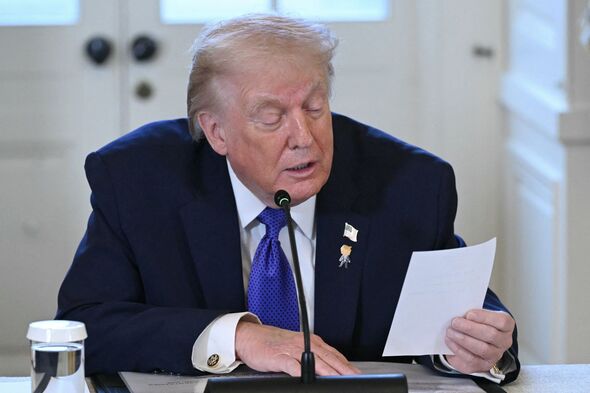
During the meeting, Secretary of State Marco Rubio handed Trump a small piece of paper intended for his eyes only. The note was meant to guide the president on an upcoming topic transition, but Trump — apparently unaware that it was not for public consumption — held it up and read it aloud for everyone in the room to hear. He prefaced his reading by saying simply, “Marco just gave me a note,” and then proceeded to speak its contents: a brief instruction directing him to return to discussions with Chevron, the major American oil company. Trump then quipped, “Go ahead, I’m going back to Chevron. Thank you, Marco,” causing visible discomfort among aides and eliciting reactions from reporters. Many in the room were stunned as the president turned what was supposed to be a private cue into an impromptu public statement.
Rubio, who had handed the note to the president, appeared uncomfortable. His expression suggested surprise at Trump’s decision to read the message aloud, but Trump responded by slapping him on the back and laughing, seemingly treating the blunder as light-hearted. The moment quickly became the focus of media attention and public commentary, with analysts and commentators describing it as a significant misstep for a president already under intense scrutiny for his foreign policy agenda.
Despite the distraction, the official subject matter of the press conference centered on two issues that have dominated Trump’s foreign policy in recent weeks: Venezuela and Greenland. On Venezuela, Trump reiterated his interest in tapping into the country’s oil wealth and incentivizing U.S. and international energy companies to enter or expand operations there. Chevron was highlighted repeatedly because it already produces hundreds of thousands of barrels of crude per day in Venezuela under existing arrangements. Trump made clear that he sees Venezuela’s oil production as not only a strategic asset for the United States but also as a way to stabilize energy markets and strengthen American economic interests globally.
Trump’s comments echoed earlier statements in which he said the United States would “run” Venezuela in the interim following Maduro’s detention and that U.S. oil companies should be assured of profits and security before investing billions of dollars into rebuilding infrastructure and refining capacity. These remarks reinforced the administration’s broader narrative that U.S. involvement in Venezuela — including military actions and the removal of Maduro — will open the door for American economic leadership in the region.
But the president’s focus on Venezuela was only half of the foreign policy discussion that day. Trump also reiterated his long-standing and increasingly contentious interest in acquiring Greenland, an autonomous territory of Denmark. Over the past year, he has publicly argued that the United States “needs” Greenland for strategic reasons, citing concerns about Russian and Chinese influence in the Arctic and the region’s importance to national defense. During the press conference, Trump declined to rule out forceful measures for gaining control of the territory, saying that if the United States did not act, rival powers might fill the void.
These comments sparked immediate controversy. Greenland’s government, as well as Danish and European officials, swiftly rejected the notion that the territory could be subjected to any form of American takeover. Leaders emphasized that Greenland is part of the Kingdom of Denmark and firmly defended its sovereignty. They underscored that Greenland’s defense arrangements are anchored within NATO — a mutual defense alliance — and any suggestion of unilateral American seizure was dismissed as a violation of international law and alliance commitments.
European officials and analysts expressed deep concern that Trump’s rhetoric surrounding Greenland could undermine the cohesion of NATO at a time when unity is considered critical in the face of Russian and Chinese geopolitical competition. Denmark’s prime minister and Greenland’s leadership both issued statements affirming that the island’s defense should remain under the collective NATO framework, and that any attempt to circumvent international norms would jeopardize long-standing transatlantic security ties. They stressed that Greenland’s role within the alliance should be strengthened, and that any discussions about territorial acquisition must respect sovereign rights and established diplomatic processes.
Beyond foreign policy matters, Trump’s press conference also featured a notable visual aside: he paused to look out of a window at the construction of a new ballroom at the White House. The project, which has involved significant renovation and demolition of historic parts of the executive mansion, has itself become a source of public debate. Trump, clearly proud of the development, invited members of the press to gaze upon the progress, boasting that the ballroom was “ahead of schedule and under budget” and predicting there would be “nothing like it in the world.” The moment, juxtaposed with the seriousness of the geopolitical discussion, underscored the unique blend of domestic and international priorities that have come to define his presidency.
Critics of Trump’s approach argue that focusing on construction projects at the White House while proposing radically transformative foreign endeavors — such as acquiring Greenland or overhauling the political landscape of Venezuela — betrays a misalignment of priorities. They contend that resources and leadership should be concentrated on pressing domestic issues such as economic inequality, health care costs, and infrastructure investment, rather than on grand territorial ambitions or symbolic architectural statements.
Supporters, however, view the president’s willingness to openly discuss contentious strategies as a demonstration of bold leadership. They argue that strengthening American economic and strategic interests abroad — through energy independence in Venezuela and geopolitical positioning in the Arctic — is essential in a multipolar world. For these allies, Trump’s remarks reinforce his reputation as a leader unafraid to challenge conventional diplomatic norms and pursue what he believes to be national strategic interests.
The press conference thus encapsulated several defining themes of Trump’s current presidency: an assertive foreign policy agenda, unconventional communication style, and a blend of high-stakes international ambitions with idiosyncratic personal flair. By publicly reading a private note, Trump inadvertently highlighted his unique relationship with the media and underscored the unpredictable nature of his public persona, even as he tackled weighty matters of national interest.
In the days since the briefing, reactions have continued to pour in from across the political spectrum. Commentators have grappled with both the substantive implications of Trump’s foreign policy intentions and the symbolic impact of his public missteps. Some see the moment as a distraction from critically important geopolitical questions; others view it as emblematic of a broader shift in how presidents engage with journalists, political allies, and the global community.
As debate continues, two issues stand out as central to understanding Trump’s objectives: the future of Venezuela and the future of Greenland. On Venezuela, the administration appears intent on leveraging recent military and diplomatic actions to secure long-term strategic and economic influence. On Greenland, the focus has shifted international relationships and raised fundamental questions about sovereignty, alliance obligations, and the limits of presidential authority.
Whether Trump’s ambitious visions for these regions will come to fruition remains uncertain, but the press conference — and the inadvertent reading of a private note — has ensured that these topics stay at the forefront of national and global conversation. What is clear is that the president’s approach continues to be as controversial as it is headline-grabbing, with far-reaching implications for U.S. foreign policy and international stability.

Emily Johnson is a critically acclaimed essayist and novelist known for her thought-provoking works centered on feminism, women’s rights, and modern relationships. Born and raised in Portland, Oregon, Emily grew up with a deep love of books, often spending her afternoons at her local library. She went on to study literature and gender studies at UCLA, where she became deeply involved in activism and began publishing essays in campus journals. Her debut essay collection, Voices Unbound, struck a chord with readers nationwide for its fearless exploration of gender dynamics, identity, and the challenges faced by women in contemporary society. Emily later transitioned into fiction, writing novels that balance compelling storytelling with social commentary. Her protagonists are often strong, multidimensional women navigating love, ambition, and the struggles of everyday life, making her a favorite among readers who crave authentic, relatable narratives. Critics praise her ability to merge personal intimacy with universal themes. Off the page, Emily is an advocate for women in publishing, leading workshops that encourage young female writers to embrace their voices. She lives in Seattle with her partner and two rescue cats, where she continues to write, teach, and inspire a new generation of storytellers.