



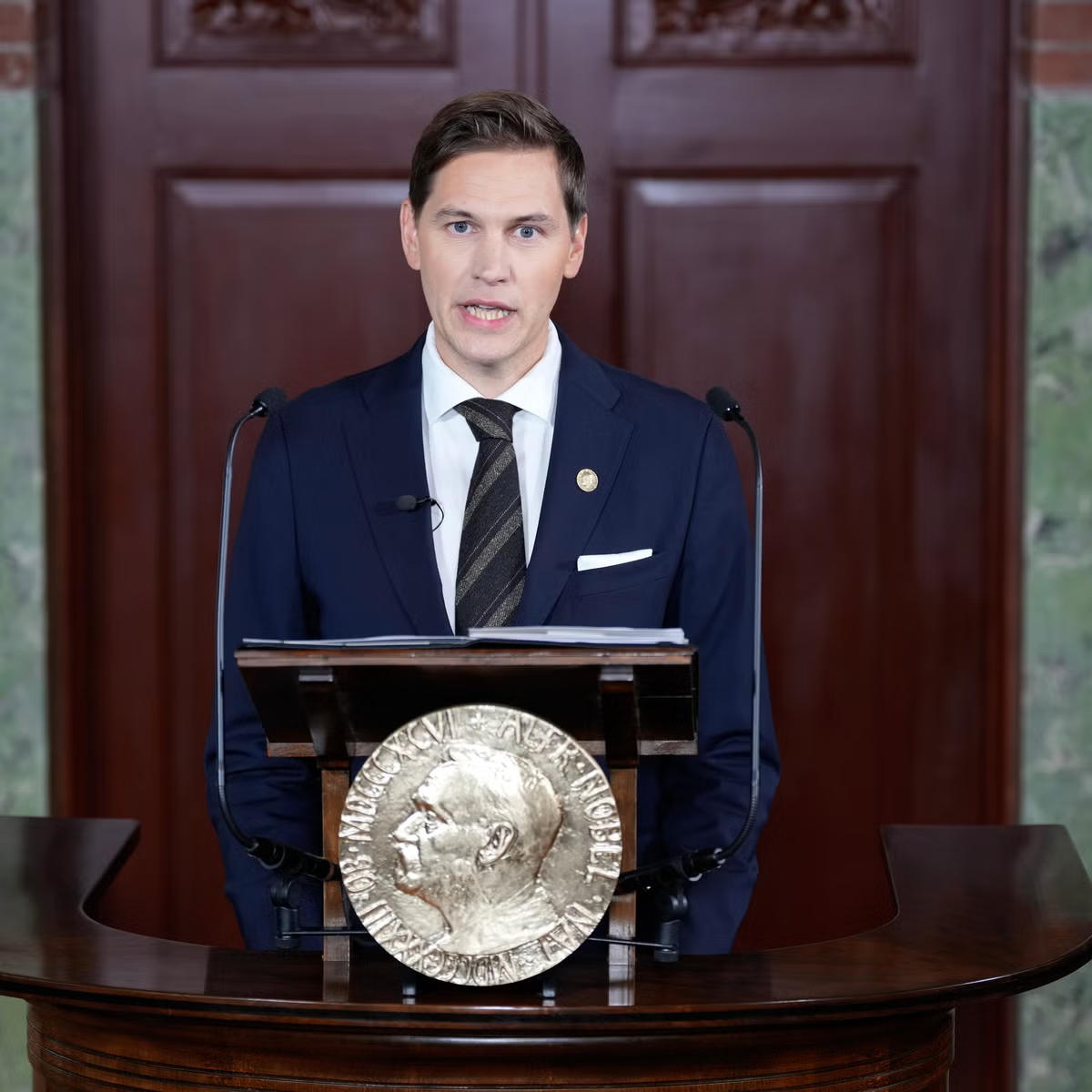
A rare intervention by Norway’s Nobel Committee has shut down a growing political spectacle in Washington, after behind-the-scenes maneuvering sparked speculation that the Nobel Peace Prize could somehow be rerouted to the sitting U.S. president.
For weeks, discussion inside political and media circles has centered on the president’s public frustration at never receiving the world’s most prestigious peace award. He has repeatedly argued that his foreign policy achievements—claims that he has “ended eight wars” and reshaped global power balances—have been ignored by an establishment that, in his view, favors ideological opponents.
That frustration escalated following dramatic developments in Venezuela. After a U.S.-led operation removed longtime leader Nicolás Maduro and transported him to New York to face charges tied to narco-terrorism, the international spotlight turned to the country’s opposition figure who had just been awarded the Nobel Peace Prize for her resistance against authoritarian rule.
In an unprecedented move, the newly crowned laureate publicly suggested she would hand the prize to the American president, praising his actions as historic and decisive. The offer immediately fueled speculation: Could a Nobel Prize be transferred? Could a sitting president effectively receive it “through the back door”?
The Nobel Committee’s answer was swift and unambiguous.
In its first-ever public clarification on the subject, the organization stated that once a Nobel Peace Prize is awarded, it is permanent and immutable. It cannot be revoked, shared, or transferred—under any circumstances. The statement emphasized that the decision “stands for all time,” closing off any legal or procedural path for the prize to change hands.
The clarification was extraordinary in itself. The committee rarely comments on hypothetical scenarios or political controversies. That it felt compelled to do so reflects how seriously it viewed the growing narrative that the prize might be reassigned.
The episode underscores the intensity of the president’s fixation on the award. He has openly criticized the Nobel Committee in the past, calling it biased and “foolish” for honoring figures he considers undeserving. This week, he renewed those attacks after learning that the prize had gone to a Venezuelan opposition leader rather than to him.
That leader, María Corina Machado, has since become a central figure in the controversy. Awarded the prize for her decades-long struggle against authoritarianism, she stunned observers by dedicating the honor to the U.S. president, arguing that his intervention in Venezuela achieved what many believed was impossible.
In a televised interview, she said the moment she learned of her victory, she “dedicated it” to him, declaring that January 3 would “go down in history as the day justice defeated tyranny.” She described the removal of Maduro as not only a victory for Venezuelans, but as a milestone for humanity, freedom, and human dignity.
Her words resonated powerfully within conservative media and among the president’s allies. To them, the offer symbolized international validation of American strength and leadership. To critics, it appeared as political theater—an attempt to curry favor with a superpower now exerting unprecedented influence over Venezuela’s future.
The president, for his part, welcomed the gesture. He told reporters and television hosts that he had heard about the offer and that it “could be a great honor.” He later confirmed that the Nobel laureate is expected to visit Washington in the coming days, describing the prospect of meeting her as something he “look[s] forward to.”
Yet the Nobel Committee’s statement ensures that, ceremonially and legally, nothing can come of it.
Even if the laureate were to physically present her medal and diploma, the prize would remain hers in the eyes of history and international law. The Nobel statutes do not allow reassignment. There is no mechanism for transfer. The award is inseparable from the individual named at the time of announcement.
This moment reveals a deeper tension between political power and symbolic legitimacy. The Nobel Peace Prize has long been controversial, often criticized for its choices and timing. Yet it remains a unique moral currency in global politics—one that cannot be commanded by force or acquired through leverage.
For the president, the prize represents something beyond recognition: a seal of historical vindication. Supporters argue that his actions have reshaped geopolitics and saved lives. Opponents counter that many of his claims are exaggerated or rooted in destabilizing strategies rather than peacebuilding.
The committee’s intervention draws a clear boundary between those competing narratives and the institution itself. It signals that the Nobel Peace Prize cannot be bent by diplomatic pressure, personal appeals, or dramatic gestures—even from those at the apex of global power.
In that sense, the episode may have lasting significance. It is not merely about one leader’s desire for a trophy, but about whether symbolic authority can be coerced in an era of hard power and spectacle.
The answer, at least for now, is no.
No matter how extraordinary the events in Venezuela become, no matter how emphatic the praise from allies abroad, and no matter how public the president’s longing for the honor grows, the Nobel Peace Prize remains fixed in place—attached forever to the name first read aloud in Oslo.

Emily Johnson is a critically acclaimed essayist and novelist known for her thought-provoking works centered on feminism, women’s rights, and modern relationships. Born and raised in Portland, Oregon, Emily grew up with a deep love of books, often spending her afternoons at her local library. She went on to study literature and gender studies at UCLA, where she became deeply involved in activism and began publishing essays in campus journals. Her debut essay collection, Voices Unbound, struck a chord with readers nationwide for its fearless exploration of gender dynamics, identity, and the challenges faced by women in contemporary society. Emily later transitioned into fiction, writing novels that balance compelling storytelling with social commentary. Her protagonists are often strong, multidimensional women navigating love, ambition, and the struggles of everyday life, making her a favorite among readers who crave authentic, relatable narratives. Critics praise her ability to merge personal intimacy with universal themes. Off the page, Emily is an advocate for women in publishing, leading workshops that encourage young female writers to embrace their voices. She lives in Seattle with her partner and two rescue cats, where she continues to write, teach, and inspire a new generation of storytellers.