


Texas officials have issued a statewide warning urging residents not to plant or handle unsolicited seed packages arriving from China, as authorities investigate a growing number of reports involving mysterious mail deliveries that could pose risks to agriculture, the environment, and public safety.
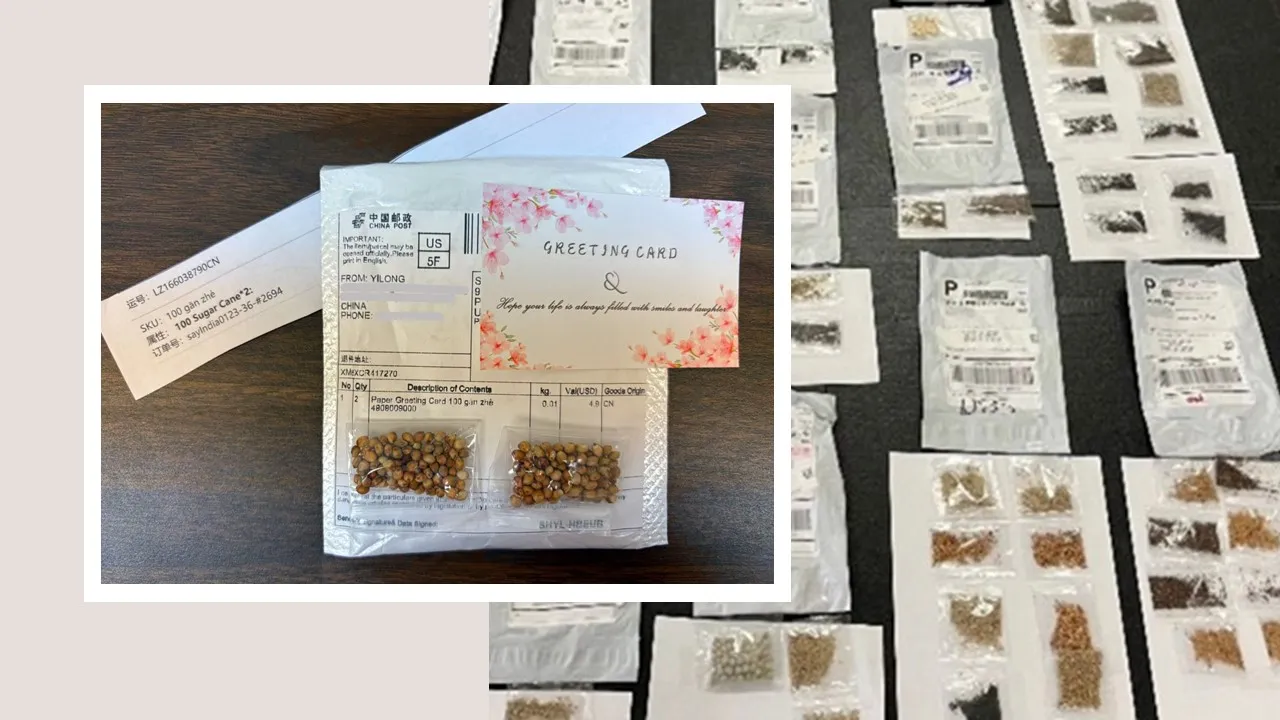
The advisory comes after hundreds of Texans reported receiving packages they never ordered, often labeled as household goods or small accessories, but containing unknown seeds instead. State officials say what may appear harmless at first glance could have serious consequences if the seeds are planted or improperly discarded.
“At a glance, this might seem like a small problem, but this is serious business,” Texas Agriculture Commissioner Sid Miller said in a statement. “The possible introduction of an invasive species poses real risks to Texas families and our agriculture industry.”
How the Issue First Emerged
The problem first came to the attention of the Texas Department of Agriculture in early 2025, when a resident in the coastal city of Clute reported receiving a package from an unknown sender in China. The parcel contained unidentified seeds and a small container of liquid.
Since that initial report, the scope of the issue has expanded significantly. State officials say they have now collected more than 1,100 packets of unsolicited seeds delivered to 109 different locations across Texas. The most recent collection occurred just days before the new year, signaling that the shipments are ongoing rather than isolated incidents.
Authorities are working with federal partners to test and safely dispose of the materials while trying to determine their origin and intent.
Why Officials Are Concerned
Agriculture experts say that introducing unknown plant species into local ecosystems can have devastating effects. Invasive plants can crowd out native species, disrupt wildlife habitats, spread plant diseases, and damage crops relied upon by farmers and ranchers.
Texas, with its vast agricultural footprint and diverse ecosystems, is particularly vulnerable. The state leads the nation in cattle production and is a major producer of cotton, corn, sorghum, and vegetables. Even a small number of invasive plants could spread rapidly if conditions are favorable.
Beyond environmental harm, officials note that importing seeds without proper authorization may violate federal and state regulations designed to protect food systems and livestock.
A Nationwide Pattern
Texas is not alone. Similar warnings were issued last year by officials in Ohio, New Mexico, and Alabama after residents in those states reported receiving unsolicited seed packages.
In Alabama, state agriculture officials later identified some of the seeds as tomato and onion varieties. While testing did not reveal harmful chemicals or toxins, authorities still cautioned residents against planting them.
“These seeds may be invasive or harmful to livestock,” Alabama Agriculture Commissioner Rick Pate said at the time, stressing that even common plant varieties can become problematic if introduced outside regulated channels.
The repeated reports across multiple states have raised concerns that the phenomenon is part of a broader pattern rather than a series of random mistakes.
Not the First Time This Has Happened
This is also not the first time Americans have encountered mysterious seed mailings. In 2020, all 50 states issued warnings after thousands of households received unsolicited seed packets, many processed through China Post, the official postal service of the Chinese government.
At the height of the COVID-19 pandemic, some recipients feared the seeds could carry diseases. Investigations later suggested another explanation.
The United States Department of Agriculture determined that many of the shipments were likely tied to a global “brushing scam.” In such schemes, online sellers mail low-value items to random addresses so they can post fake reviews under the name of a “verified buyer,” boosting their product ratings and sales.
However, officials stress that even if the intent is fraudulent rather than malicious, the risks associated with unregulated seed distribution remain real.
Global Reach of the Seed Mystery
Reports of unsolicited seed deliveries have not been limited to the United States. Households in several European Union countries, the United Kingdom, Canada, and parts of the Indo-Pacific region—including Australia and Taiwan—have also reported receiving similar packages in recent years.
This global spread has complicated efforts to pinpoint responsibility or determine whether newer shipments represent a continuation of past scams or something else entirely.
Texas officials say they are not ruling out any possibilities as they work with federal agencies to analyze the seeds and trace shipment patterns.
What Residents Should Do
State and federal authorities are clear in their guidance: do not open the packages, do not plant the seeds, and do not throw them away in regular household trash.
Residents who receive unsolicited seed packages are urged to contact their local agriculture department immediately. Proper handling and disposal are critical to preventing accidental spread.
“Whether it’s part of an ongoing scam or something more sinister, we are determined to protect Texans,” Commissioner Miller said. “Unsolicited seeds coming into our country are a risk to American agriculture, our environment, and public safety.”
Officials say discarded seeds could still germinate in landfills or compost facilities, allowing invasive species to take root far from their original delivery sites.
Federal Coordination and Ongoing Testing
Texas authorities are coordinating with federal partners to collect, test, and safely dispose of the seed packets. Testing focuses on identifying plant species, detecting potential pests or pathogens, and determining whether any biosecurity threats exist.
While no harmful compounds have been publicly confirmed in the Texas cases so far, officials emphasize that the absence of immediate danger does not eliminate long-term risks.
Agriculture departments across the country are also sharing data to determine whether shipment patterns suggest coordinated distribution.
Why Awareness Matters
Experts say public awareness is one of the most effective tools in preventing harm. Many recipients initially assume the packages were sent by mistake and consider planting the seeds out of curiosity.
That single decision, officials warn, could have lasting consequences.
Invasive species are notoriously difficult and expensive to eradicate once established. Prevention—by stopping unregulated introductions before they begin—is far more effective than cleanup after the fact.
A Caution for the Future
As online commerce continues to expand and international shipping becomes faster and cheaper, officials say incidents like these may become more common.
State leaders are urging residents to remain vigilant, report suspicious deliveries, and resist the temptation to treat mystery packages as harmless novelties.
Texas officials say updates will be shared as testing continues and investigators learn more about the source and purpose of the shipments. For now, the message remains simple and firm: if you didn’t order the seeds, don’t plant them.

Emily Johnson is a critically acclaimed essayist and novelist known for her thought-provoking works centered on feminism, women’s rights, and modern relationships. Born and raised in Portland, Oregon, Emily grew up with a deep love of books, often spending her afternoons at her local library. She went on to study literature and gender studies at UCLA, where she became deeply involved in activism and began publishing essays in campus journals. Her debut essay collection, Voices Unbound, struck a chord with readers nationwide for its fearless exploration of gender dynamics, identity, and the challenges faced by women in contemporary society. Emily later transitioned into fiction, writing novels that balance compelling storytelling with social commentary. Her protagonists are often strong, multidimensional women navigating love, ambition, and the struggles of everyday life, making her a favorite among readers who crave authentic, relatable narratives. Critics praise her ability to merge personal intimacy with universal themes. Off the page, Emily is an advocate for women in publishing, leading workshops that encourage young female writers to embrace their voices. She lives in Seattle with her partner and two rescue cats, where she continues to write, teach, and inspire a new generation of storytellers.