


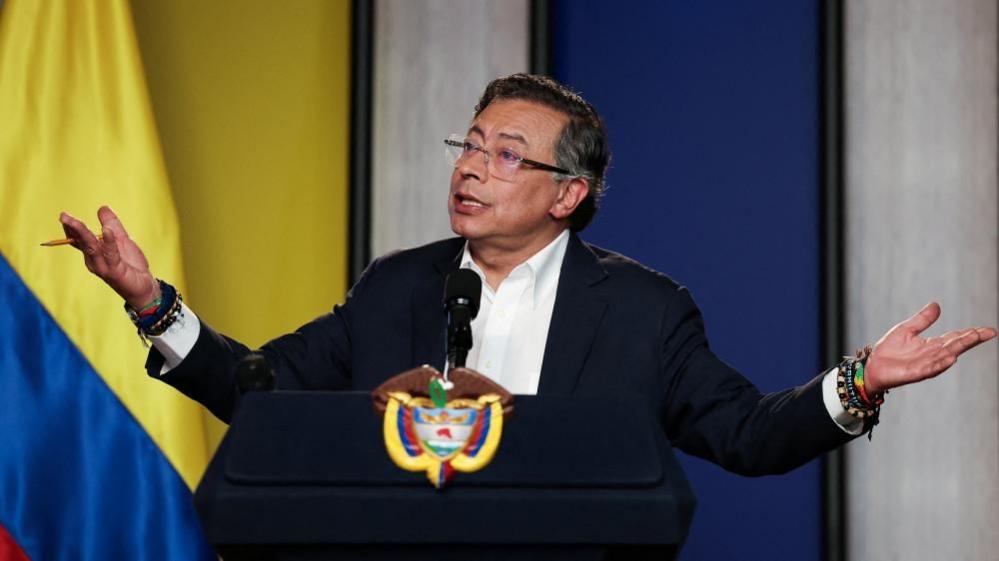
Tensions between the United States and Colombia escalated this week after President Donald Trump publicly accused Colombian President Gustavo Petro of involvement in drug trafficking, suggesting that Colombia could face military action similar to the U.S. operation that captured Venezuelan President Nicolás Maduro.
Speaking aboard Air Force One on January 4, Trump described Colombia as “very sick” and accused its leader of being “a sick man who likes making cocaine and selling it to the United States.” When asked whether Colombia might face intervention akin to the Venezuelan raid conducted just a day earlier, Trump responded, “Sounds good to me,” signaling openness to aggressive measures. He added a pointed warning to Petro, telling him to “watch his ass,” further inflaming tensions.
These remarks starkly contrast with the longstanding cooperation between Colombia and the United States in the fight against drug trafficking. Colombia remains the world’s largest producer of cocaine, and historically, Petro’s administration has worked closely with Washington to combat the cartels. Despite this, Trump’s comments painted Petro as personally implicated in the illegal drug trade, though no credible evidence supports such claims.
Petro’s Response: Denial and Defiance
In response, President Petro vehemently rejected Trump’s allegations. On social media and in public statements, he called the claims “illegitimate” and emphasized that he has never been involved in drug trafficking. Petro highlighted his government’s efforts to dismantle coca cultivation and criminal organizations, including coca eradication programs and direct action against armed groups involved in the drug trade.
Petro pointed to a major operation in which his administration seized 14 tonnes of cocaine, believed to be the largest single seizure in history. He also underscored his military campaigns against Colombia’s illegal armed groups, including the Gulf Clan, the National Liberation Army, and remnants of the FARC, to demonstrate his commitment to law enforcement and public safety.
Addressing the accusations directly, Petro wrote that he is neither “illegitimate” nor a “narco,” noting that his only personal asset is his family home, which he continues to pay for from his presidential salary. He insisted that his bank statements are fully transparent and that he has never spent beyond his income. “I am not greedy,” he asserted, refuting Trump’s portrayal of him as corrupt or complicit in the drug trade.
Warnings Against U.S. Intervention
Petro did not limit his response to denial. He issued a forceful warning about the potential consequences of any U.S. military action. He stated that bombing or military strikes without sufficient intelligence could result in civilian casualties, including children. Targeting farmers or small communities could drive more people into guerrilla groups, further destabilizing Colombia. Petro also warned that attempting to remove him from power could provoke widespread unrest, describing himself as “a commander of the people” and pledging that Colombians would resist any external attack.
In a particularly dramatic declaration, Petro referenced his past involvement with the left-wing M-19 guerrilla group and declared:
“I swore not to touch a weapon again… but for the homeland I will take up arms again.”
He reinforced his resolve with a symbolic warning: “If you arrest the president whom a good part of my people want and respect, you will unleash the popular jaguar,” signaling that U.S. intervention could have severe political and social consequences.
Context and Background
Gustavo Petro became the first left-wing president of Colombia in 2022. Throughout his tenure, he has faced criticism from conservative political circles but has also pushed forward progressive reforms, particularly in the areas of environmental policy, social programs, and anti-narcotics enforcement.
Trump’s threats come in the wake of the high-profile operation in Venezuela, where Nicolás Maduro was captured by U.S. forces and charged with drug trafficking and terrorism. The successful operation has heightened fears in Latin America that other countries with active drug markets could be targeted.
Regional and Diplomatic Reactions
The Trump-Petro confrontation has raised alarm among Latin American governments and international observers. While Colombia’s administration has maintained that it will continue cooperating with the United States on drug interdiction and intelligence sharing, officials emphasized that Colombia’s sovereignty must be respected.
Regional and global leaders have expressed concern that unilateral U.S. intervention could destabilize Latin America. Experts note that aggressive actions against a sovereign nation could disrupt counter-narcotics operations and provoke unintended political and social consequences, potentially strengthening the very groups the interventions are intended to weaken.
Analysis: What This Means for U.S.–Colombia Relations
The exchange between Trump and Petro reflects a growing pattern of assertive U.S. foreign policy in Latin America, particularly when it comes to counter-narcotics operations and regional security. Analysts note that threats of military action against Colombia, a long-standing partner in the fight against drug trafficking, could strain diplomatic relations, reduce cooperation, and undermine shared goals.
For the Colombian public, Petro’s response is as much about domestic perception as it is about international signaling. By presenting himself as a defender of national sovereignty, Petro aims to consolidate political support and rally citizens against perceived foreign threats.
For Washington, the controversy illustrates the delicate balance between aggressive foreign policy rhetoric and the practical realities of maintaining cooperation with key partners in the region. Any military action against Colombia could carry significant diplomatic, legal, and strategic risks, particularly given the country’s established role in international counter-narcotics efforts.
Key Takeaways
-
Trump accused President Petro and Colombia of being heavily involved in cocaine production and sales to the U.S., suggesting military action could be warranted.
-
Petro strongly denied all allegations, emphasizing transparency in his finances and his government’s active role in combating drug trafficking.
-
Petro issued a stark warning about the consequences of U.S. intervention, including civilian casualties, increased guerrilla recruitment, and social unrest.
-
The Colombian president reaffirmed his commitment to defend his country and its sovereignty, even invoking the symbolic language of armed resistance.
-
Despite the rhetoric, Colombia has stressed ongoing cooperation with the United States on counter-narcotics efforts, underlining that the conflict is currently rhetorical rather than operational.
President Gustavo Petro’s defiant stance marks a significant escalation in U.S.–Colombia relations, highlighting the tensions between national sovereignty and foreign policy assertiveness. As both leaders continue to exchange warnings and accusations, the situation underscores the precarious balance of diplomacy, regional security, and the ongoing fight against narcotics in Latin America.

Emily Johnson is a critically acclaimed essayist and novelist known for her thought-provoking works centered on feminism, women’s rights, and modern relationships. Born and raised in Portland, Oregon, Emily grew up with a deep love of books, often spending her afternoons at her local library. She went on to study literature and gender studies at UCLA, where she became deeply involved in activism and began publishing essays in campus journals. Her debut essay collection, Voices Unbound, struck a chord with readers nationwide for its fearless exploration of gender dynamics, identity, and the challenges faced by women in contemporary society. Emily later transitioned into fiction, writing novels that balance compelling storytelling with social commentary. Her protagonists are often strong, multidimensional women navigating love, ambition, and the struggles of everyday life, making her a favorite among readers who crave authentic, relatable narratives. Critics praise her ability to merge personal intimacy with universal themes. Off the page, Emily is an advocate for women in publishing, leading workshops that encourage young female writers to embrace their voices. She lives in Seattle with her partner and two rescue cats, where she continues to write, teach, and inspire a new generation of storytellers.