

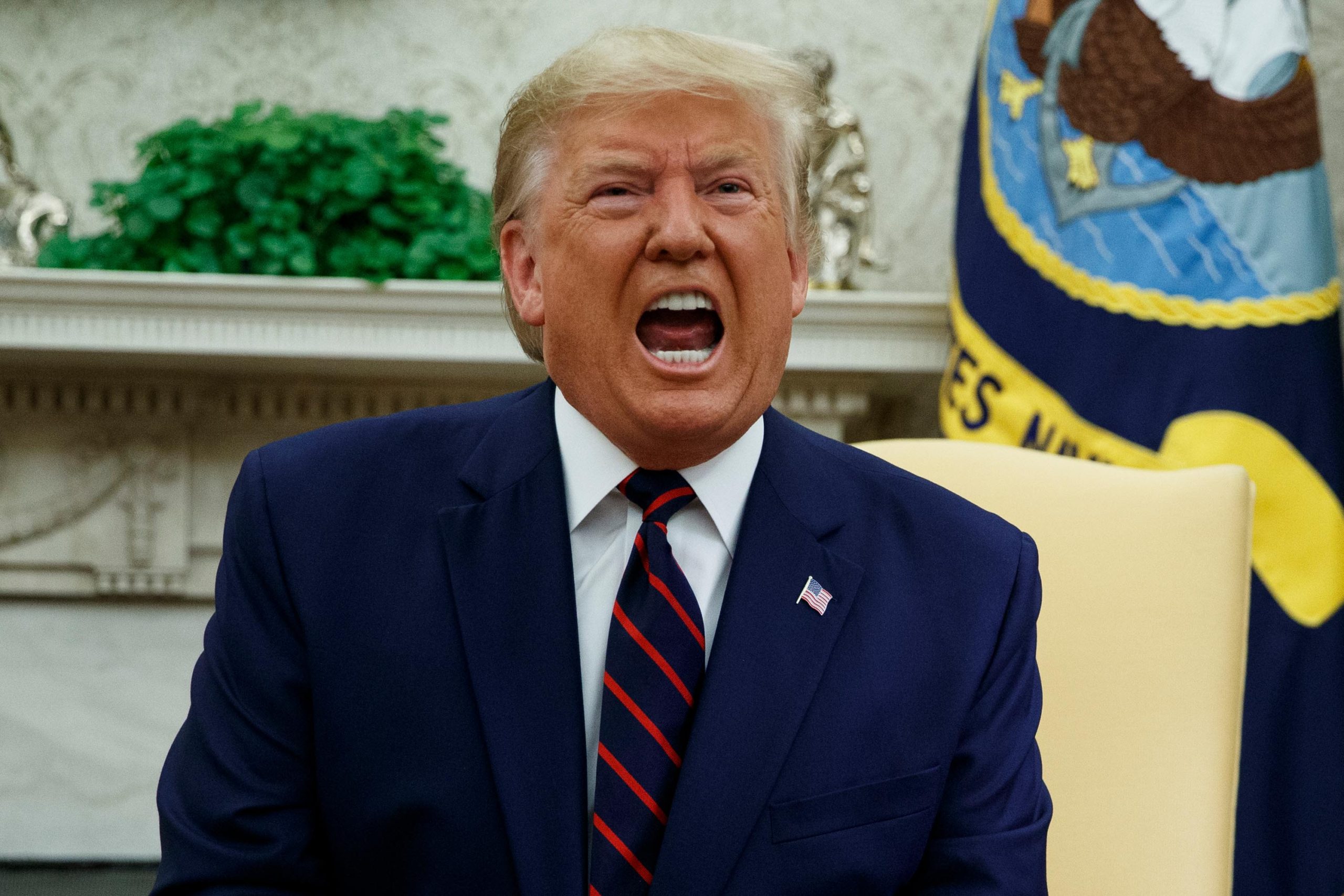
President Donald Trump has issued a sharp warning to Iran, threatening potential U.S. military action if the country’s leadership violently suppresses a growing wave of anti-regime protests that have already turned deadly.
The warning came hours after Trump met with Israeli Prime Minister Benjamin Netanyahu, underscoring escalating tensions in the Middle East as unrest spreads across Iran amid a deepening economic crisis.
Posting on his Truth Social platform, Trump said the United States would not stand by if Iranian authorities use lethal force against demonstrators.
“If Tehran violently kills peaceful protesters, the United States will come to their rescue,” Trump wrote, adding that U.S. forces were “locked and loaded and ready to go.”
Protests Erupt After Currency Collapse
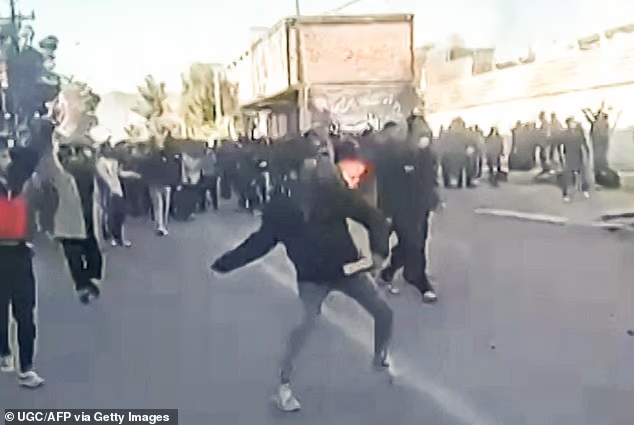
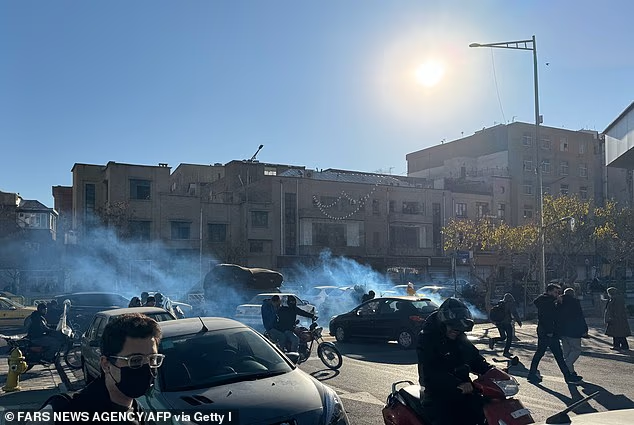
The protests erupted following the sharp collapse of Iran’s rial currency, which has plunged to record lows amid sanctions, inflation, and long-standing economic mismanagement. Demonstrations began in Tehran and quickly spread to other cities, with protesters chanting slogans against the ruling clerical establishment.
According to reports from inside the country, at least seven people have been killed so far as security forces moved to disperse crowds. Iranian authorities have not released detailed casualty figures, but state-linked media have acknowledged “limited unrest” while blaming foreign interference.
The demonstrations mark the most significant public challenge to the government in years, tapping into widespread frustration over unemployment, rising food prices, and international isolation.
Trump Issues Direct Warning
Trump’s comments represent one of his most direct threats toward Iran since returning to office. While stopping short of explicitly declaring military action, his language signaled a willingness to intervene if the situation escalates further.
“We are locked and loaded and ready to go,” Trump wrote, a phrase that immediately drew attention in Washington and foreign capitals.
Administration officials have not clarified what form any “rescue” of protesters might take, though analysts say the rhetoric alone significantly raises the risk of miscalculation between Washington and Tehran.
The remarks came just hours after Trump hosted Netanyahu at his Mar-a-Lago estate on New Year’s Eve, making the Israeli leader the only foreign head of government to meet with Trump during the holiday period.
Iran Blames U.S. and Israel
Iranian officials responded swiftly and angrily to Trump’s statements. Ali Larijani, secretary of Iran’s Supreme National Security Council, accused both the United States and Israel of orchestrating the unrest.
“Intervention by the U.S. in Iran’s domestic problems corresponds to chaos in the entire region and the destruction of U.S. interests,” Larijani wrote on X, a platform banned inside Iran.
“The people of the United States should know that Trump began the adventurism. They should take care of their own soldiers,” he added.
Iranian officials have repeatedly argued that Western intelligence agencies and Israel encourage protests to weaken the regime, claims Washington and Jerusalem deny.
A Long-Running Shadow War
The latest standoff comes against the backdrop of a decades-long proxy conflict between Iran and Israel. For years, the two rivals have fought indirectly through allied militias, cyber operations, and covert strikes across the Middle East.
That shadow war escalated dramatically in 2024, when Iran and Israel exchanged direct missile attacks for the first time, raising fears of a broader regional conflict.
In June, Trump openly backed Israel by authorizing Operation Midnight Hammer, a U.S. military strike involving B-2 bombers that dropped bunker-buster bombs on Iranian nuclear facilities. The operation marked one of the most aggressive U.S. actions against Iran in decades.
Missile Strikes and Retaliation
Following the U.S. strike on three Iranian uranium enrichment facilities, Iran responded by launching ballistic missiles at Al Udeid Air Base in Qatar, which hosts U.S. and allied forces. While no American casualties were reported, the attack underscored how quickly tensions could spiral.
Ali Shamkhani, a close adviser to Iran’s Supreme Leader Ayatollah Ali Khamenei, warned that any further intervention would be met with force.
“Any interventionist hand that gets too close to the security of Iran will be cut,” Shamkhani said in remarks carried by Iranian state media.
The rhetoric reflects a hardening stance within Iran’s leadership as protests continue for a sixth consecutive day.
Domestic Politics Complicate Trump’s Stance
Trump’s warning to Iran also comes at a sensitive moment domestically. Divisions within the Republican Party over U.S. support for Israel have grown more visible, with some hardline MAGA figures criticizing continued military and financial aid.
Rep. Marjorie Taylor Greene and other conservatives have publicly broken with Trump on Middle East policy, arguing that U.S. involvement risks dragging the country into another prolonged conflict.
Those tensions could intensify as Republicans head toward midterm elections later this year, where foreign policy and military spending are emerging as fault lines within the party.
Echoes of Past Uprisings
The current protests are the largest Iran has seen since 2022, when the death of 22-year-old Mahsa Amini in police custody sparked nationwide demonstrations. Amini had been detained by morality police for allegedly failing to wear her hijab properly.
While the current unrest has not yet reached the same nationwide scale, analysts warn it could expand if economic conditions continue to deteriorate and security forces respond with greater force.
Iranian officials have sought to draw comparisons to U.S. interventions in Iraq and Afghanistan, warning protesters against expecting Western help.
“The people of Iran know the experience of ‘being rescued’ by Americans,” one official said, referencing decades of conflict across the region.
https://www.youtube.com/watch?v=jEA-r3Azgcs
What Comes Next
For now, protests remain concentrated in major urban areas, but their persistence poses a serious challenge to Iran’s leadership. Trump’s warning adds another volatile element to an already tense situation, increasing the risk of confrontation between two long-standing adversaries.
Whether the U.S. ultimately intervenes — diplomatically or militarily — remains unclear. But with protesters in the streets, missiles recently exchanged, and rhetoric escalating on all sides, the margin for error appears increasingly thin.
As Iran’s leadership struggles to contain unrest at home, the world is watching to see whether this crisis remains internal — or ignites something far larger.

Emily Johnson is a critically acclaimed essayist and novelist known for her thought-provoking works centered on feminism, women’s rights, and modern relationships. Born and raised in Portland, Oregon, Emily grew up with a deep love of books, often spending her afternoons at her local library. She went on to study literature and gender studies at UCLA, where she became deeply involved in activism and began publishing essays in campus journals. Her debut essay collection, Voices Unbound, struck a chord with readers nationwide for its fearless exploration of gender dynamics, identity, and the challenges faced by women in contemporary society. Emily later transitioned into fiction, writing novels that balance compelling storytelling with social commentary. Her protagonists are often strong, multidimensional women navigating love, ambition, and the struggles of everyday life, making her a favorite among readers who crave authentic, relatable narratives. Critics praise her ability to merge personal intimacy with universal themes. Off the page, Emily is an advocate for women in publishing, leading workshops that encourage young female writers to embrace their voices. She lives in Seattle with her partner and two rescue cats, where she continues to write, teach, and inspire a new generation of storytellers.