



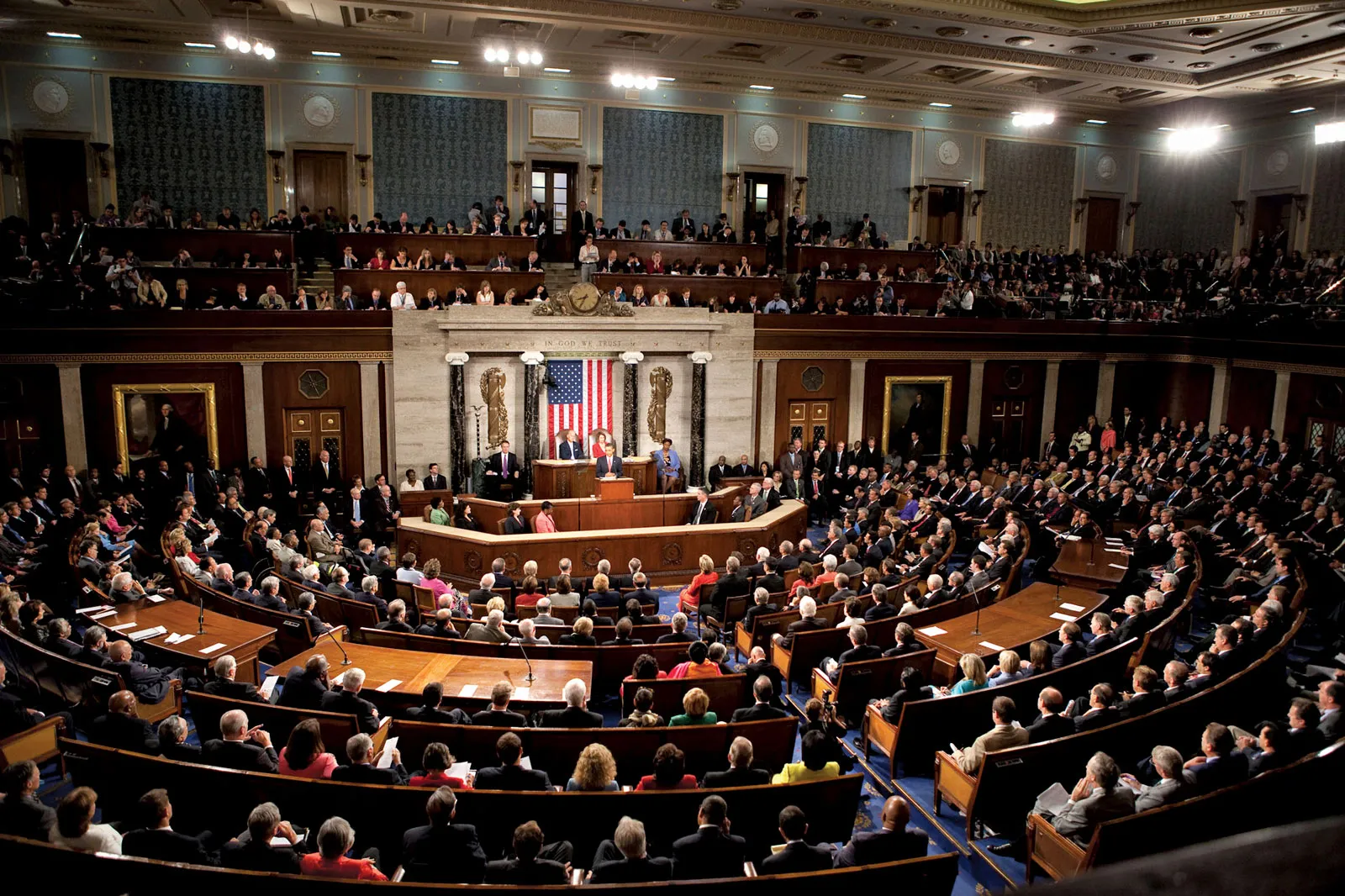
A critical Supreme Court case concerning the Voting Rights Act (VRA) could give Republicans a significant advantage in the 2026 midterm elections, potentially reshaping the U.S. House of Representatives and placing several senior Democrats in precarious positions.
The case, Louisiana v. Callais, revolves around Section 2 of the 1965 Voting Rights Act, which prohibits any law or electoral map that denies voting rights based on race or color. Historically, Section 2 has been instrumental in establishing majority-minority districts that favor Democratic candidates, particularly in Republican-controlled states with sizable Black populations.
If the Supreme Court strikes down race-based districts, some analysts estimate Republicans could gain nine or more congressional seats, potentially flipping the balance in the House. During oral arguments two months ago, a majority of conservative justices indicated opposition to the current interpretation of Section 2, raising alarms for Democrats nationwide.
“It’s potentially really important for 2026,” said Kyle Kondik, managing editor of Sabato’s Crystal Ball at the University of Virginia Center for Politics. “If the court eliminates protections for these districts, several states in the South could see Democratic seats disappear.”
The Stakes for Southern Democrats
The Southern United States, where numerous majority-minority districts have been established under Section 2, is considered the focal point of the case. If the law is weakened, red states could redraw districts in ways that disadvantage Democratic incumbents while potentially creating moderate swing seats — a double-edged scenario for both parties.
Rep. Cleo Fields (D-La.) is among the most vulnerable. His 6th Congressional District in Louisiana was reshaped last year to create a second Black-majority seat, following Section 2 mandates. Despite the potential threat, Fields remains cautiously optimistic. “We must remain vigilant and committed to defending the principles enshrined in Section 2 of the Voting Rights Act of 1965,” he stated.
Rep. Troy Carter (D-La.), representing New Orleans, faces similar risks. Republicans in Louisiana are exploring ways to challenge the state’s two Democratic districts. “The Voting Rights Act is not a relic; it is a living promise that our democracy belongs to everyone,” Carter emphasized. “It remains as vital today as it was 60 years ago.”
Other Vulnerable Democrats
In South Carolina, Rep. Jim Clyburn is the sole Democratic representative in the state. Given his prominence and the narrow margins in his 6th Congressional District, state Republicans have reportedly discussed reconfiguring his seat should Section 2 be curtailed. Clyburn warned that the court’s decision could have repercussions lasting nearly a century.
Rep. Steve Cohen (D-Tenn.) represents a district with the second-highest percentage of Black residents in the nation after Rep. Bennie Thompson (D-Miss.). Thompson, the former chairman of the House Select Committee on Jan. 6, could also be at risk, as Mississippi Republicans might seek to redraw his 2nd Congressional District if Section 2 protections are eliminated. “In Mississippi, that could make it harder for Black voters in the 2nd District to have a say. We can’t let decades of progress be undone,” Thompson said.
Alabama Democrats are not immune. Rep. Shomari Figures, whose district was court-mandated as a plurality minority seat, could see Republican efforts to reconfigure the 2nd Congressional District threaten his reelection. Similarly, Rep. Terri Sewell’s (D-Ala.) 7th Congressional District, a majority-minority district established in 1992, may also come under scrutiny if the Supreme Court strikes Section 2 from consideration.
Even Missouri faces potential upheaval. Rep. Wesley Bell (D-Mo.), who unseated former Rep. Cori Bush in a competitive primary, represents a district with a plurality Black population. While redistricting him may present logistical challenges, some state Republicans have argued his district constitutes an unconstitutional racial gerrymander, opening the door for future legal disputes.
The Broader GOP Strategy
Republicans currently hold a slim majority in the House, with 220 seats compared to the Democrats’ 213, and two seats vacant. Speaker Mike Johnson (R-La.) can only afford minimal defections on key votes. The party is exploring multiple strategies to maintain control in 2026, including pushing for mid-decade redistricting in states like Texas, where new congressional maps could yield up to five additional GOP seats. Other states, including Florida, are also under review for potential Republican gains.
Meanwhile, California voters recently approved a ballot measure to neutralize mid-decade redistricting in Texas by securing more Democratic seats, highlighting the ongoing partisan tug-of-war over electoral maps.
Potential Implications of the Supreme Court Ruling
If the Supreme Court issues a ruling that effectively nullifies race-based district protections under Section 2, the GOP could significantly reshape House districts in the South. According to analysis by The New York Times’ Nate Cohn, eliminating these districts could cut the 24 Democratic-held seats in the South by roughly half, creating an immediate advantage for Republicans.
However, there are significant unknowns. The precise timing of the ruling, its interpretation, and the states’ responses remain uncertain. Some experts caution that eliminating Section 2 districts may inadvertently allow “blue dog” Democrats to secure moderate swing districts, particularly in a cycle favorable to Democrats. Kondik emphasized the unpredictability: “We don’t know when it’s coming. We don’t know what it will say. And we don’t necessarily know how states will respond.”
Ballotpedia identifies approximately 30 congressional districts with majority or plurality Black populations. A majority of these districts are in red states, putting them at the highest risk if the Supreme Court issues a broad ruling against Section 2 protections.
Historical Context
Since 1938, the party controlling the White House has lost House seats in nearly every midterm election, a trend that Republicans must navigate carefully in 2026. For Democrats, the potential erosion of Section 2 protections threatens to accelerate these losses, particularly in Southern states where redistricting could immediately shift the balance of power.
The stakes are high. The Supreme Court’s decision in Louisiana v. Callais may determine not only the partisan composition of the House but also the political fortunes of several high-profile Democratic lawmakers, including Fields, Carter, Clyburn, Cohen, Thompson, Figures, Sewell, and Bell.
Looking Ahead
While the precise effects of the ruling remain uncertain, analysts agree that the Supreme Court case represents a potential inflection point in the upcoming midterms. Republicans could gain a substantial structural advantage, reshaping the political map of the South and challenging longstanding Democratic strongholds. Conversely, Democrats face the challenge of defending districts that could be dismantled or altered if Section 2 is weakened.
“The results so far have kind of been a wash from a partisan standpoint,” Kondik noted. “The one way where Republicans really could come out of this with a much better overall House map is a quick and maximal Voting Rights Act decision. Failing that, they may get a little bit of an edge out of redistricting, but probably not as big as they would have hoped.”
As the Supreme Court prepares to issue its ruling, both parties are bracing for the potential consequences. For Democrats, the focus will be on protecting minority representation and preserving Section 2 safeguards. For Republicans, the case presents an unprecedented opportunity to consolidate power and reshape the legislative landscape ahead of the 2026 midterm elections.

Emily Johnson is a critically acclaimed essayist and novelist known for her thought-provoking works centered on feminism, women’s rights, and modern relationships. Born and raised in Portland, Oregon, Emily grew up with a deep love of books, often spending her afternoons at her local library. She went on to study literature and gender studies at UCLA, where she became deeply involved in activism and began publishing essays in campus journals. Her debut essay collection, Voices Unbound, struck a chord with readers nationwide for its fearless exploration of gender dynamics, identity, and the challenges faced by women in contemporary society. Emily later transitioned into fiction, writing novels that balance compelling storytelling with social commentary. Her protagonists are often strong, multidimensional women navigating love, ambition, and the struggles of everyday life, making her a favorite among readers who crave authentic, relatable narratives. Critics praise her ability to merge personal intimacy with universal themes. Off the page, Emily is an advocate for women in publishing, leading workshops that encourage young female writers to embrace their voices. She lives in Seattle with her partner and two rescue cats, where she continues to write, teach, and inspire a new generation of storytellers.