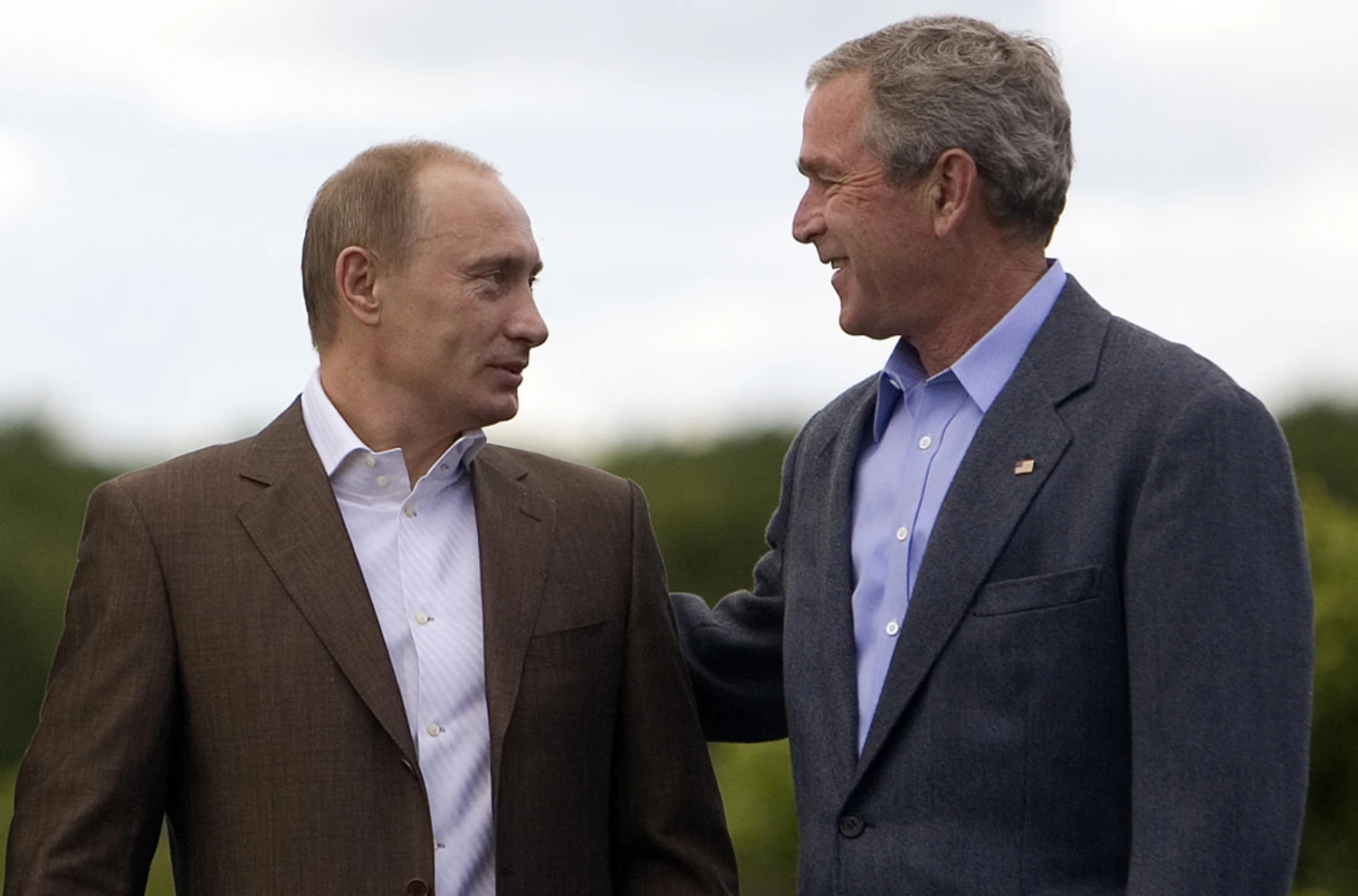
A newly released transcript from a 2001 meeting between Russian President Vladimir Putin and then–U.S. President George W. Bush reveals that Putin privately asserted Ukraine was historically “part of Russia” more than two decades before Moscow launched its full-scale invasion.
The conversation took place during the leaders’ first face-to-face meeting in June 2001 in Slovenia, according to documents published by the U.S. National Security Archive. The transcript shows Putin delivering what analysts described as a brief historical narrative outlining his view of the Soviet Union’s collapse and the territorial boundaries that emerged from it.
During the exchange, Putin argued that Russia had voluntarily surrendered vast amounts of land following the end of the Soviet Union, portraying the dissolution not as an act of coercion but as a unilateral concession by Moscow.
“What really happened? Soviet goodwill changed the world, voluntarily,” Putin said, according to the transcript. “And Russians gave up thousands of square kilometers of territory, voluntarily. Unheard of. Ukraine, part of Russia, for centuries given away. Kazakhstan, given away. The Caucasus too. Hard to imagine, and done by party bosses.”
The remarks closely mirror narratives Putin would later advance publicly in speeches and essays, particularly in the years leading up to Russia’s invasion of Ukraine in 2022. At the time of the 2001 meeting, however, relations between Washington and Moscow were relatively stable, and both leaders were seeking closer cooperation in the aftermath of the September 11 terrorist attacks.
Bush responded by emphasizing a desire to integrate Russia into the Western security framework rather than treat it as a geopolitical rival. According to the transcript, the U.S. president told Putin he viewed Russia as part of the West and encouraged cooperation against shared threats.
Bush urged Putin to “redefine the new threats coming from those that hate America,” suggesting that extremist groups hostile to the United States could also pose dangers to Russia. The exchange reflected early efforts by the Bush administration to pursue a partnership with Moscow, particularly on counterterrorism and strategic stability.
During the discussion, Putin also raised the issue of Russia’s relationship with NATO, expressing frustration over Moscow’s exclusion from the alliance. He argued that Russia had historically sought integration with Western institutions but had been rebuffed.
“In 1954, the Soviet Union applied to join NATO. I have the document,” Putin told Bush. “NATO gave a negative answer with four specific reasons: the lack of an Austrian settlement, the lack of a German settlement, the totalitarian grip on Eastern Europe, and the need for Russia to cooperate with the UN disarmament process. Now all these conditions have been met. Perhaps Russia could be an ally.”
The transcript highlights how early Putin framed NATO expansion and post–Cold War borders as historical injustices—arguments that would later become central to Kremlin messaging. While Bush did not endorse Putin’s territorial claims, the exchange underscores that disagreements over Ukraine’s sovereignty and Russia’s role in Europe were already present at the highest diplomatic levels years before the war.
The release of the transcript comes amid renewed scrutiny of Russia’s long-term strategic intentions in Ukraine. Since launching its full-scale invasion in February 2022, Moscow has repeatedly justified the war by questioning Ukraine’s legitimacy as a sovereign state and portraying it as historically Russian territory.
Putin has continued to signal an aggressive posture toward Ukraine even while claiming to support negotiations. Earlier this year, he stated that Russia was seeking to end the conflict on its own terms, while simultaneously expressing a desire to intensify military action.
“Our hands itch,” Putin was quoted as saying by The Moscow Times, adding, “We are ready to go further and finish off this vermin.”
Western officials and analysts have pointed to such statements as evidence that Moscow’s objectives extend beyond territorial disputes to the subjugation of Ukraine’s political independence. The 2001 transcript reinforces the view that these ambitions were not the product of recent events but part of a worldview Putin has articulated for decades.
The documents released by the National Security Archive provide rare insight into early private conversations between U.S. and Russian leaders, shedding light on how historical grievances and competing interpretations of the post-Soviet order shaped relations long before the outbreak of war.
As the conflict in Ukraine continues, the transcript adds historical context to arguments that Russia’s invasion was not a sudden reaction to contemporary security concerns, but the culmination of long-held claims about territory, identity, and power in Eastern Europe.

Emily Johnson is a critically acclaimed essayist and novelist known for her thought-provoking works centered on feminism, women’s rights, and modern relationships. Born and raised in Portland, Oregon, Emily grew up with a deep love of books, often spending her afternoons at her local library. She went on to study literature and gender studies at UCLA, where she became deeply involved in activism and began publishing essays in campus journals. Her debut essay collection, Voices Unbound, struck a chord with readers nationwide for its fearless exploration of gender dynamics, identity, and the challenges faced by women in contemporary society. Emily later transitioned into fiction, writing novels that balance compelling storytelling with social commentary. Her protagonists are often strong, multidimensional women navigating love, ambition, and the struggles of everyday life, making her a favorite among readers who crave authentic, relatable narratives. Critics praise her ability to merge personal intimacy with universal themes. Off the page, Emily is an advocate for women in publishing, leading workshops that encourage young female writers to embrace their voices. She lives in Seattle with her partner and two rescue cats, where she continues to write, teach, and inspire a new generation of storytellers.