


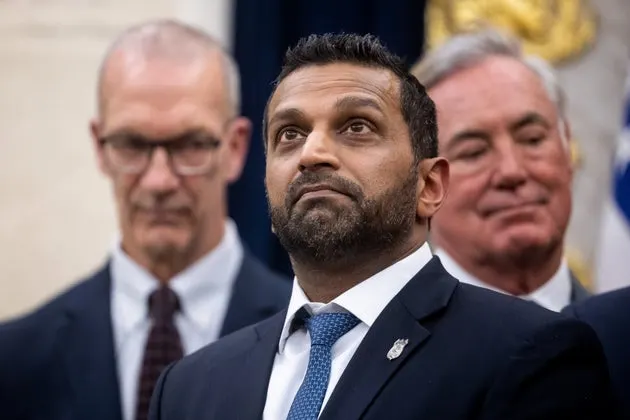
FBI Director Kash Patel has announced that the Federal Bureau of Investigation’s long-standing headquarters in Washington, D.C., will be permanently shut down, marking one of the most consequential structural changes to the agency in decades.
In a statement released on Dec. 26, Patel confirmed that the J. Edgar Hoover Building—home to the FBI for roughly half a century—will no longer serve as the bureau’s headquarters. He said the transition away from the aging facility would begin immediately.
“December 26: Shutting down the Hoover Building,” Patel wrote in a post on social media.
According to Patel, the FBI will relocate core operations to the Ronald Reagan Building and International Trade Center, a massive federal complex located just blocks from the Hoover Building in downtown Washington. The move follows an earlier announcement by the Trump administration designating the Reagan Building as the bureau’s new operational base.
The Reagan complex already houses several major federal agencies, including U.S. Customs and Border Protection, the Environmental Protection Agency, and the General Services Administration. It previously housed the U.S. Agency for International Development before that agency was significantly reduced under Trump administration reforms.
Patel framed the decision as both a safety imperative and a cost-saving measure, arguing that continued use of the Hoover Building posed unacceptable risks to employees.
“We selected the already-existing Reagan Building, saving billions and allowing the transition to begin immediately with required safety and infrastructure upgrades already underway,” Patel said.
Longstanding Concerns Over Building Safety
Concerns about the condition of the Hoover Building are not new. As early as 2011, the Government Accountability Office described the facility as “deteriorating,” citing structural issues, outdated systems, and escalating maintenance costs.
In his Dec. 26 statement, Patel said the building is no longer safe for FBI personnel, reinforcing long-held criticisms from both inside and outside the agency.
Constructed in the 1970s, the Hoover Building replaced the FBI’s earlier headquarters inside the Department of Justice. It was officially named after longtime FBI Director J. Edgar Hoover in 1972 and dedicated in 1975.
At the dedication ceremony, then-President Gerald Ford praised FBI employees and described the bureau as “the bastion of Federal law enforcement under the Department of Justice.” Over time, however, the building became emblematic not only of the FBI’s centralization in Washington but also of bureaucratic stagnation, according to critics.
Patel’s Long-Standing Opposition to the Headquarters
The closure aligns closely with Patel’s views prior to becoming FBI director. Before his appointment, Patel was an outspoken critic of the bureau’s leadership culture and its concentration of personnel in Washington, D.C.
In a September 2024 interview, Patel controversially suggested shuttering the Hoover Building altogether and reopening it “as a museum of the deep state.” That remark resurfaced during his Senate confirmation hearings earlier this year.
During questioning by Sen. Chris Coons (D-Del.), Patel clarified that his comments were intended to underscore a broader concern: the disproportionate number of FBI employees stationed in the nation’s capital.
Patel told senators he was committed to moving more FBI personnel out of Washington and into field offices across the country to work more closely with local law enforcement.
“I’m trying to highlight a significantly greater point,” Patel said at the time, adding that he wanted FBI employees in Washington to “go out into the interior of the country … and work with sheriffs’ departments and local officers.”
Coons responded that such an argument could be defensible but expressed concern about Patel’s earlier rhetoric.
“If that had been your statement, that would be something that would be defensible,” Coons said. “It’s the rest of it, saying you’re going to turn it into a museum of the deep state, that causes repeated questions and concerns.”
Workforce Redistribution and Cost Arguments
Patel has repeatedly argued that the FBI’s workforce is overly concentrated in the Washington region. In a May interview with Fox News, he cited internal figures indicating that roughly one-third of the FBI’s workforce is located within a 50-mile radius of Washington, D.C.
“When we’re fully manned, the FBI has about 38,000 employees,” Patel said. “In the national capital region, there were 11,000 FBI employees. That’s like a third of the workforce. A third of the crime doesn’t happen here.”
Patel said his plan includes relocating approximately 1,500 FBI employees out of the Washington area and into other parts of the country, where he argues their presence would have greater impact.
The decision to use the Reagan Building instead of constructing a new headquarters also reverses years of planning. In 2023, the General Services Administration selected Greenbelt, Maryland, as the preferred site for a new, purpose-built FBI headquarters after evaluating multiple locations in Maryland and Virginia.
That proposed facility was intended to be a “state-of-the-art headquarters” with enhanced security and transportation access, but it was not expected to open until at least 2035.
Political Reaction and Congressional Pushback
The Trump administration’s decision to abandon the Greenbelt project drew sharp criticism from congressional Democrats, particularly those representing Virginia.
In a joint statement issued in July, Sens. Tim Kaine and Mark Warner called the reversal a “hasty, improvised approach” that ignored years of bipartisan planning.
“For years, Democratic and Republican administrations alike have agreed on the need for a secure, purpose-built headquarters that actually meets the FBI’s mission needs,” the senators said. “This announcement brushes aside years of careful planning, ignores the recommendations of security and mission experts, and raises serious concerns about how this decision was made.”
Supporters of the move, however, argue that Patel’s approach avoids massive construction costs and accelerates urgently needed changes.
Patel said taxpayers were facing the prospect of spending billions of dollars on a new facility that would not be operational for another decade.
“This decision puts resources where they belong: defending the homeland, crushing violent crime, and protecting national security,” Patel said. “It delivers better tools for today’s FBI workforce at a fraction of the cost.”
A Symbolic and Operational Shift
The closure of the Hoover Building represents more than a logistical change. For supporters, it signals a break from what they view as an overly centralized and politicized FBI culture. For critics, it raises concerns about transparency, long-term planning, and the politicization of institutional reform.
What will ultimately become of the Hoover Building itself remains unclear. Patel has not announced whether the structure will be demolished, repurposed, or transferred to another federal use.
For now, the FBI is preparing for an immediate transition to the Reagan Building, marking the end of an era for one of the most recognizable—and controversial—buildings in federal law enforcement history.

Emily Johnson is a critically acclaimed essayist and novelist known for her thought-provoking works centered on feminism, women’s rights, and modern relationships. Born and raised in Portland, Oregon, Emily grew up with a deep love of books, often spending her afternoons at her local library. She went on to study literature and gender studies at UCLA, where she became deeply involved in activism and began publishing essays in campus journals. Her debut essay collection, Voices Unbound, struck a chord with readers nationwide for its fearless exploration of gender dynamics, identity, and the challenges faced by women in contemporary society. Emily later transitioned into fiction, writing novels that balance compelling storytelling with social commentary. Her protagonists are often strong, multidimensional women navigating love, ambition, and the struggles of everyday life, making her a favorite among readers who crave authentic, relatable narratives. Critics praise her ability to merge personal intimacy with universal themes. Off the page, Emily is an advocate for women in publishing, leading workshops that encourage young female writers to embrace their voices. She lives in Seattle with her partner and two rescue cats, where she continues to write, teach, and inspire a new generation of storytellers.