

The United States has carried out multiple lethal military strikes against Islamic State-linked militants operating in northwestern Nigeria, President Donald Trump announced late Thursday, marking a significant escalation of U.S. counterterrorism activity in West Africa.
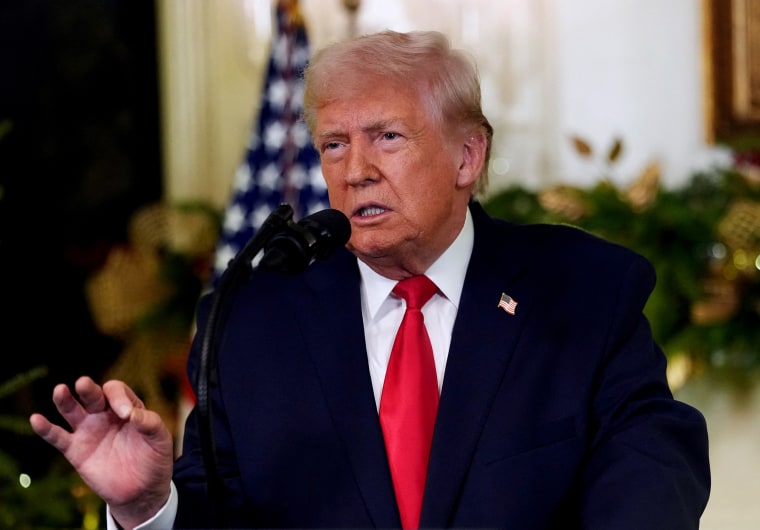
In a statement posted on his Truth Social platform, Trump said the strikes were conducted at his direct order and were aimed at extremist fighters accused of carrying out violent attacks against Christian communities in the region. The president described the operations as “powerful and deadly,” signaling that further military action could follow if the militants continue their campaign of violence.
“Tonight, at my direction as Commander in Chief, the United States launched a powerful and deadly strike against ISIS terrorist scum in Northwest Nigeria,” Trump wrote. “They have been targeting and viciously killing, primarily, innocent Christians, at levels not seen for many years, and even centuries.”
Trump added that the U.S. military carried out “numerous perfect strikes,” emphasizing the precision and effectiveness of the operation. He also warned that additional attacks would be authorized if the group continues its activities.
“I have previously warned these terrorists that if they did not stop the slaughtering of Christians, there would be hell to pay,” he said. “Tonight, there was.”
Limited Details on the Operation
U.S. officials have not yet released detailed information about the timing, locations, or scale of the strikes, nor have they confirmed casualty figures. It remains unclear whether the operation involved airstrikes, drones, or other military assets. The Department of Defense has not issued a formal statement as of early Friday.
However, Trump’s remarks suggest the strikes targeted Islamic State militants operating in Nigeria’s northwest, a region that has seen increasing instability in recent years due to the presence of jihadist groups, criminal gangs, and armed militias.
The president referred to the Pentagon as the “Department of War,” an informal term he has used previously, and praised the military’s execution of the mission. His comments underscore a more aggressive posture toward extremist groups beyond the Middle East, expanding U.S. counterterrorism focus into Africa.
Growing Threat in Northwestern Nigeria
Nigeria has long battled insurgent violence, particularly in the northeast, where Boko Haram and its splinter group, Islamic State West Africa Province (ISWAP), have waged a brutal campaign for more than a decade. In recent years, however, extremist violence has spread into northwestern regions, where armed groups exploit weak security, vast terrain, and local grievances.
Islamic State-affiliated militants in Nigeria have been blamed for attacks on villages, mass kidnappings, and targeted killings, including assaults on Christian communities. Human rights organizations have repeatedly warned that religious minorities face heightened risk in areas where jihadist groups operate with relative impunity.
Trump’s statement framed the U.S. intervention as a direct response to what he described as escalating violence against Christians. He portrayed the strikes as both punitive and deterrent, aimed at sending a clear message to extremist groups operating in the region.
U.S. Military Presence in Africa
The United States maintains a limited but strategic military presence in Africa, primarily focused on counterterrorism, intelligence sharing, and training local forces. U.S. Africa Command (AFRICOM) oversees operations across the continent, including surveillance missions and targeted strikes against extremist leaders.
While the U.S. has conducted operations against Islamic State and al-Qaeda affiliates in countries such as Somalia and Libya, direct strikes in Nigeria are relatively rare and often shrouded in secrecy. If confirmed by defense officials, the reported operation would represent a notable expansion of U.S. kinetic activity in West Africa.
Analysts say the move reflects growing concern in Washington about the spread of Islamic State networks across the Sahel and coastal West Africa, where militant groups have exploited political instability and weak governance.
Political Messaging and Domestic Implications
Trump’s announcement comes as he continues to emphasize a hardline approach to terrorism during his presidency. By publicizing the strikes personally and using stark language, the president reinforced his image as a decisive commander in chief willing to use military force to protect religious communities abroad.
The timing of the announcement, delivered during the Christmas holiday period, also underscores its symbolic weight. Trump has repeatedly framed the protection of persecuted Christians as a priority of his foreign policy, particularly in regions affected by Islamist extremism.
Critics, however, may question the lack of transparency surrounding the operation and whether unilateral military action could complicate relations with Nigeria’s government. Nigerian officials have not yet publicly commented on the reported strikes.
Regional and International Reaction
As of early Friday, there has been no official response from Nigerian authorities or Islamic State-linked groups. It remains unclear whether the Nigerian government requested or approved the U.S. action, or whether it was conducted independently.
Security experts note that while targeted strikes can degrade militant leadership and capabilities, they do not address the underlying drivers of instability, such as poverty, corruption, and local grievances. Civilian harm, if it occurs, can also fuel resentment and recruitment by extremist groups.
International reaction is likely to depend on further details about the operation, including its legal basis and humanitarian impact.
Warning of Further Action
Trump made clear that Thursday’s strikes were not necessarily the end of U.S. involvement in the region. His statement included a direct warning to militants, suggesting that continued attacks would trigger additional military responses.
The president’s language left little room for ambiguity, signaling that the United States is prepared to escalate if necessary. “If they did not stop,” he said, “there would be hell to pay.”
Such rhetoric aligns with Trump’s broader approach to counterterrorism, which prioritizes military pressure and deterrence over diplomatic engagement with extremist actors.
What Comes Next
Defense officials are expected to provide further clarification in the coming hours or days, including confirmation of the operation, assessment of its impact, and coordination with Nigerian forces. Analysts will closely watch whether the strikes lead to retaliatory attacks or shifts in militant activity across the region.
For now, Trump’s announcement places Nigeria firmly within the spotlight of U.S. counterterrorism efforts, highlighting growing concern over Islamic State’s footprint in Africa and the continued targeting of religious communities.
As the situation develops, the operation may mark a turning point in how the United States confronts extremist violence in West Africa—one that signals a willingness to act decisively beyond traditional theaters of conflict.

Emily Johnson is a critically acclaimed essayist and novelist known for her thought-provoking works centered on feminism, women’s rights, and modern relationships. Born and raised in Portland, Oregon, Emily grew up with a deep love of books, often spending her afternoons at her local library. She went on to study literature and gender studies at UCLA, where she became deeply involved in activism and began publishing essays in campus journals. Her debut essay collection, Voices Unbound, struck a chord with readers nationwide for its fearless exploration of gender dynamics, identity, and the challenges faced by women in contemporary society. Emily later transitioned into fiction, writing novels that balance compelling storytelling with social commentary. Her protagonists are often strong, multidimensional women navigating love, ambition, and the struggles of everyday life, making her a favorite among readers who crave authentic, relatable narratives. Critics praise her ability to merge personal intimacy with universal themes. Off the page, Emily is an advocate for women in publishing, leading workshops that encourage young female writers to embrace their voices. She lives in Seattle with her partner and two rescue cats, where she continues to write, teach, and inspire a new generation of storytellers.