


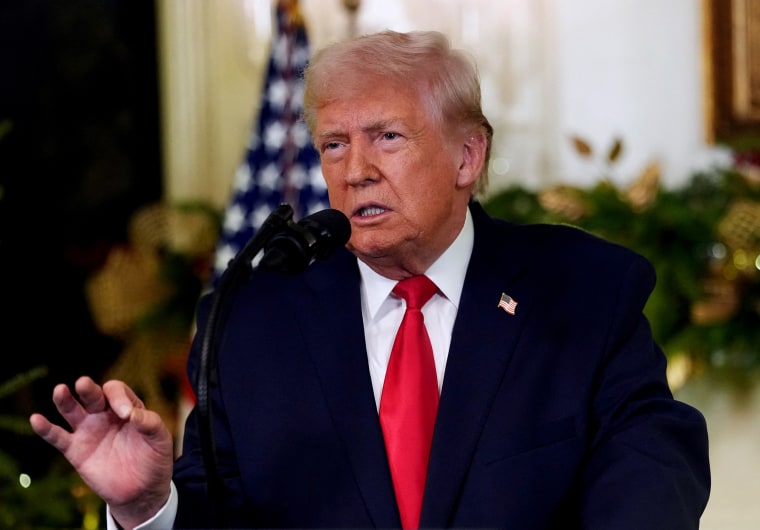
President Donald Trump has sparked fresh speculation about his political future after publicly floating the idea of stepping away from the White House to pursue a full-time career as a television host.
The 79-year-old Republican, who is currently serving his second term as President of the United States, raised eyebrows on Tuesday evening after suggesting he could trade the Oval Office for a return to the entertainment spotlight — a decade after leaving The Apprentice.
Trump posed the provocative question directly to his supporters on Truth Social while promoting his role as host of the Trump Kennedy Center Honors, which aired at 8 p.m. EST on CBS and streamed on Paramount+.
In a post announcing the broadcast, the President told followers that he had been personally asked to serve as master of ceremonies for the star-studded event, which honors major figures from film, music, and theater, including Sylvester Stallone, Michael Crawford, KISS, George Strait, and Gloria Gaynor.
“THE TRUMP KENNEDY CENTER HONORS will be broadcast tonight, on CBS, and Stream on Paramount+. Tune in at 8 P.M. EST!” Trump wrote.
“At the request of the Board, and just about everybody else in America, I am hosting the event,” he continued. “Tell me what you think of my ‘Master of Ceremony’ abilities.”
He then added a line that immediately ignited political and media chatter: “If really good, would you like me to leave the Presidency in order to make ‘hosting’ a full time job?”
Teasing or Serious Signal?
While it remains unclear whether Trump’s comment was intended as genuine contemplation or tongue-in-cheek provocation, the suggestion touched on a familiar theme in his career — the blending of politics, celebrity, and entertainment.
Trump has long thrived on media attention and audience engagement, and his post appeared designed to energize supporters while reinforcing his comfort in front of the camera. Nevertheless, the notion of a sitting president openly floating early retirement for a television career is highly unusual in modern American politics.
White House officials did not immediately comment on the remarks, and there has been no formal indication that Trump is considering stepping down from office.
Political observers largely interpreted the post as a playful challenge to his audience rather than a concrete plan. Still, it underscored Trump’s enduring connection to the entertainment world and his willingness to blur the lines between governance and showmanship.
A Return to Familiar Territory
Trump’s hosting role at the Trump Kennedy Center Honors marked a symbolic return to a position he once dominated. Long before entering politics, he was best known as the face of The Apprentice, the entrepreneurial reality series that ran from 2004 to 2015.
The show, which featured contestants competing for a job within Trump’s organization, transformed him from a real estate developer into a mainstream celebrity. His signature catchphrase, “You’re fired,” became part of American pop culture, and his on-screen persona portrayed him as a decisive, hyper-successful business magnate.
The timing of Trump’s remarks is notable, as 2025 marks ten years since he stepped away from The Apprentice — a departure that coincided with the launch of his first presidential campaign.
At the height of its popularity, the show played a significant role in shaping public perceptions of Trump, helping catapult him from boardrooms to living rooms across the country.
Controversy Surrounding The Apprentice
Despite its success, Trump’s tenure on The Apprentice ended amid controversy. During his initial presidential run in 2015, NBC cut ties with the future president following comments he made about Mexican immigrants that the network said did not align with its values.
At the time, Trump dismissed the decision and framed it as politically motivated. Nevertheless, the break marked the end of a television chapter that had significantly bolstered his national profile.
Media critics later reassessed the show’s legacy, with some arguing that it helped create a polished public image that masked financial struggles within Trump’s business empire.
“In the show, he appeared to demonstrate impeccable business instincts and unparalleled wealth,” one analysis noted, “even though his businesses had barely survived multiple bankruptcies and faced yet another when he was cast.”
Despite such critiques, The Apprentice remains widely credited with laying the groundwork for Trump’s successful entry into politics.
The Trump Kennedy Center Honors
Trump’s hosting appearance also drew attention because of the venue itself. The event was held at the newly renamed Trump Kennedy Center, a rebranding that has already proven deeply divisive.
Formerly known as the John F. Kennedy Center for the Performing Arts, the Washington, D.C. landmark was established as a tribute to the assassinated president and has long been regarded as a nonpartisan cultural institution.
On December 18, the center’s board voted unanimously to rename the building to include Trump’s name alongside Kennedy’s, officially rechristening it the Trump-Kennedy Center.
Supporters of the move argued that Trump’s influence on American culture and politics justified the change, while critics accused the board of politicizing a national memorial.
Kennedy Family Pushback
The renaming sparked immediate backlash from members of the Kennedy family, several of whom publicly condemned the decision.
Joe Kennedy III, the late president’s grandnephew, issued a sharp rebuke, stating that the Kennedy Center is a “living memorial” protected by federal law.
“The Kennedy Center is a living memorial to a fallen president and named for President Kennedy by federal law,” he said. “It can no sooner be renamed than can someone rename the Lincoln Memorial, no matter what anyone says.”
Other relatives echoed similar sentiments, arguing that the addition of Trump’s name undermines the center’s original purpose and legacy.
Despite the controversy, Trump has embraced the change, attending events at the venue and now serving as host for one of its most high-profile annual ceremonies.
A Presidency Defined by Showmanship
Trump’s willingness to publicly toy with the idea of leaving office for entertainment reflects a broader pattern throughout his political career. Unlike traditional politicians, he has consistently leaned into spectacle, provocation, and direct engagement with his base.
From campaign rallies styled as entertainment events to frequent social media commentary, Trump has blurred the boundaries between politics and performance in ways few presidents before him have attempted.
His supporters often celebrate this approach as refreshing and authentic, while critics argue it trivializes the seriousness of the presidency.
Still, Trump’s ability to dominate headlines — even with hypothetical scenarios — remains one of his most effective political tools.
No Immediate Exit in Sight
Despite the playful tone of his remarks, there is no constitutional or procedural indication that Trump is preparing to step aside. Under U.S. law, a president cannot simply abandon office without triggering a formal resignation process that would elevate the vice president to the presidency.
No such steps have been discussed, and Trump has made no official statements suggesting dissatisfaction with his current role.
Instead, analysts believe the post served multiple purposes: promoting the honors broadcast, reinforcing his celebrity credentials, and energizing his supporters with a familiar mix of humor and provocation.
Conclusion
Donald Trump’s suggestion that he could trade the presidency for a full-time hosting career may have been delivered with a wink, but it nonetheless reignited debate about the unique nature of his leadership style.
A former reality television star turned two-term president, Trump remains unlike any political figure before him — equally at home on a stage, on a screen, or behind the Resolute Desk.
Whether the comment was serious or simply another example of Trump’s flair for spectacle, it once again demonstrated his unmatched ability to command attention, blur roles, and keep both allies and critics guessing about what he might do next.
For now, the White House remains his stage — but as Trump reminded the nation, the spotlight has never been far from where he feels most comfortable.

Emily Johnson is a critically acclaimed essayist and novelist known for her thought-provoking works centered on feminism, women’s rights, and modern relationships. Born and raised in Portland, Oregon, Emily grew up with a deep love of books, often spending her afternoons at her local library. She went on to study literature and gender studies at UCLA, where she became deeply involved in activism and began publishing essays in campus journals. Her debut essay collection, Voices Unbound, struck a chord with readers nationwide for its fearless exploration of gender dynamics, identity, and the challenges faced by women in contemporary society. Emily later transitioned into fiction, writing novels that balance compelling storytelling with social commentary. Her protagonists are often strong, multidimensional women navigating love, ambition, and the struggles of everyday life, making her a favorite among readers who crave authentic, relatable narratives. Critics praise her ability to merge personal intimacy with universal themes. Off the page, Emily is an advocate for women in publishing, leading workshops that encourage young female writers to embrace their voices. She lives in Seattle with her partner and two rescue cats, where she continues to write, teach, and inspire a new generation of storytellers.