


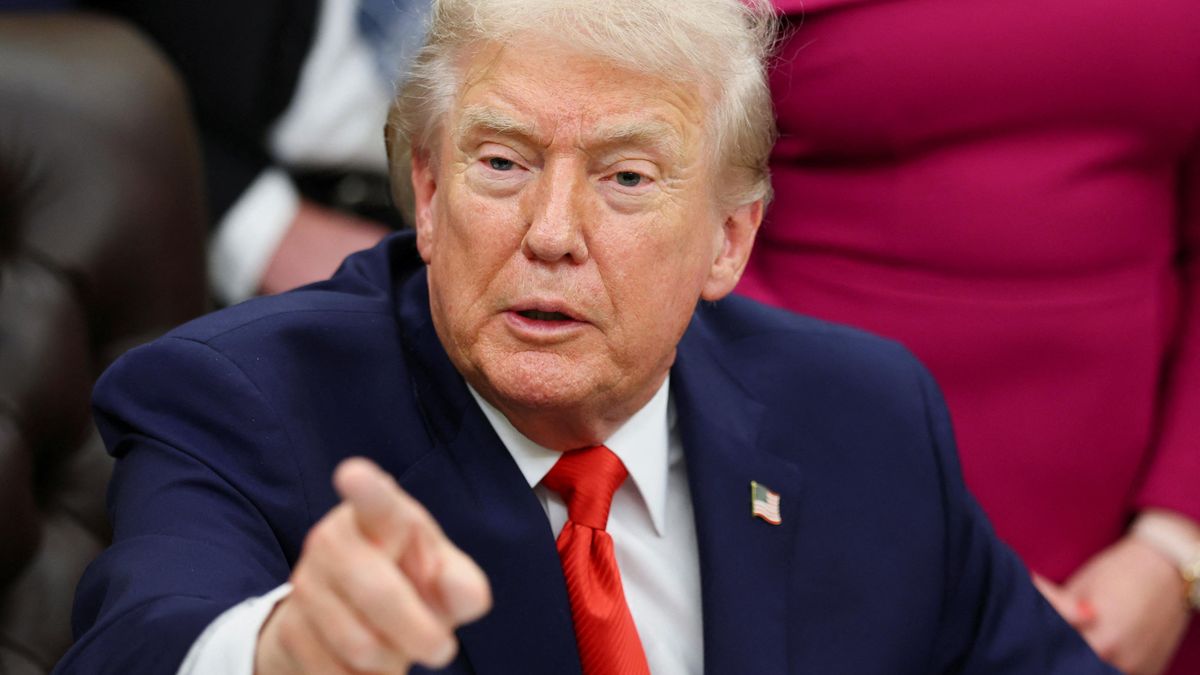
President Donald Trump defended former President Bill Clinton and other political figures featured in the latest Jeffrey Epstein file release, calling the widespread photo dump “a terrible thing.” Speaking at a press conference Monday, Trump insisted that many meetings with Epstein were innocent and criticized Democrats for pushing the release, framing the files as politically motivated and distracting from the accomplishments of his administration.
The new tranche of documents, released under the Epstein Files Transparency Act, included photographs, transcripts, and other records that show Clinton, pop star Michael Jackson, and other high-profile figures alongside Epstein and his associates. While the images show interactions between Epstein and some of the most prominent Americans of the past decades, Trump repeatedly emphasized that inclusion in the files does not equate to wrongdoing. “I know there are a lot of people that are angry about all the pictures of other people. I think it’s terrible,” Trump said. “This whole thing with Epstein is a way to try to deflect from the tremendous success of the Republican Party. I thought that was finished, a lot of people are very angry that this continues.”
Of former President Clinton, Trump said, “I like Bill Clinton, I’ve always gotten along with Bill Clinton. We’ve always gotten along with him, I respect him. Bill Clinton’s a big boy; he can handle it, but you probably have pictures of people that innocently met Jeffrey Epstein years ago.” The president highlighted that his own name appears in some photos but insisted his interactions with Epstein were limited. “I threw [Epstein] out of Mar-a-Lago,” he said, stressing that he cut ties with Epstein long before the financier’s criminal activities came to light.
The Epstein Files Transparency Act, signed into law last month, mandates that the Department of Justice (DOJ) release all materials related to Epstein, including court documents, photographs, and internal memos. The files, which include images, call logs, and interview transcripts, were partially released last week, prompting reactions from politicians, alleged victims, and the public. Former President Bill Clinton issued a statement through his spokesperson, demanding full disclosure of all materials referencing or containing his image. He stated that selective releases create the appearance of wrongdoing, despite him being repeatedly cleared by the DOJ in previous investigations.
Clinton’s statement emphasized that no special protection is required for him and called for Attorney General Pam Bondi to immediately release all remaining materials. “The Epstein Files Transparency Act imposes a clear legal duty on the US Department of Justice to produce the full and complete record the public demands and deserves. However, what the Department of Justice has released so far, and the manner in which it did so, makes one thing clear: someone or something is being protected,” his office said. “We do not know whom, what, or why. But we do know this: We need no such protection.”
A group of 19 alleged Epstein victims, along with Ghislaine Maxwell’s accusers, also criticized the DOJ, claiming that the partial release violated the law. According to their statement, the department “withheld massive quantities of documents” and failed to redact the identities of survivors in some cases, creating a risk of exposure and harm. They argued that the release made it difficult for survivors to access the information most relevant to seeking accountability. The group called for “immediate congressional oversight, including hearings, formal demands for compliance, and legal action.”
Senate Minority Leader Chuck Schumer echoed these concerns, introducing a resolution aimed at compelling the DOJ to fully comply with the Transparency Act. “Instead of transparency, the Trump administration released a tiny fraction of the files and blacked out massive portions of what little they provided. This is a blatant cover-up,” Schumer said in a statement. The resolution, however, is largely symbolic due to the lack of Republican support and the Senate’s recess until January 5. Nevertheless, it reflects ongoing Democratic pressure for greater disclosure.
Trump, for his part, maintained that the administration was acting appropriately and emphasized the need to protect Epstein’s victims. Deputy Attorney General Todd Blanche defended the DOJ’s decision to release only a portion of the files by the statutory deadline, citing the complexity of obscuring survivor identities. Blanche explained that several files, including a photograph showing Trump, Melania Trump, and Maxwell, were temporarily removed from public access because they included victims. These files were later reinstated after redactions were applied.
Blanche stated, “We are not redacting information around President Trump, around any other individual involved with Mr. Epstein, and that narrative—which is not based on fact at all—is completely false.” He defended the administration’s approach as a measured effort to fulfill the law while safeguarding victims. “The Epstein files existed for years and years and years and you did not hear a peep out of a single Democrat for the past four years and yet… all of a sudden, out of the blue, Senator Schumer suddenly cares about the Epstein files. That’s the hoax.”
Federal prosecutors originally brought sex trafficking charges against Epstein in 2019, shortly before he was found dead in his New York jail cell. Epstein’s longtime associate, Ghislaine Maxwell, is currently serving a 20-year federal prison sentence for sex trafficking crimes. Blanche noted that her earlier transfer to a minimum-security prison was motivated by concerns for her safety due to credible threats against her life.
The files, which have been partially released, contain thousands of documents, including images of Clinton with Epstein, sometimes in informal or recreational settings. One image shows Clinton in a pool with Maxwell, while another features him in a hot tub with a woman whose face was redacted. The DOJ emphasized that these images provide limited context and do not imply any criminal behavior.
The partial release has sparked debate about the scope of the Transparency Act and the role of Congress in ensuring accountability. Critics argue that releasing only selected materials undermines public trust and transparency, while the administration contends that extensive redactions are necessary to protect survivors. The files have prompted scrutiny not only of high-profile figures like Clinton and Trump but also of how federal agencies handle sensitive information.
Trump, however, framed the controversy as politically motivated. “Everybody was friendly with this guy. He was around, he was all over Palm Beach and other places,” he said, referencing Epstein’s social connections in the 1990s and 2000s. The president also appeared to mock former Harvard President Larry Summers, labeling him Epstein’s “best friend,” while noting that Clinton, like many others, had known Epstein in social settings.
The debate over the files intersects with broader questions about media coverage, partisanship, and the handling of sensitive information in politically charged cases. Democrats argue that selective releases create a misleading narrative, while Republicans, including Trump, suggest that the files have been weaponized for political gain. Alleged victims continue to advocate for full transparency to ensure their experiences are recognized and that any potential accountability is not obstructed.
Legal experts note that the Epstein Files Transparency Act represents a landmark effort to codify disclosure requirements for cases involving high-profile perpetrators of sexual abuse. The act mandates disclosure of all relevant documents, including photographs, interviews, and internal memos, with careful attention to protecting the identities of victims. Noncompliance or incomplete releases can expose the DOJ and other agencies to legal challenges, as highlighted by the lawsuits and resolutions introduced in Congress.
Meanwhile, the Trump administration has emphasized that it intends to release additional records on a rolling basis, stating that redactions and careful review take time. Blanche reiterated that the DOJ’s approach is consistent with the law and intended to prevent inadvertent harm to survivors. However, some victims argue that delayed or incomplete disclosure continues to erode trust in the government’s handling of the Epstein case.
The files also underscore Epstein’s extensive network of social connections and the ease with which he interacted with influential figures. While inclusion in the files does not imply wrongdoing, public perception has been shaped by the release of images and documents without full context. Former President Bill Clinton has sought to clarify this, emphasizing that any interactions with Epstein were innocent and that selective releases risk creating misleading narratives.
As the debate continues, the release of the Epstein files is likely to remain a point of contention in American politics. Both Trump and Clinton have publicly defended their interactions with Epstein, while victims and lawmakers press for complete transparency. With the DOJ committed to further releases, the full scope of Epstein’s network and the context of his interactions with high-profile figures may eventually come to light.
In the meantime, the political implications are clear. Democrats continue to push for accountability and oversight, while Republicans, including Trump, frame the discussion as a partisan attack. The files have reignited public scrutiny of Epstein’s relationships with powerful individuals, as well as questions about the legal and procedural handling of sensitive documents.
Ultimately, the Epstein files controversy highlights the complex intersection of criminal investigations, political rivalries, and public perception. For high-profile figures like former President Bill Clinton, the focus remains on clarifying their involvement—or lack thereof—while the DOJ navigates the delicate balance between transparency and victim protection. As additional documents are released, the conversation surrounding Epstein, his associates, and the broader implications for government transparency is expected to continue well into 2026.

Emily Johnson is a critically acclaimed essayist and novelist known for her thought-provoking works centered on feminism, women’s rights, and modern relationships. Born and raised in Portland, Oregon, Emily grew up with a deep love of books, often spending her afternoons at her local library. She went on to study literature and gender studies at UCLA, where she became deeply involved in activism and began publishing essays in campus journals. Her debut essay collection, Voices Unbound, struck a chord with readers nationwide for its fearless exploration of gender dynamics, identity, and the challenges faced by women in contemporary society. Emily later transitioned into fiction, writing novels that balance compelling storytelling with social commentary. Her protagonists are often strong, multidimensional women navigating love, ambition, and the struggles of everyday life, making her a favorite among readers who crave authentic, relatable narratives. Critics praise her ability to merge personal intimacy with universal themes. Off the page, Emily is an advocate for women in publishing, leading workshops that encourage young female writers to embrace their voices. She lives in Seattle with her partner and two rescue cats, where she continues to write, teach, and inspire a new generation of storytellers.