


Former President Bill Clinton has issued a forceful public statement demanding the complete release of all remaining government records related to Jeffrey Epstein, after his name and image appeared multiple times in a newly released tranche of files tied to the disgraced financier.
The statement was released on December 22 through Clinton’s spokesperson, Angel Ureña, following the publication of hundreds of thousands of documents by the U.S. Department of Justice. The materials are part of a sweeping disclosure effort mandated under the Epstein Files Transparency Act, which was signed into law last month.
The latest release includes photographs and references involving a wide range of high-profile figures, including politicians, entertainers, and business leaders. Among those pictured are Michael Jackson, Richard Branson, Prince Andrew, and President Donald Trump. The presence of individuals in the files does not, by itself, suggest criminal wrongdoing.
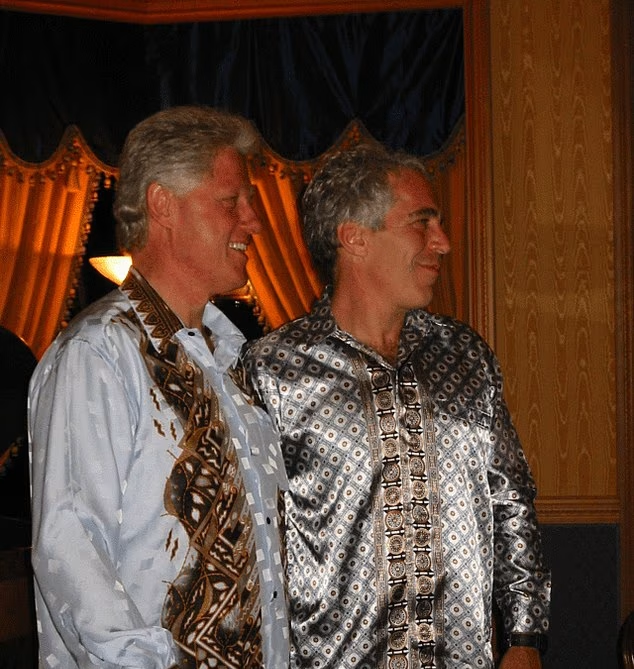
Clinton, who served as the 42nd president of the United States from 1993 to 2001, is featured in several images contained within the documents. In response, his team has gone on the offensive, arguing that the Department of Justice has failed to meet both the legal and ethical standards required under the new transparency law.
“The Epstein Files Transparency Act imposes a clear legal duty on the Department of Justice to produce the full and complete record the public demands and deserves,” Ureña said in the statement. “However, what has been released so far, and the manner in which it was released, makes one thing unmistakably clear: someone or something is being protected.”
The statement stops short of accusing the Justice Department of shielding any specific individual, but raises pointed questions about the selective nature of the disclosures.
“We do not know whom, what, or why,” the statement continued. “But we do know this: We need no such protection.”
Clinton’s team has called on President Donald Trump to intervene directly, urging him to instruct Attorney General Pam Bondi to immediately authorize the release of all remaining records that reference, mention, or include images of the former president.
The demand includes a broad array of materials, such as grand jury transcripts, interview notes, photographs, and any findings produced by the U.S. Attorney’s Office for the Southern District of New York. Clinton’s spokesperson specifically referenced testimony previously given to Congress under oath by Trump’s first-term attorney general, indicating that additional records exist and are subject to disclosure.
According to the statement, withholding any such materials would only deepen public suspicion.
“Refusal to do so will confirm the widespread belief that the Department of Justice’s actions to date are not about transparency,” Ureña said, “but about insinuation — using selective releases to imply wrongdoing about individuals who have already been repeatedly cleared by the very same Department of Justice, across multiple administrations of both parties.”
Jeffrey Epstein, a wealthy financier with extensive connections to global elites, was arrested in 2019 on federal sex trafficking charges. He was later found dead in his New York jail cell while awaiting trial, in what authorities ruled a suicide. His death fueled widespread speculation and conspiracy theories, many of which persist today.
The renewed focus on Epstein comes as the Justice Department continues to release archival material related to its long-running investigation, following years of public pressure and litigation aimed at unsealing records.
Among the images included in the latest release are photographs showing Clinton alongside Epstein associate Ghislaine Maxwell, who is currently serving a prison sentence for her role in Epstein’s sex trafficking operation. One image shows Clinton swimming with Maxwell, a detail that has drawn particular attention online.
Clinton’s representatives have sought to draw a sharp distinction between individuals who severed ties with Epstein before his criminal conduct became public and those who maintained relationships afterward.
“There are two types of people here,” the statement said. “The first group knew nothing and cut Epstein off before his crimes came to light. The second group continued relationships after that. We’re in the first.”
The spokesperson added that no amount of delay or selective disclosure by those in the second category would alter that fact.
Clinton has previously acknowledged limited contact with Epstein but has long denied any knowledge of or involvement in Epstein’s crimes. His team has consistently maintained that any interactions occurred years before Epstein’s illegal activities were exposed and that the former president had no connection to Epstein’s sex trafficking operation.
The Justice Department has emphasized that inclusion in the files does not imply guilt. Officials have repeatedly stated that many of the individuals named or pictured were never accused of wrongdoing and were included solely because they appeared in seized materials or investigative records.
Still, critics argue that partial disclosures risk misleading the public by releasing images or names without sufficient context. Clinton’s statement echoes that concern, warning that piecemeal releases can create damaging impressions even in the absence of evidence.
The Epstein Files Transparency Act, enacted on November 19, 2025, was designed to address those concerns by compelling the Justice Department to release all non-exempt records related to Epstein, subject to limited redactions for victim privacy and national security.
While the Department of Justice has described the current releases as compliant with the law, pressure is mounting from across the political spectrum for greater clarity and completeness.
Several lawmakers have echoed Clinton’s call for full disclosure, arguing that anything less undermines public trust in federal institutions. Others caution that indiscriminate releases could retraumatize victims or unfairly damage reputations.
As the debate continues, Clinton’s demand places the spotlight squarely on the White House and the Justice Department, challenging them to prove that the process is driven by transparency rather than implication.
For now, the release of the Epstein files has reignited public scrutiny of one of the most controversial scandals in recent history — and ensured that questions surrounding who knew what, and when, remain firmly in the national conversation.

Emily Johnson is a critically acclaimed essayist and novelist known for her thought-provoking works centered on feminism, women’s rights, and modern relationships. Born and raised in Portland, Oregon, Emily grew up with a deep love of books, often spending her afternoons at her local library. She went on to study literature and gender studies at UCLA, where she became deeply involved in activism and began publishing essays in campus journals. Her debut essay collection, Voices Unbound, struck a chord with readers nationwide for its fearless exploration of gender dynamics, identity, and the challenges faced by women in contemporary society. Emily later transitioned into fiction, writing novels that balance compelling storytelling with social commentary. Her protagonists are often strong, multidimensional women navigating love, ambition, and the struggles of everyday life, making her a favorite among readers who crave authentic, relatable narratives. Critics praise her ability to merge personal intimacy with universal themes. Off the page, Emily is an advocate for women in publishing, leading workshops that encourage young female writers to embrace their voices. She lives in Seattle with her partner and two rescue cats, where she continues to write, teach, and inspire a new generation of storytellers.