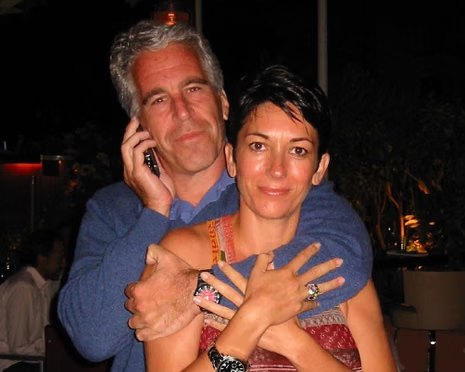
The Department of Justice has released two additional batches of files related to Jeffrey Epstein and Ghislaine Maxwell, containing some of the most disturbing details yet seen from the grand jury records tied to their sex trafficking investigations. Among the hundreds of pages of testimony are accounts of underage girls being coerced into sexually exploitative acts and other explicit behavior while in Epstein’s presence, including instances previously blocked from public view.
The release late Saturday follows a decision earlier this month by a federal judge permitting the disclosure of grand jury materials under the Epstein Files Transparency Act, signed into law by President Donald Trump. Judge Paul Engelmayer ruled that the law overrode the normal confidentiality of grand jury testimony but required redactions to protect victims’ identities.
One of the most shocking revelations comes from a grand jury hearing ahead of Epstein’s planned 2019 federal trial—a trial never held due to his death. An FBI agent testified that a 14-year-old girl visited Epstein’s Palm Beach mansion to give him massages wearing only her underwear, receiving $300 per session. The testimony described lotions and moisturizers in the massage room and walls adorned with nude sketches or paintings. The Palm Beach home itself featured a library described as “straight out of Beauty and the Beast,” highlighting the juxtaposition of opulence and abuse.
The files released Saturday were less redacted than those released Friday, which included 119 pages that were almost entirely blacked out, frustrating lawmakers. Congressman Ro Khanna, one of the law’s authors, criticized the previous release for providing little usable information.
The new documents include notes left for Epstein in 2005, illustrating the operational nature of the abuse: “has girl for tonight” and “she can be here tomorrow from 2pm to whenever.” Another note indicated a girl wanted to speak with Epstein “about college,” reflecting how mentorship or educational promises were used to manipulate victims.
A November 19, 2019, grand jury hearing focused on Maxwell’s federal case revealed that a girl first met Epstein and Maxwell while attending a summer arts program in 1994 at the Interlochen Center for the Arts in Michigan. The 13-year-old girl was approached by the pair while talking to friends at a picnic table. Maxwell and Epstein asked about her classes and teachers, initiating a relationship that would later be exploited. Epstein later visited the girl’s home, claiming he gave scholarships and liked to mentor young people. The girl subsequently spent considerable time at Epstein and Maxwell’s Palm Beach residence, taking part in outings described by agents as grooming.
The transcripts also detail how Epstein exploited the girl’s aspirations to become a model and actress, claiming connections to Victoria’s Secret executives and then sexually abusing her. Many victims were coerced into giving Epstein massages while underage. Maxwell’s role in facilitating abuse is also evident; she was reportedly topless around underage girls at the pool, normalizing sexualized behavior.
The documents include notes and communications revealing a systematized operation. Scheduling of girls’ visits often appeared as appointments, and correspondence suggests manipulation of social and familial dynamics to ensure compliance. Patterns of predatory behavior emerge, showing how Epstein and Maxwell targeted girls at camps, schools, and arts programs, offering gifts, outings, and promises of advancement to coerce participation.
The release has renewed scrutiny of the social and institutional networks that allowed Epstein’s activities to continue. He maintained high-profile connections for decades, prompting questions about how such abuse could continue largely unchecked. Experts note the files’ potential implications for ongoing civil litigation by survivors seeking damages from Epstein’s estate and associated defendants.
The grand jury transcripts, photographs, and notes provide a stark portrait of grooming, manipulation, and coercion that underpinned the abuse, illustrating how victims were drawn into Epstein’s orbit and exploited over years. They offer long-awaited insight into the scope and organization of Epstein and Maxwell’s criminal operations, emphasizing the need for continued investigation and accountability.
While the trauma inflicted on victims cannot be undone, the documents provide transparency, context, and a historical record of one of the most notorious sex trafficking cases in modern U.S. history. They underscore the importance of protecting minors, monitoring power dynamics, and ensuring legal systems prioritize both justice and victim privacy.
As investigators, lawmakers, and advocacy organizations continue to analyze the material, the full scope of Epstein and Maxwell’s crimes—and the lessons they impart—will remain central to discussions of justice, prevention, and accountability for years to come.

Emily Johnson is a critically acclaimed essayist and novelist known for her thought-provoking works centered on feminism, women’s rights, and modern relationships. Born and raised in Portland, Oregon, Emily grew up with a deep love of books, often spending her afternoons at her local library. She went on to study literature and gender studies at UCLA, where she became deeply involved in activism and began publishing essays in campus journals. Her debut essay collection, Voices Unbound, struck a chord with readers nationwide for its fearless exploration of gender dynamics, identity, and the challenges faced by women in contemporary society. Emily later transitioned into fiction, writing novels that balance compelling storytelling with social commentary. Her protagonists are often strong, multidimensional women navigating love, ambition, and the struggles of everyday life, making her a favorite among readers who crave authentic, relatable narratives. Critics praise her ability to merge personal intimacy with universal themes. Off the page, Emily is an advocate for women in publishing, leading workshops that encourage young female writers to embrace their voices. She lives in Seattle with her partner and two rescue cats, where she continues to write, teach, and inspire a new generation of storytellers.