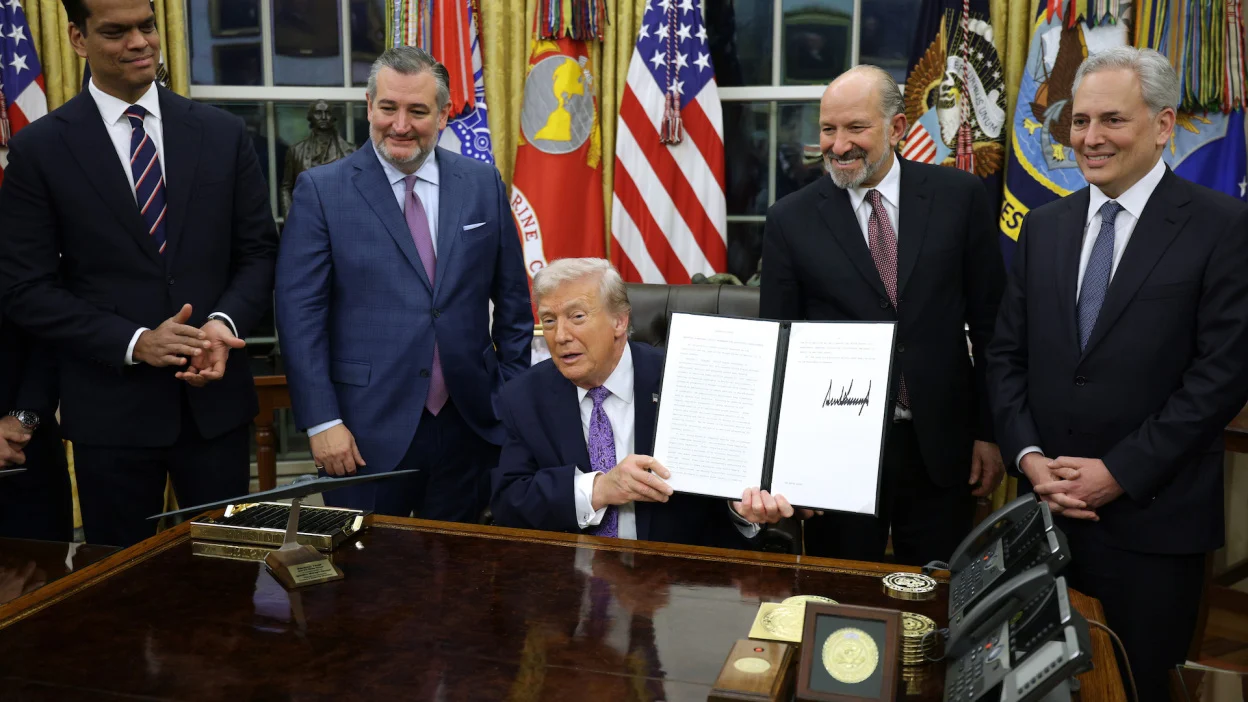
In a move that has ignited debates across the country, President Donald Trump signed an executive order on Thursday aimed at limiting the ability of individual U.S. states to regulate artificial intelligence. The measure, which lacks the force of law, seeks to establish a unified federal approach to AI while creating a taskforce whose “sole responsibility” will be challenging state laws that impose restrictions on the technology.
At a signing ceremony, Trump emphasized the need to streamline AI approval processes, arguing that requiring companies to obtain authorization from 50 different state governments would stifle investment and innovation. “If they had to get 50 different approvals from 50 different states, you could forget it,” Trump said. The president framed the order as a necessary step to maintain the United States’ competitive edge in the global AI race, especially against nations like China, which are rapidly advancing in the sector.
The executive order, titled “Ensuring a National Policy Framework for Artificial Intelligence,” resurrects a legislative idea that failed earlier this year. Republicans had sought a 10-year moratorium on state AI regulations as part of the One Big Beautiful Bill Act, but the effort was removed by a near-unanimous Senate vote. While the bill itself did not become law, the executive order now advances a similar goal: preempting state-level regulation without passing new legislation. Critics have noted that, as an executive order, it carries no legal force to invalidate state laws directly, though the creation of the AI Litigation Task Force could set the stage for federal challenges.
The AI Litigation Task Force, mandated by the order, is directed to review state statutes and identify any that could “require AI models to alter their truthful outputs.” This language is widely interpreted as a potential prelude to legal action against states that have implemented AI safety, transparency, or bias mitigation laws. Likely targets include California, which requires AI companies to disclose safety testing for new models, and Colorado, which mandates risk assessments for algorithmic discrimination in employment practices. By singling out such laws, the administration is signaling a federal preference for minimal oversight, leaving the bulk of regulation in the hands of companies rather than state governments.
Trump’s order has drawn immediate backlash from state officials, civil liberties organizations, and privacy advocates. Many argue that the measure disproportionately benefits major AI companies while exposing consumers, particularly vulnerable populations and children, to potential harms. “Trump’s campaign to threaten, harass, and punish states that seek to pass commonsense AI regulations is just another chapter in his playbook to hand over control of one of the most transformative technologies of our time to big tech CEOs,” said Teri Olle, vice-president of Economic Security California Action, which co-sponsored AI safety legislation in California this year. She added, “This is not about allowing for American innovation. It’s about ensuring the tech companies have unchecked power.”
Supporters of the order, including Silicon Valley executives and conservative tech leaders, have praised the measure as a way to remove regulatory uncertainty. They argue that a fragmented patchwork of state laws could create operational hurdles, slow innovation, and discourage investment. Trump has repeatedly framed the order as essential for maintaining U.S. leadership in AI, warning that the country risks falling behind in the rapidly evolving global market.
“You can’t go through 50 states. You have to get one approval. Fifty is a disaster. You’ll have one woke state and you’ll have to do all woke,” Trump said last month at the U.S.-Saudi Investment Forum. He further argued that state regulations could inject political ideology into AI development, which he and allies contend could limit creativity and competitiveness. On social media, he reiterated this perspective, warning that state-level regulations could “destroy AI in its infancy” and jeopardize U.S. technological supremacy.
The executive order also reflects a broader policy agenda in the Trump administration emphasizing national over local control of emerging technologies. While AI has the potential to generate economic growth, drive productivity, and transform industries, it also presents risks related to privacy, misinformation, algorithmic bias, and environmental impact. Critics argue that the order fails to address these concerns, leaving major corporations with the ability to deploy AI systems with minimal oversight or accountability.
Earlier this year, congressional Republicans attempted to codify a similar federal approach through legislation. The One Big Beautiful Bill Act included a proposed moratorium on state AI regulation, but the measure faced bipartisan opposition and was ultimately removed from the final bill. Despite this legislative setback, the executive order allows the administration to pursue its objectives through administrative means, including the creation of the AI Litigation Task Force within the Department of Justice. This taskforce will likely become a central instrument in enforcing federal supremacy over AI regulation, including initiating lawsuits to challenge state statutes.
Critics have pointed out that the order appears narrowly focused on protecting corporate interests rather than addressing the broader social and ethical implications of AI. Advocacy groups have raised concerns that unchecked AI could exacerbate existing inequalities, contribute to surveillance overreach, and amplify harmful content online. Researchers have also warned that large AI models require substantial computational resources, leading to high energy consumption and environmental costs. Yet the executive order does not include mechanisms for mitigating these issues, prioritizing speed and centralization over oversight.
From an economic perspective, AI has emerged as a major driver of innovation, investment, and global competition. Companies developing large language models, autonomous systems, and predictive analytics tools have lobbied heavily against restrictive regulations. Trump’s order aligns with their interests, emphasizing a hands-off regulatory environment and promising a more streamlined approval process. However, opponents argue that this approach could result in long-term societal risks that outweigh short-term economic gains.
The order also highlights a politically charged dimension to the AI debate. Trump has repeatedly framed AI regulation in terms of ideological control, asserting that left-leaning policies could influence the outputs of generative AI systems. During speeches and interviews, he has expressed concern that so-called “woke” states could impose rules on AI companies that would shape the technology according to progressive agendas. These statements have sparked intense debate among policymakers, technologists, and the public over the proper balance between innovation, safety, and governance.
Legal experts have noted that while the executive order directs the federal government to challenge state regulations, it does not nullify existing laws. The effectiveness of the AI Litigation Task Force will depend on its ability to pursue court cases and navigate complex constitutional questions about state versus federal authority. Scholars have highlighted that any legal challenges could take years to resolve, creating uncertainty for both companies and consumers.
The Trump administration has consistently emphasized its commitment to ensuring that the United States remains the global leader in AI capabilities. White House officials have framed AI as a critical component of national competitiveness, citing advancements in machine learning, autonomous systems, and cybersecurity. However, the administration’s approach prioritizes acceleration and centralization over careful regulation, raising questions about the potential risks to public safety, privacy, and social equity.
“AI is not a sector that can be safely left to corporate self-regulation,” said Dr. Elena Martinez, an AI ethics researcher. “Unchecked deployment of these technologies could result in widespread harm, from algorithmic bias in hiring and lending to automated systems spreading misinformation or engaging in surveillance without accountability.” Civil liberties groups have also criticized the executive order for weakening states’ ability to protect their residents, arguing that local regulation can provide vital safeguards against corporate overreach.
Despite the backlash, Trump and his allies have framed the order as a major victory for innovation. By creating a single, federally guided approach to AI development, they argue, the United States will avoid the delays, bureaucracy, and conflicting requirements that a patchwork of state regulations might impose. AI executives have praised the order as a necessary measure to maintain investment, scale, and competitiveness, particularly in an international context where technological leadership is seen as crucial for national security and economic power.
The executive order comes amid heightened public awareness of AI’s transformative potential, including the rapid adoption of chatbots, generative art systems, and predictive analytics. While the technology promises unprecedented capabilities, it also raises ethical, social, and economic questions. Experts note that without appropriate checks, AI could exacerbate inequities, amplify harmful content, and undermine trust in digital platforms. Critics warn that Trump’s approach, by prioritizing unfettered development over safety, could have far-reaching consequences for society.
Trump’s order also intersects with broader geopolitical concerns. The administration has repeatedly cited China as a primary competitor in the AI space, emphasizing the need for the United States to maintain technological superiority. This framing has helped justify aggressive federal action, including efforts to preempt state regulations that might slow development. Supporters argue that without a unified federal strategy, U.S. companies risk losing their competitive edge in the global market, potentially ceding leadership to foreign competitors.
Ultimately, the executive order represents a defining moment in the ongoing debate over AI governance. By limiting state-level regulation and centralizing authority in the federal government, the Trump administration has signaled its commitment to a rapid, innovation-driven approach, while simultaneously drawing sharp criticism from advocates of safety, ethics, and consumer protection. The order has set the stage for a prolonged conflict between federal authorities, state governments, and private industry over the future of one of the most transformative technologies of the 21st century.
As the AI Litigation Task Force begins its work, observers expect a wave of legal challenges and policy debates that will shape the trajectory of artificial intelligence in the United States for years to come. Meanwhile, public discourse around the order highlights the tension between innovation, regulatory oversight, and societal responsibility, underscoring the stakes of balancing economic growth with ethical governance in an era defined by rapidly advancing technology.

Emily Johnson is a critically acclaimed essayist and novelist known for her thought-provoking works centered on feminism, women’s rights, and modern relationships. Born and raised in Portland, Oregon, Emily grew up with a deep love of books, often spending her afternoons at her local library. She went on to study literature and gender studies at UCLA, where she became deeply involved in activism and began publishing essays in campus journals. Her debut essay collection, Voices Unbound, struck a chord with readers nationwide for its fearless exploration of gender dynamics, identity, and the challenges faced by women in contemporary society. Emily later transitioned into fiction, writing novels that balance compelling storytelling with social commentary. Her protagonists are often strong, multidimensional women navigating love, ambition, and the struggles of everyday life, making her a favorite among readers who crave authentic, relatable narratives. Critics praise her ability to merge personal intimacy with universal themes. Off the page, Emily is an advocate for women in publishing, leading workshops that encourage young female writers to embrace their voices. She lives in Seattle with her partner and two rescue cats, where she continues to write, teach, and inspire a new generation of storytellers.