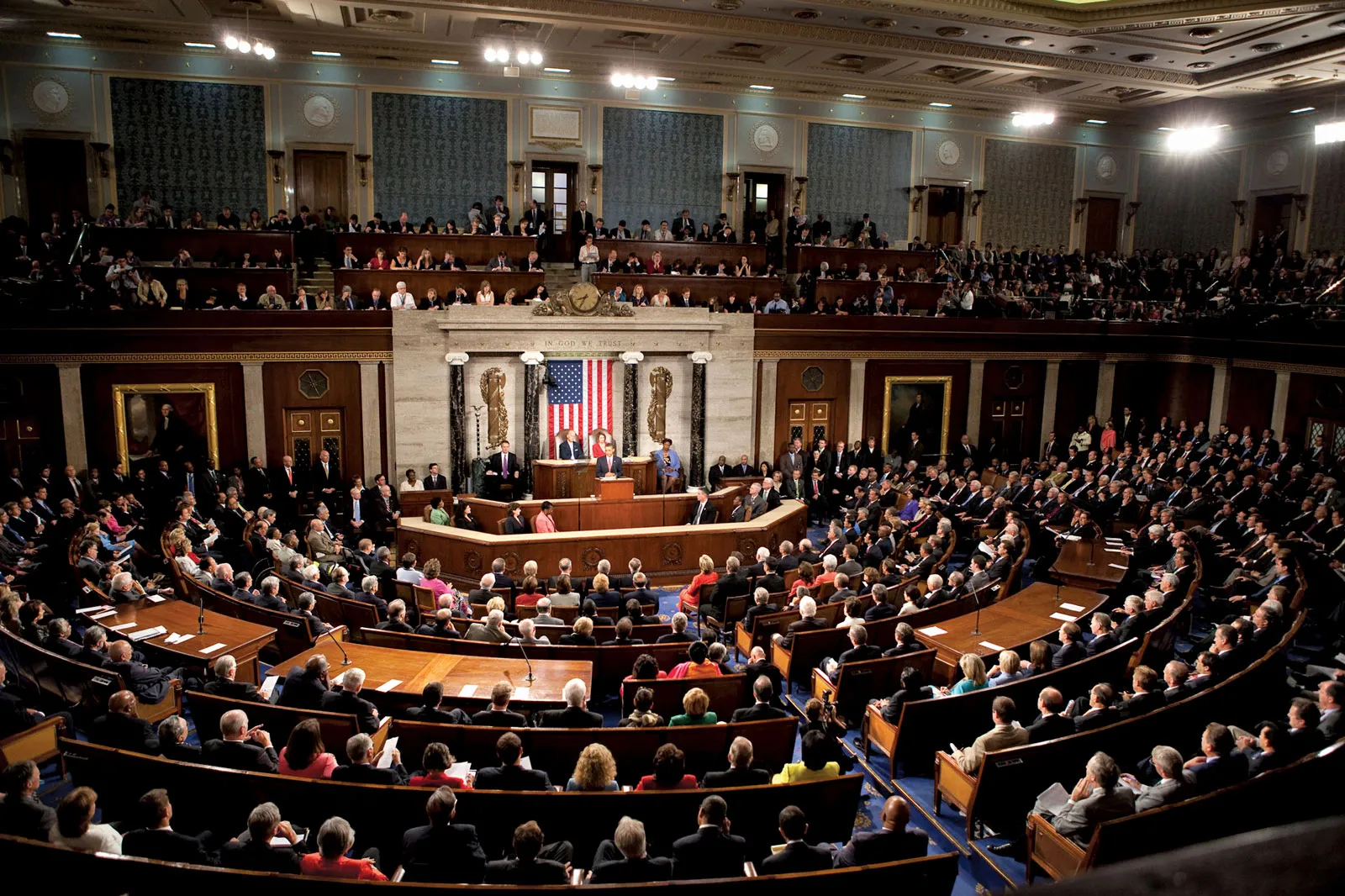
A significant bipartisan break emerged in the House of Representatives this week as more than a dozen Republican lawmakers joined Democrats to advance legislation aimed at overturning a major executive order issued by President Donald Trump. The vote marked a rare and consequential rebuke of the administration from within the president’s own party, highlighting growing divisions over labor rights, executive authority, and the role of unions in the federal workforce.
The House voted 222–200 on Wednesday to move forward with legislation designed to nullify a March executive order that eliminated collective bargaining rights for roughly one million federal employees. The executive action had barred collective bargaining across wide swaths of the federal government, particularly in agencies tied to national security and public safety. While Republicans largely opposed the effort, 13 GOP members broke ranks and voted with Democrats, allowing the bill to clear a critical procedural hurdle.
The legislation was brought to the floor by Rep. Jared Golden, a Democrat from Maine, using a discharge petition—a rarely successful parliamentary tool that enables lawmakers to force a vote on legislation even when House leadership declines to schedule it. Under House rules, a discharge petition requires the signatures or support of a majority of members, making its success both politically and procedurally notable.
Golden’s bill, formally titled the Protect America’s Workforce Act (PAWA), seeks to restore collective bargaining rights for federal employees across a range of departments affected by the executive order. These include agencies involved in defense, diplomacy, veterans’ services, energy oversight, and health care—sectors that employ large numbers of military veterans and specialized professionals.
Republicans Break With the White House
The 13 Republicans who voted to advance the bill were Reps. Jeff Van Drew of New Jersey; Nicole Malliotakis, Nick LaLota, Mike Lawler, and Tom Kean Jr. of New York and New Jersey; Brian Fitzpatrick, Rob Bresnahan, and Ryan Mackenzie of Pennsylvania; Don Bacon of Nebraska; Zach Nunn of Iowa; Chris Smith of New Jersey; Pete Stauber of Minnesota; and Mike Turner of Ohio.
Their decision to side with Democrats was critical to the bill’s advancement and underscored internal disagreements within the Republican conference. While GOP leadership and the White House have defended the executive order as a necessary national security measure, these lawmakers argued that the action went too far and unfairly stripped workers of long-standing rights.
Five Republicans—Fitzpatrick, Bacon, Bresnahan, LaLota, and Lawler—served as formal co-sponsors of the legislation. Four additional Republicans co-sponsored the bill but did not sign the discharge petition itself, reflecting a more cautious approach amid pressure from party leadership.
What the Executive Order Did
The executive order at the center of the controversy eliminated collective bargaining rights for federal employees in multiple departments, including portions of the Departments of Defense, State, Veterans Affairs, Justice, and Energy. It also applied to certain positions within the Departments of Homeland Security, Treasury, Health and Human Services, Interior, and Agriculture.
The administration argued that union activity within these agencies could hinder operational efficiency and compromise national security. The White House framed the move as an effort to streamline management, reduce bureaucracy, and ensure that agency leaders retained maximum flexibility.
Critics, however, described the order as the most sweeping rollback of federal labor rights in modern U.S. history. They argued that it silenced workers who play essential roles in national defense, public health, and veterans’ care, while doing little to address actual security risks.
Federal Workers and Union Rights
Unlike private-sector employees, federal workers already operate under significant restrictions when it comes to labor organizing. They are prohibited from striking and cannot negotiate over wages or benefits. Collective bargaining in the federal government is limited primarily to workplace conditions, scheduling, safety standards, and grievance procedures.
Supporters of PAWA argue that even these limited rights are essential for workforce morale, accountability, and operational stability. They contend that eliminating collective bargaining entirely removes an important channel for resolving disputes before they escalate into larger problems.
Golden emphasized this point in remarks following the vote, noting that many of the workers affected by the executive order serve in highly sensitive and demanding roles.
“President Trump said ending collective bargaining was about protecting our national defense,” Golden said. “But in my district, many affected workers build our warships and care for our veterans. These workers make our country safer and stronger every day.”
Golden added that voters did not elect lawmakers to silence federal employees and that the legislation provides an opportunity to restore their voice. “If the majority we built over the past few months sticks together, we can overturn this union-busting executive order,” he said.
Bipartisan Justifications
Republican co-sponsor Brian Fitzpatrick of Pennsylvania framed the vote as a reaffirmation of the House’s institutional role rather than a partisan statement.
“Today’s vote is a reminder of what this House can accomplish when we honor its purpose and allow the people’s will to move forward,” Fitzpatrick said. He argued that protecting national security and respecting workers’ rights are not mutually exclusive goals.
“Federal workers, many of whom are veterans, are the backbone of our public service,” Fitzpatrick added. “When they have a voice in the decisions that shape their work, our government is more stable, more capable, and better prepared to serve the American people.”
Fitzpatrick urged lawmakers to maintain the bipartisan coalition through the final vote, calling the effort a test of Congress’s ability to rise above party lines.
Labor Groups Applaud the Move
Organized labor quickly praised the House vote. Liz Shuler, president of the AFL-CIO, described the development as a major victory for the labor movement.
“The labor movement fought back against the largest act of union-busting in American history by doing what we do best: organizing,” Shuler said. She credited grassroots mobilization and bipartisan outreach for building enough momentum to overcome leadership resistance.
Union leaders argue that the executive order undermined decades of labor-management cooperation within the federal government and set a precedent that could eventually extend to private-sector labor protections.
https://twitter.com/EricLDaugh/status/1998912315672977728
What Happens Next
Wednesday’s vote does not immediately overturn the executive order but clears the way for full floor debate and a final House vote on the Protect America’s Workforce Act. If passed, the bill would move to the Senate, where its future is less certain.
The White House has not indicated whether the president would sign or veto the legislation if it reaches his desk. Administration officials have continued to defend the executive order as a necessary reform, signaling a potential showdown between Congress and the executive branch.
The vote also raises broader questions about executive authority and congressional oversight. By using a discharge petition, lawmakers demonstrated their willingness to bypass leadership structures to challenge presidential actions—an approach that could be replicated in future disputes.
As debate continues, the outcome of PAWA may hinge on whether the fragile bipartisan coalition holds. For now, the vote represents a rare moment of cross-party alignment and a clear signal that executive orders affecting millions of workers are not immune from legislative pushback.

Emily Johnson is a critically acclaimed essayist and novelist known for her thought-provoking works centered on feminism, women’s rights, and modern relationships. Born and raised in Portland, Oregon, Emily grew up with a deep love of books, often spending her afternoons at her local library. She went on to study literature and gender studies at UCLA, where she became deeply involved in activism and began publishing essays in campus journals. Her debut essay collection, Voices Unbound, struck a chord with readers nationwide for its fearless exploration of gender dynamics, identity, and the challenges faced by women in contemporary society. Emily later transitioned into fiction, writing novels that balance compelling storytelling with social commentary. Her protagonists are often strong, multidimensional women navigating love, ambition, and the struggles of everyday life, making her a favorite among readers who crave authentic, relatable narratives. Critics praise her ability to merge personal intimacy with universal themes. Off the page, Emily is an advocate for women in publishing, leading workshops that encourage young female writers to embrace their voices. She lives in Seattle with her partner and two rescue cats, where she continues to write, teach, and inspire a new generation of storytellers.