


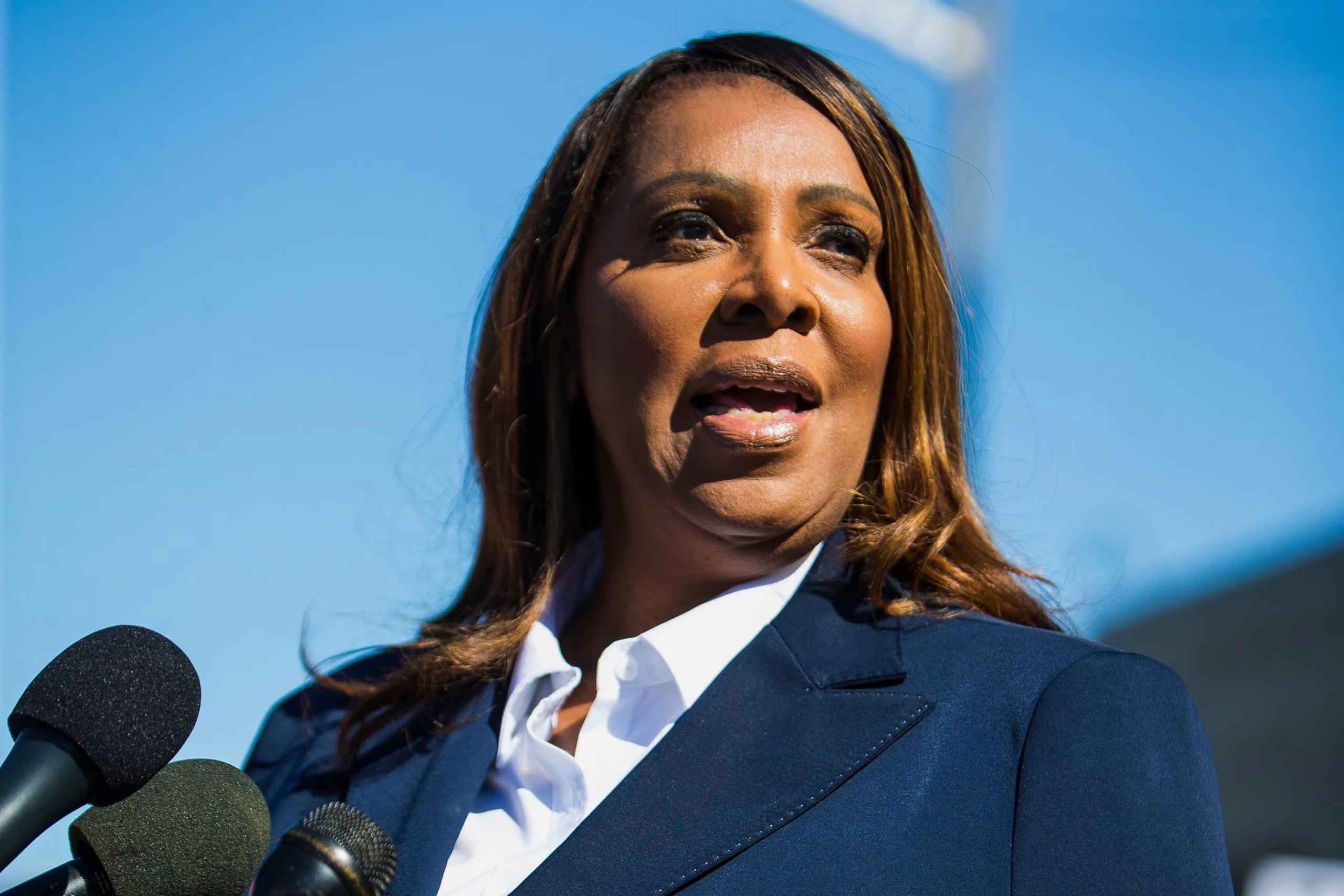
The legal showdown over the authority of the Trump administration’s handpicked prosecutors continues in Albany, New York, as Attorney General Letitia James has taken a bold step in challenging two grand jury subpoenas issued to her office. The subpoenas, related to civil cases against the Trump Organization and the National Rifle Association (NRA), were served by the Federal Bureau of Investigation (FBI) and have become the focal point of a heated legal and political dispute over the limits of federal prosecutorial power.
At the heart of the dispute is Acting U.S. Attorney John Sarcone, whose appointment as Northern New York’s chief federal law enforcement officer has been widely criticized and challenged in courts across the nation. Sarcone, appointed by the Trump administration, has faced questions over the legality of his authority to act in the role, particularly in light of a broader pattern in which the administration bypassed the Senate confirmation process for multiple U.S. attorneys.
The subpoenas in question, issued by a grand jury in Albany in August, requested that James’ office turn over all documents and records related to her civil cases against the Trump Organization and the NRA. James’ legal team quickly moved to quash the subpoenas, arguing that they were issued in bad faith, lacked a legitimate legal basis, and infringed upon state sovereignty and constitutional protections, including First Amendment rights. Additionally, the subpoenas were issued by a federal prosecutor whose appointment they claim was unlawful.
In court filings, attorneys representing James framed the subpoenas as part of a broader, politically motivated campaign by the Trump administration to retaliate against her for holding the president and his allies accountable. “The Executive Branch seeks to transform a personal grievance, which failed as civil claims, into a federal criminal prosecution—a plain and calculated campaign to harass a law enforcement agency that held Mr. Trump and his organization to account,” the motion to quash the subpoenas stated.
The backdrop to the subpoenas includes James’ successful civil litigation against Trump last year, in which she secured a $500 million penalty against the former president for allegedly inflating his net worth to secure more favorable business deals. While a state appeals court later vacated the financial penalty, the civil case drew national attention and highlighted James’ determination to investigate potential misconduct within Trump’s business dealings. According to court filings, the subpoenas were issued to investigate whether James’ office “selectively pursued” these lawsuits while ignoring similar claims against other entities and individuals.
Prosecutors defending the subpoenas argue that the grand jury has broad authority to investigate potential violations of federal law. They assert that James repeatedly promised to investigate, prosecute, and sue both the NRA and Trump, and that the subpoenas are therefore a legitimate tool to determine whether she abused her prosecutorial discretion. “The challenged subpoenas … were issued by a validly empaneled grand jury in the Northern District of New York, which is entitled to investigate whether Attorney General Letitia James—alone or in concert with others—violated federal law by selectively pursuing the NYOAG lawsuits against the NRA and President Trump when other similarly situated entities and individuals went unpursued,” prosecutors wrote in their court filing.
The hearing in Albany comes at a time when multiple courts nationwide have scrutinized the Trump administration’s unconventional method of appointing U.S. attorneys. Federal judges have increasingly ruled against the authority of several of these handpicked prosecutors. Recent examples include the dismissal of criminal cases against James and former FBI Director James Comey due to the lack of lawful authority held by the appointed prosecutors, as well as the disqualification of Alina Habba as the U.S. attorney in New Jersey. These rulings have highlighted a growing legal tension over the administration’s attempts to maintain control over key federal offices without Senate confirmation.
In Albany, U.S. District Judge Lorna Schofield, who is overseeing the case after judges from the Northern District recused themselves, has narrowed the scope of the hearing to a single issue: whether Sarcone’s allegedly unlawful appointment invalidates the subpoenas. Sarcone has functioned as the Acting U.S. attorney in Northern New York, but a panel of judges refused to approve a permanent appointment after his controversial interim tenure. In response, Attorney General Pam Bondi appointed Sarcone as a “special attorney to the attorney general,” effectively allowing him to serve indefinitely as the top federal prosecutor in Northern New York.
Lawyers for James argue that the subpoenas are part of a coordinated effort by the Trump administration to exert political pressure and punish a state attorney general who has challenged the former president and his allies. “The U.S. Department of Justice asks this Court to treat this as an ordinary case. It portrays the subpoenas as routine and recites the usual standards governing grand jury investigations, while trying to convince this Court to ignore the extraordinary reality before it—that these subpoenas are a flagrant abuse of the criminal justice system, even by this President’s standards,” James’ attorneys wrote in a motion to quash.
The legal and political stakes of this case are high. A ruling that Sarcone lacked the authority to issue the subpoenas could have far-reaching implications for other cases initiated by handpicked Trump appointees across the country. It could also reinforce concerns about the administration’s attempts to circumvent long-standing legal and procedural norms in appointing federal prosecutors. Conversely, if the court upholds the subpoenas, it could embolden the administration to pursue aggressive investigations of state attorneys general and other officials who have pursued legal actions against Trump and his allies.
Legal experts note that the case exemplifies a broader struggle between federal and state authorities, particularly when politically sensitive cases intersect with questions about the legitimacy of federal appointments. “This is not just about Letitia James or Trump,” said one legal analyst familiar with the case. “It’s about the authority of the federal government to investigate, the independence of state officials, and whether the mechanisms of checks and balances are being respected.”
The case also underscores the growing tension between the Trump administration and elected state officials who have pursued legal action against the former president. Across the country, similar conflicts have emerged, with federal prosecutors’ appointments being challenged in Nevada, California, and New Jersey. In each instance, Trump’s appointees have remained in charge of their respective offices despite federal judges ruling on their authority, reflecting a broader pattern of legal resistance and political maneuvering.
For James, the subpoenas represent more than a procedural challenge—they symbolize the ongoing pushback against her efforts to hold powerful figures accountable. Her office has been at the forefront of several high-profile investigations into Trump and his allies, and the legal fight in Albany could set precedent for how state attorneys general can defend their independence against federal encroachment.
Observers note that the case is likely to draw national attention given the prominent figures involved and the potential implications for the balance of power between federal and state law enforcement. Legal scholars have emphasized that the court’s decision could influence ongoing debates about the proper scope of federal authority, the independence of state prosecutors, and the role of grand juries in politically sensitive investigations.
While the immediate hearing focuses solely on the authority of Sarcone to issue the subpoenas, the broader narrative touches on questions of accountability, fairness, and the integrity of the justice system. Both sides are expected to present detailed arguments regarding the legality of the subpoenas, the validity of Sarcone’s appointment, and the broader implications for federal-state relations in high-profile political cases.
The outcome of today’s hearing could have lasting effects not only on the Trump Organization and NRA cases but also on the wider landscape of federal oversight and the independence of state legal authorities. Legal analysts suggest that a ruling in favor of James could strengthen state attorneys general across the country, providing a safeguard against politically motivated federal investigations. Conversely, a ruling in favor of the federal prosecutors could embolden aggressive federal oversight in politically sensitive matters, potentially reshaping the dynamics of state-federal interactions for years to come.
As the legal drama unfolds, both sides have emphasized the importance of precedent and procedural rigor. James’ legal team continues to frame the subpoenas as an extraordinary overreach, while federal prosecutors maintain that the grand jury’s investigative powers are vast and must be respected regardless of political context.
The Albany courtroom today will thus serve as a critical battleground, testing the limits of federal authority, the independence of state officials, and the judiciary’s ability to navigate politically charged investigations without succumbing to pressure from executive branch actors.
While the immediate focus remains on the question of Sarcone’s authority, the broader implications extend to the ongoing debate over the balance of power between state and federal governments, particularly when politically sensitive investigations are at stake. Both legal experts and political observers are watching closely, recognizing that the court’s decision could shape the conduct of federal investigations for years to come.
In conclusion, Letitia James’ challenge to the grand jury subpoenas in the Trump and NRA cases is a defining moment in the ongoing struggle between federal power and state independence. The hearing in Albany will test not only the legality of Sarcone’s appointment but also the resilience of state authorities in the face of politically motivated federal scrutiny. The outcome will have significant implications for the administration of justice, the protection of state sovereignty, and the broader principles of accountability and rule of law in politically charged environments.

Emily Johnson is a critically acclaimed essayist and novelist known for her thought-provoking works centered on feminism, women’s rights, and modern relationships. Born and raised in Portland, Oregon, Emily grew up with a deep love of books, often spending her afternoons at her local library. She went on to study literature and gender studies at UCLA, where she became deeply involved in activism and began publishing essays in campus journals. Her debut essay collection, Voices Unbound, struck a chord with readers nationwide for its fearless exploration of gender dynamics, identity, and the challenges faced by women in contemporary society. Emily later transitioned into fiction, writing novels that balance compelling storytelling with social commentary. Her protagonists are often strong, multidimensional women navigating love, ambition, and the struggles of everyday life, making her a favorite among readers who crave authentic, relatable narratives. Critics praise her ability to merge personal intimacy with universal themes. Off the page, Emily is an advocate for women in publishing, leading workshops that encourage young female writers to embrace their voices. She lives in Seattle with her partner and two rescue cats, where she continues to write, teach, and inspire a new generation of storytellers.