


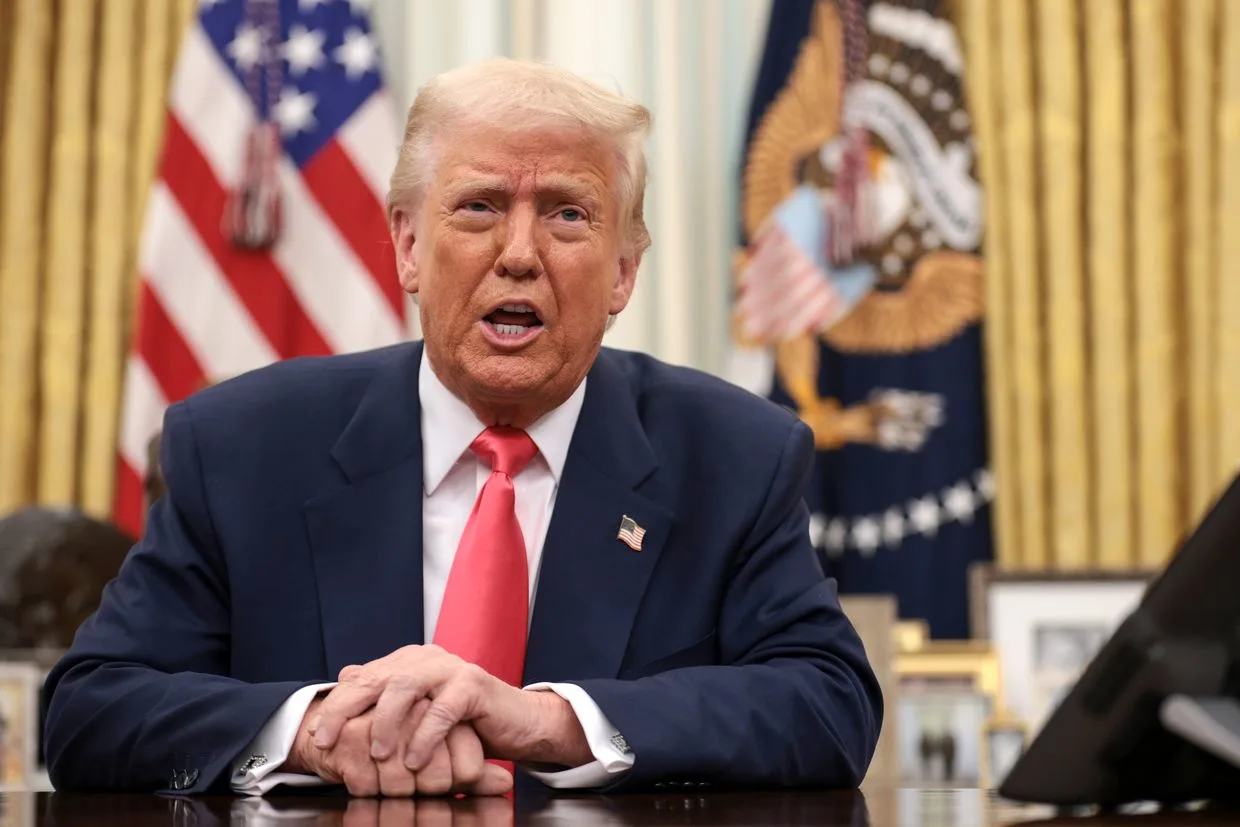
President Donald Trump confirmed Thursday that his administration is reviewing whether the family of the man accused of ambushing two National Guard members in Washington, D.C., should be deported. The remarks, made during a brief but tense exchange with NewsNation reporter Libbey Dean, come less than 24 hours after a shocking attack that has reignited national debates about border security, refugee vetting, and the consequences of the Biden-era Afghan resettlement program.
Federal investigators identified the shooter as Rahmanullah Lakanwal, a 29-year-old Afghan national who entered the United States in 2021 under the chaotic Operation Allies Welcome initiative. According to officials, Lakanwal opened fire near Farragut Square—just two blocks from the White House—killing 20-year-old Spc. Sarah Beckstrom of the West Virginia National Guard and leaving Air Force Staff Sgt. Andrew Wolfe, 24, fighting for his life.
The attack unfolded in minutes. Beckstrom and Wolfe were stationed in a federal security role as part of the Trump administration’s urban crime crackdown. Witnesses reported sudden gunfire, followed by other Guardsmen tackling the shooter to the ground. According to sources, Lakanwal was heard shouting “Allahu Akbar” as he was subdued.
When asked directly whether he intends to remove the shooter’s wife and five children—who reside in Washington state—President Trump didn’t hesitate.
“Well, we’re looking at that right now. We’re looking at the whole situation with family. Tragic situation,” he said.
His response immediately set off a political firestorm, with conservatives demanding a full immigration audit and Democrats accusing the administration of scapegoating. But given the gravity of the attack, the mood among the public—especially military families—is unmistakably tense.
A Sudden Political Earthquake
The revelation that Lakanwal came to America during the Biden administration’s rushed Afghan withdrawal only heightened emotions. The fall of Kabul produced one of the largest uncontrolled migration flows into the U.S. since the Vietnam era, and critics warned at the time that vetting was rushed and incomplete.
Under Trump, Lakanwal reportedly received asylum approval, though FBI Director Kash Patel has released few details about what prompted the decision or how thoroughly the applicant was screened.
The Homeland Security system has undergone intense strain for years, but the combination of rushed processing, missing biometric data, and unclear intelligence reporting made the Afghan resettlement effort a uniquely fragile operation. After Wednesday’s shooting, that fragility is now front and center.
The White House acted swiftly. USCIS Director Joseph Edlow announced that every green card issued to citizens of 19 countries of concern is now under full-scale review. Worse for Afghan applicants, the agency has suspended all pending applications from Afghan nationals until further notice.
“At the direction of @POTUS,” Edlow said on X, “I have directed a full-scale, rigorous reexamination of every Green Card for every alien from every country of concern.”
In addition, Trump has vowed to “permanently pause migration from all Third World Countries”, a declaration that sent Washington into a flurry of debate but electrified Trump’s supporters, who say the attack is exactly why such policies are necessary.
Behind Closed Doors
Within hours of the shooting, senior officials from DHS, DOJ, FBI, and the National Guard convened in an emergency security briefing. Sources familiar with the discussions say the administration is examining all individuals connected to Lakanwal’s movement in and out of the country since 2021.
While the president’s comments about deporting the shooter’s family drew the most headlines, the review extends far deeper. Investigators are looking at whether Lakanwal had assistance, whether he communicated with extremist networks, and whether gaps in the asylum approval process directly contributed to the tragedy.
According to the Washington Times, the suspect overstayed his visa and was living in the U.S. illegally before gaining asylum. Those revelations have pushed long-standing questions about immigration enforcement back into the spotlight.
Why the Base Is Furious
To the conservative base—especially veterans and military families—this shooting hit a nerve. Two young service members, both from West Virginia, were deployed to D.C. to help restore order in a city that has struggled with rising crime and persistent political tension. One is now dead. The other may not survive.
Beckstrom, the fallen Guardsman, volunteered to cover holiday duty. She served with the 863rd Military Police Company, a unit dedicated to protecting communities both at home and abroad. Her death has prompted an outpouring of grief across the state.
Meanwhile, Democrats are already facing scrutiny for years of downplaying crime spikes and attacking Trump’s renewed reliance on National Guard deployments. Some lawmakers argued as recently as last month that such deployments risked “militarizing” urban spaces.
Now, after one of the deadliest attacks on Guard personnel in recent memory, those same arguments sound hopelessly out of tune.
The Stakes Couldn’t Be Higher
This incident has the potential to redefine immigration policy for years. Trump’s push for aggressive deportations, tougher vetting, and mass reviews of green cards has always been controversial. But the fact that the suspect not only entered the U.S. under Biden’s program but later secured asylum has given new ammunition to the administration’s argument that the system is fundamentally broken.
For Afghan advocacy groups like Afghan Evac, the tragedy is a nightmare scenario—one that threatens to overshadow the sacrifices of thousands who fought alongside U.S. troops. Shawn VanDiver, president of the organization, warned against blaming an entire population.
“We can’t let the actions of one deranged individual totally vilify an entire population,” he said.
But for many Americans, especially those in the heartland, the argument rings hollow in the face of a dead soldier, a critically injured airman, and the sense that Washington has lost control of its own national security.
What Happens Next
U.S. Attorney Jeanine Pirro announced that Lakanwal now faces first-degree murder, several firearm charges, and additional counts of assault with intent to kill. She added that “many more charges” are expected.
“The young woman who died—she was ambushed on a cold street in our nation’s capital,” Pirro said. “We will pursue every charge available.”
The FBI is investigating the shooting as a potential act of terrorism, though officials have not yet announced a formal determination.
Meanwhile, pressure is mounting for the Trump administration to release more information about how Lakanwal was vetted, what intelligence existed about his past, and why he was able to live in the U.S. for years without triggering security alarms.
Republicans say the answers will expose deeper failures of the Biden withdrawal. Democrats are bracing for yet another policy battle they seem poorly positioned to win.
What is clear is that this attack has reshaped the national conversation—and placed immigration, asylum, and national security at the center of American politics once again.

Sarah Mitchell is a bestselling novelist recognized for her insightful and emotionally resonant stories that explore the complexities of human relationships. Originally from Denver, Colorado, Sarah grew up in a family of teachers who nurtured her curiosity and love for storytelling. She studied psychology at Stanford University, where she became fascinated by the intricacies of human behavior—an interest that would later shape her writing career. Sarah’s novels are praised for their nuanced characters, intricate plots, and ability to capture the subtle tensions that define love, friendship, and family ties. Her breakthrough novel, The Spaces Between Us, became an instant bestseller, lauded for its honest portrayal of strained family relationships and the fragile bonds that hold people together. Since then, she has published several works that continue to captivate audiences around the world. Outside of her writing career, Sarah is passionate about mental health advocacy and often partners with organizations to promote awareness and support for those struggling with emotional well-being. Her personal life is quieter—she enjoys hiking in the Colorado mountains, practicing yoga, and spending time with close friends. With each new book, Sarah Mitchell cements her reputation as a writer who illuminates the beauty and struggles of human connection.