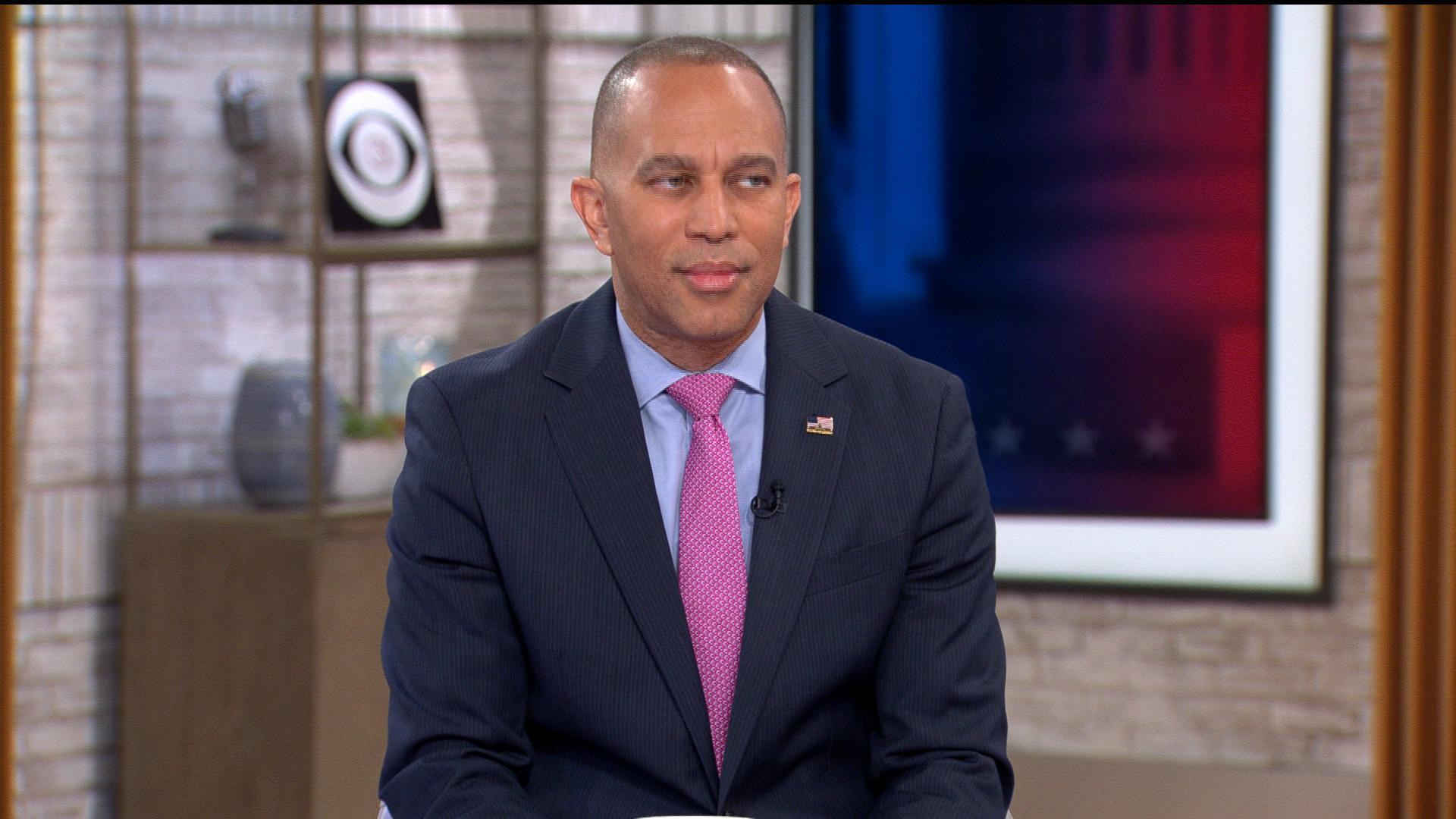
House Minority Leader Hakeem Jeffries found himself in a deeply uncomfortable spotlight this week after a reporter confronted him with a pointed question that Democrats and much of the media have gone to great lengths to avoid. The topic? Democratic Delegate Stacey Plaskett’s documented communications with Jeffrey Epstein during a 2019 congressional hearing — communications that have resurfaced just as the Epstein files once again dominate national conversation.
It was a moment that could have offered clarity or confidence from the top Democrat in the House. Instead, what Americans got was something quite different: hesitation, stumbling, and a visible scramble to dodge the question altogether.
For a party that insists it wants transparency on all matters related to Epstein, Jeffries’ reaction left many asking why the Democratic leadership can’t bring itself to directly address misconduct inside its own ranks.
A Scandal the Media Would Rather Memory-Hole
To understand the weight of the question Jeffries faced, it’s worth recalling the details — details that, remarkably, have received only a fraction of the scrutiny they would have received had they involved a Republican.
In 2019, the Washington Post reported that Del. Stacey Plaskett exchanged text messages with Jeffrey Epstein during a House hearing involving former Trump attorney Michael Cohen. Epstein, who at that time was under renewed public scrutiny due to past convictions and ongoing investigations, reportedly messaged Plaskett in real time while she questioned Cohen. According to the report, Plaskett even adjusted her questioning based on Epstein’s cues.
The revelation was stunning on its face. A sitting member of Congress, communicating with Epstein during a hearing, taking political guidance from him — and during an event designed to damage Donald Trump. Add to that the fact that Plaskett had taken donations from Epstein and initially resisted returning the money, and the situation becomes even more staggering.
Despite the gravity of the story, large portions of the media left it untouched. Many outlets pushed it aside. Others barely mentioned it at all. And some ignored it outright.
But this week, as the renewed release of Epstein-related documents shakes political circles, the story has resurfaced — much to the discomfort of Democratic leadership.
The Question Jeffries Didn’t Want to Answer
The moment came when a reporter asked Jeffries:
“Why should Americans trust you and House Democrats on the Jeffrey Epstein files when one of your own—Congresswoman Plaskett—was found to be texting with Jeffrey Epstein during a hearing, getting information from him, using that in her questioning during a congressional hearing, at one point he tells her ‘good job’?”
It was a clean, fair, direct question. And it referenced verifiable reporting from one of the nation’s most prominent newspapers. Any leader confident in his caucus might have addressed it head-on.
But Jeffries didn’t.
Instead, he offered a halting, deflective response:
“This is a bipartisan effort to make sure that, consistent with what the survivors have requested, that there’s full and complete transparency and every single predator that may be in those Justice Department files doesn’t escape accountability.”
Missing was any acknowledgement of the facts in the question. Missing was any mention of Plaskett. Missing was any assurance that the matter was handled. Missing was even the slightest explanation.
The stammering response was so evasive that it drew immediate attention online — not from Republicans, but from Americans of all political stripes who sensed Jeffries was dodging something he didn’t want to discuss.
For a party that claims it wants transparency, the moment felt anything but transparent.
https://twitter.com/washingtonpost/status/1989483659980628191
When Deflection Becomes the Story
Jeffries’ non-answer immediately became an emblem of what critics argue is the Democrats’ ongoing reluctance to confront Epstein connections within their own ranks. And the timing of it could not be worse for the party.
While Trump opponents have attempted to revive smears and insinuations around Epstein, the renewed public documents and testimony emerging this year have overwhelmed those attempts — pointing instead to a long list of high-profile Democrats, donors, and cultural elites. That shift has rattled many in the Democratic Party, eager to redirect attention away from their own vulnerabilities.
Jeffries’ reaction only underscored that tension.
The Democrats’ messaging machine is usually polished. But in a rare moment, the façade slipped — and the public saw a leader visibly tripped up by a question that should not have been difficult to address if the party had dealt with the Plaskett issue honestly years ago.
A Forgotten Email That Raises Even More Questions
Yet the Plaskett story isn’t the only loose thread hanging over Jeffries. As if his awkward answer wasn’t enough, another revelation has emerged — one tying Epstein to Jeffries more directly, years before the scandal involving Plaskett.
A newly uncovered email revealed that a Democratic fundraising group reached out to Epstein in 2013 regarding “Brooklyn’s Barack” — a nickname used by donors and activists promoting Hakeem Jeffries as a rising Democratic star.
The email, sent to Epstein long after his 2008 conviction, described Jeffries as “an impressive guy” who would be “a progressive voice in New York politics for years to come.” The sender encouraged Epstein to contact them by phone or email to discuss support for Jeffries.
The email does not say Epstein donated to Jeffries. It does not suggest Jeffries was personally communicating with Epstein. And it does not accuse Jeffries of wrongdoing.
But the fact that Democratic political groups — fully aware of Epstein’s history by 2013 — reached out to him in support of Jeffries is a storyline no Democratic strategist wants to explain.
Especially not during a week when the Epstein files are dominating headlines.
https://twitter.com/GuntherEagleman/status/1990542223864139964
The Media Double Standard Returns
If any Republican had been in Plaskett’s position — exchanging texts with Epstein during a hearing, receiving donations from him, altering their questioning based on his advice — the media firestorm would have lasted for months. There would have been breaking-news banners, wall-to-wall coverage, and perhaps even televised hearings.
Instead, the story was buried.
If any Republican fundraising group had emailed Epstein in 2013 promoting a rising conservative star, openly soliciting his involvement, it would have been treated as a scandal of national importance.
Instead, silence.
Jeffries’ stumble this week didn’t happen in isolation — it happened because a reporter asked a question the media had largely refused to touch. And the reason the moment went viral was simple: Americans are tired of selective outrage.
Both parties should face tough questions. Both parties should be held to the same standard. Both parties should be forced to explain questionable associations.
But that’s not what happens.
And the moment Jeffries tried to talk his way around the question, the public recognized the pattern instantly.
A Leader Who Doesn’t Want the Spotlight
Jeffries’ discomfort was unmistakable. It’s not the first time he’s faced questions that cut too close to Democratic vulnerabilities, but it may be the clearest example yet of why many on the left would prefer Epstein discussions remain tightly controlled, carefully framed, and politically convenient.
Even his defenders admitted the optics were bad.
Jeffries’ comparison to Barack Obama — a favorite line among some Democratic commentators — suddenly felt hollow. Whatever one thinks of Obama politically, he was rarely caught unprepared. Jeffries, by contrast, struggled to form even a basic deflection.
And that’s what makes the moment politically damaging.
Americans saw a leading Democrat:
-
avoid addressing a legitimate question
-
fumble through a canned talking point
-
stumble over his own words
-
and dodge any mention of Plaskett’s actions
It wasn’t a scandal created by Republicans. It wasn’t a smear. It wasn’t speculation. It was a reporter asking about documented behavior.
And Jeffries couldn’t answer.
https://twitter.com/Rightanglenews/status/1990171069009809773
The Story Isn’t Going Away
The Epstein files are resurfacing. Democratic involvement is being scrutinized more closely than at any point since Epstein’s death. And the public appetite for answers is only growing.
For Jeffries, the stumble was more than a moment — it was a warning. The Democratic Party can’t keep dodging its own Epstein problems while claiming moral authority on everything else. The public refuses to accept selective transparency.
The question that tripped him up is one Democrats will face again — and soon.

James Jenkins is a celebrated Pulitzer Prize-winning author whose work has reshaped the way readers think about social justice and human rights in America. Raised in Atlanta, Georgia, James grew up in a community that instilled in him both resilience and a strong sense of responsibility toward others. After studying political science and creative writing at Howard University, he worked as a journalist covering civil rights issues before dedicating himself fully to fiction. His novels are known for their sharp, empathetic portraits of marginalized communities and for weaving personal stories with broader political realities. Jenkins’s breakout novel, Shadows of Freedom, won national acclaim for its unflinching look at systemic inequality, while his more recent works explore themes of identity, resilience, and the fight for dignity in the face of oppression. Beyond his novels, James is an active public speaker, lecturing at universities and participating in nonprofit initiatives that support literacy and community empowerment. He believes that storytelling is a way to preserve history and inspire change. When not writing, James enjoys jazz music, mentoring young writers, and traveling with his family to explore cultures and stories around the world.