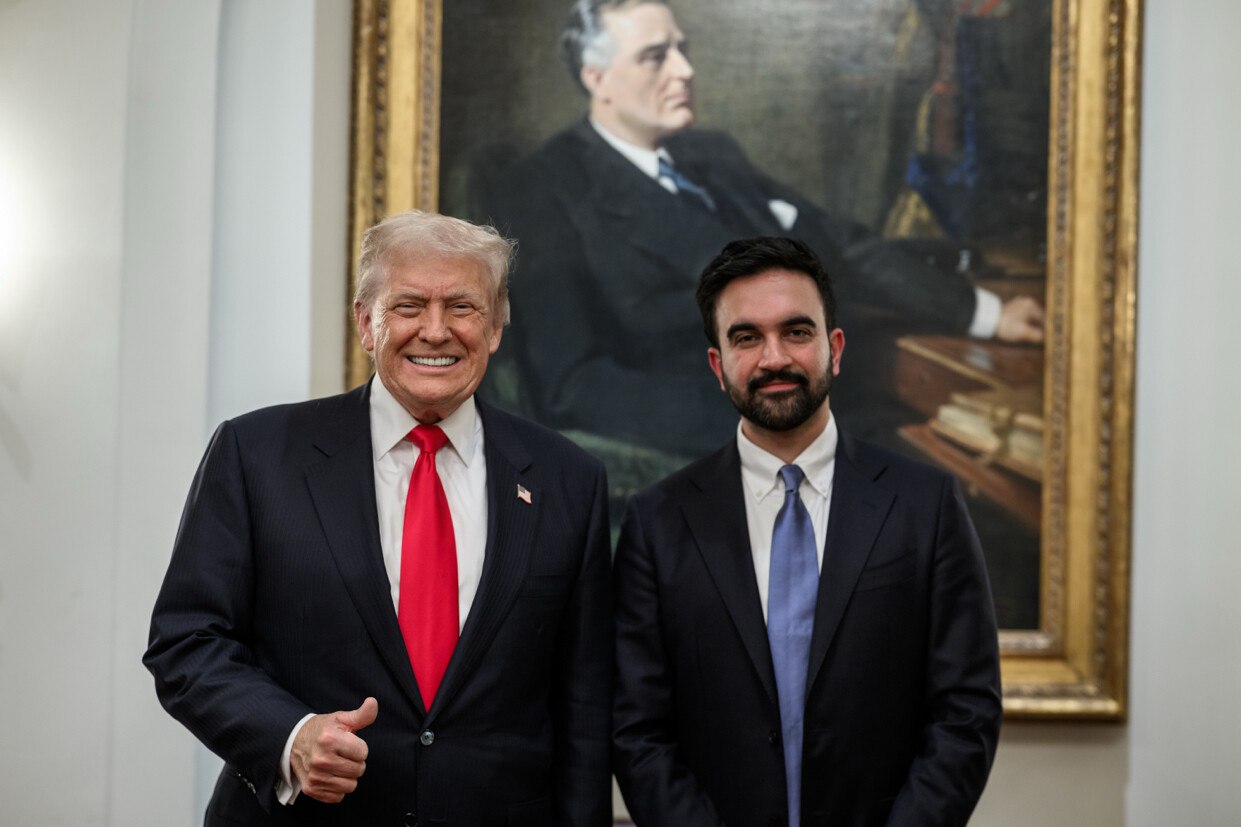
New York City mayor-elect Zohran Mamdani has offered a glimpse into an unexpected and surprisingly cordial meeting with President Donald Trump last week, revealing one of the most unusual items he encountered during his visit to the Oval Office: a dossier titled “UFC at the White House.”
Speaking Wednesday on The Adam Friedland Show, Mamdani described walking into the president’s iconic office and noticing “all these different coffee table books” laid out across the furniture. Amid the collection of presidential memorabilia, glossy publications, and historical volumes, one stood out in particular: a folder detailing Trump’s plans to host a mixed martial arts event on the South Lawn.
“One of them is ‘UFC at the White House,’” Mamdani said. He added that prior to seeing the dossier, he had “no idea” about the event, which is scheduled for June next year in celebration of the United States’ 250th anniversary. The folder contained concept art and planning materials for the octagon-shaped cage arena Trump intends to erect on the South Lawn, alongside preliminary logistical details for the historic sporting spectacle.
“I was just flipping through that,” Mamdani said. When pressed for further details, he explained that the folder was largely visual—a compilation of renderings illustrating what the event might look like at the presidential residence next summer.
A presidential event with a twist
Trump first mentioned the event publicly in July during a speech at the Iowa State Fairgrounds. Scheduled for June 14, 2026—coincidentally the president’s 80th birthday—the fight is expected to include a weigh-in for the combatants in front of the Lincoln Memorial. Initially, Trump claimed that the bout would accommodate 25,000 spectators, although UFC President Dana White later clarified the venue would hold approximately 5,000 people. To accommodate a larger audience, White pledged that large screens would be set up in a nearby park to relay the fight to an estimated 85,000 viewers.
The president’s planning dossier also addresses logistical concerns, including a $700,000 restoration of the South Lawn after the event, ensuring the historic grounds are returned to their original state. Details regarding the fighters set to participate remain undisclosed.
Mamdani, when asked if he intended to attend the event, laughed and responded, “No!” The mayor-elect emphasized that, despite the unusual nature of the proposed fight and its high-profile location, his focus remained on the discussion of city governance and federal collaboration during the Oval Office meeting.
An unexpectedly cordial visit
The encounter between Mamdani, a democratic socialist, and Trump, who previously referred to him as a “100% Communist Lunatic” during the mayoral campaign, might have been expected to be tense. Earlier in the campaign, Trump had threatened to withhold federal funding from New York City if Mamdani were elected—a remark that shocked many of the president’s MAGA supporters. Nevertheless, the meeting proved surprisingly cordial.
Mamdani described the conversation with the president as constructive and civil, focusing on issues pertinent to New York City and the broader relationship between the federal government and the nation’s largest city. While the UFC dossier may have drawn the most attention in public discussion, it was far from the central focus of their conversation.
Trump’s long-standing ties to combat sports
Trump’s interest in combat sports is well documented. He has maintained a close personal and professional relationship with UFC executives, including Dana White, and has attended multiple bouts over the past several years. White himself spoke at Trump’s Mar-a-Lago victory party following the 2024 presidential election, solidifying the president’s association with the sport.
During the 2024 campaign, Trump leveraged his UFC connections to reach broader audiences. Interviews with former fighters and podcasters, such as Joe Rogan, allowed him to engage with fans of mixed martial arts while highlighting his affinity for high-profile sporting events. These interactions helped shape Trump’s public persona as an enthusiastic supporter of combat sports, in addition to his long history of attending professional boxing matches and high-stakes tournaments.
Trump’s hosting of UFC events and appearances by fighters at the White House underscores a broader pattern in which he blends entertainment, spectacle, and politics. Irish former UFC champion Conor McGregor, for example, was welcomed to the White House for St. Patrick’s Day earlier this year, highlighting Trump’s willingness to bring celebrities and sports figures into the executive fold. His engagement with UFC and other combat sports figures has repeatedly drawn media attention, often sparking commentary about the intersection of politics, entertainment, and showmanship.
Plans for the South Lawn fight
The UFC at the White House event is not simply a symbolic gesture; it is part of a broader celebratory effort marking the 250th anniversary of the United States. By combining a globally recognized sporting event with the ceremonial significance of the presidency, Trump aims to create an unprecedented public spectacle. The Octagon, which will be constructed on the South Lawn, represents a literal and figurative blending of entertainment and executive authority.
Details about the logistical execution remain closely held by the White House and UFC organizers. While renderings and concept art provide a glimpse of what the event might look like, questions regarding participant selection, safety protocols, and crowd management remain unanswered. White’s public statements suggest the company is prioritizing the protection of the grounds and managing public attendance through both in-person and remote viewing options.
Mamdani’s perspective and takeaways
For Mamdani, the experience was a window into the unconventional nature of Trump’s presidency and his approach to symbolic events. While initially surprised by the dossier and the scope of the planned fight, the mayor-elect maintained a measured perspective on the encounter. He underscored that his attention during the visit was on substantive governance discussions rather than the theatrical elements surrounding the Oval Office.
The meeting also allowed Mamdani to observe Trump in a professional setting outside the high-pressure environment of campaign rhetoric. For a politician who had been publicly criticized by Trump, the cordiality of the meeting was unexpected, highlighting the nuances that can exist behind the highly publicized and often combative political discourse.
The broader political and cultural context
Trump’s blending of sports, entertainment, and politics is emblematic of his broader approach to the presidency. By hosting UFC events, engaging celebrities, and staging high-profile spectacles, he continues to redefine traditional notions of presidential decorum and the public role of the Oval Office. The planned South Lawn fight exemplifies this trend, merging national celebration with personal branding and spectacle.
Critics argue that such undertakings divert attention and resources from pressing policy matters. Supporters, however, praise the president for creating memorable, engaging events that connect the presidency with a wide audience, often in ways that standard political functions cannot achieve. The UFC event, with its ties to the nation’s 250th anniversary celebrations, fits within this framework of using entertainment to amplify national milestones.
Trump and New York City
The meeting with Mamdani also touches on the complex relationship between the Trump administration and New York City. During the mayoral campaign, Trump’s criticisms of the city’s leadership and threats to withhold federal funding highlighted the tension between federal authority and municipal governance. Mamdani’s post-election visit offered an opportunity for dialogue, demonstrating the necessity of cooperation even amid political disagreements.
While the UFC dossier drew the most public attention, Mamdani emphasized the substantive aspects of the conversation, including federal support for municipal initiatives, infrastructure priorities, and coordination on public safety measures. The presence of the dossier provided a striking visual counterpoint to the weightier policy discussions unfolding in the room.
Looking forward
As plans for the UFC event advance, public and media scrutiny is likely to intensify. Questions about participant selection, audience capacity, logistics, and costs will dominate coverage in the coming months. Meanwhile, Mamdani’s reflections offer a rare, candid glimpse into the Oval Office environment under Trump—a space where traditional symbolism, personal branding, and policy discussions coexist in often unexpected ways.
For Mamdani, the takeaway was both amusing and enlightening. The discovery of the UFC at the White House dossier underscored the president’s affinity for spectacle and high-profile events while serving as a reminder of the unique, sometimes unpredictable nature of modern presidential governance. The experience highlighted the intersection of tradition, entertainment, and politics in ways few visitors to 1600 Pennsylvania Avenue have encountered.

Emily Johnson is a critically acclaimed essayist and novelist known for her thought-provoking works centered on feminism, women’s rights, and modern relationships. Born and raised in Portland, Oregon, Emily grew up with a deep love of books, often spending her afternoons at her local library. She went on to study literature and gender studies at UCLA, where she became deeply involved in activism and began publishing essays in campus journals. Her debut essay collection, Voices Unbound, struck a chord with readers nationwide for its fearless exploration of gender dynamics, identity, and the challenges faced by women in contemporary society. Emily later transitioned into fiction, writing novels that balance compelling storytelling with social commentary. Her protagonists are often strong, multidimensional women navigating love, ambition, and the struggles of everyday life, making her a favorite among readers who crave authentic, relatable narratives. Critics praise her ability to merge personal intimacy with universal themes. Off the page, Emily is an advocate for women in publishing, leading workshops that encourage young female writers to embrace their voices. She lives in Seattle with her partner and two rescue cats, where she continues to write, teach, and inspire a new generation of storytellers.