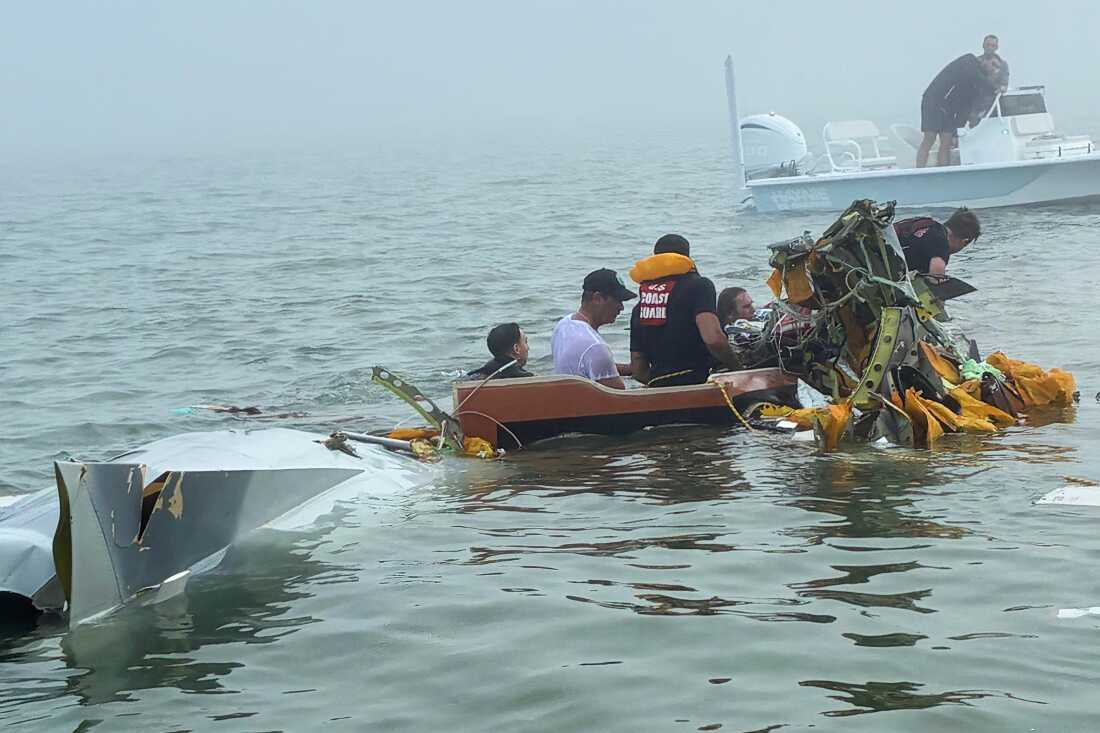
A routine humanitarian mission ended in catastrophe off the Texas coast this week when a Mexican Navy aircraft carrying a young medical patient and several crew members crashed in heavy fog near Galveston, killing six people and devastating families on both sides of the border. The accident has triggered a joint investigation by U.S. and Mexican authorities as questions mount over weather conditions, navigation systems, and the final moments before impact.
The twin-engine turboprop aircraft was en route to Galveston as part of a medical evacuation coordinated with a nonprofit organization that transports Mexican children with severe burn injuries to specialized hospitals in the United States. On Monday afternoon, as the plane approached its destination, air traffic controllers lost contact with the aircraft for approximately ten minutes. Officials initially believed it had landed safely, only to later realize it had gone down in coastal waters near the causeway connecting Galveston Island to the mainland.
Mexico’s government confirmed Tuesday that at least six people were killed in the crash. Search and rescue teams recovered five bodies shortly after the incident and pulled two survivors from the wreckage. A daylong search continued for a missing Navy lieutenant before authorities located his body later that night, bringing a grim end to hopes that he might still be alive.
The crash site, located in a bay near a heavily traveled stretch of coastline, was shrouded in thick fog at the time of the accident. Meteorologists estimated visibility at no more than half a mile, conditions that aviation experts say significantly complicate landing procedures, even for experienced pilots and modern aircraft.
Radar data reviewed by investigators suggests the plane was flying far below a safe altitude during its descent. According to former National Transportation Safety Board and Federal Aviation Administration investigator Jeff Guzzetti, the aircraft appeared to be descending rapidly below 200 feet while still more than two miles from the runway. Standard procedures would have required the pilot to abort the landing if the runway was not visible at a minimum altitude of 205 feet, climbing back to attempt another approach or diverting to a different airport.
Compounding the danger, a key navigation system for the runway at Galveston’s airport had reportedly been out of service for about a week. That system normally provides critical guidance to pilots during poor visibility, sending signals directly to the cockpit to assist with alignment and descent. Without it, pilots must rely more heavily on visual confirmation and alternative instruments—both of which can be severely limited in dense fog.
“Looking at the recorded flight track alongside the weather and equipment outage, this approach should never have occurred,” Guzzetti said, while cautioning that investigators would need to examine mechanical data and cockpit communications before reaching firm conclusions.
Witnesses near the crash site described chaotic and harrowing scenes as the aircraft plunged into the water. Sky Decker, a professional yacht captain who lives nearby, said he rushed out in his boat after hearing reports of the crash. Guided by police officers through near-zero visibility, he reached the partially submerged wreckage and entered the water to help trapped passengers.
Inside the aircraft, Decker found a badly injured woman pinned beneath debris with only a small pocket of air to breathe. Jet fuel had mixed with seawater, filling the cabin with fumes as she fought to stay conscious. Decker managed to free her, but also discovered another passenger who had already died. His account underscores both the speed of the crash and the desperate conditions survivors faced in the immediate aftermath.
While investigators worked at the scene in Texas, the emotional toll of the tragedy was being felt hundreds of miles away in rural Mexico. In the small community of El Pantano, in the southern state of Veracruz, relatives of Navy Lieutenant Luis Enrique Castillo gathered anxiously as news trickled in. Castillo, 29, had been reported missing following the crash, leaving his family clinging to hope as hours passed with little information.
His father, Eduardo Castillo, said the family received only limited updates from military officials and had no means to travel to the United States due to visa restrictions. Surrounded by photographs and diplomas celebrating his son’s achievements, Eduardo refreshed his phone repeatedly, waiting for any word. Castillo’s wife is pregnant, with the couple expecting their first child in just three months.
Late Tuesday night, the call finally came. Search teams had recovered Luis Enrique Castillo’s body. The confirmation shattered the family’s hopes and brought raw grief to their home. “Now he’s never going to meet his unborn child,” his father said as relatives embraced and wept.
Mexico’s president addressed the tragedy during her morning briefing, calling it deeply painful and confirming that members of the Navy were among those killed. She emphasized that both countries are cooperating fully in the investigation and expressed condolences to the families of the victims, as well as solidarity with the nonprofit organizations involved in the medical mission.
The National Transportation Safety Board has taken the lead on the U.S. side of the investigation. A spokesperson said investigators will review a wide range of factors, including aircraft maintenance records, weather forecasts, pilot training, and communications with air traffic control. Recovering the aircraft from the water could take a week or more, and a preliminary report is expected within 30 days.
Aviation safety experts caution against drawing early conclusions but note that medical transport missions can place intense pressure on flight crews. In past incidents involving air medical flights, pilots have sometimes taken increased risks due to the urgency of delivering critically ill patients to hospitals. Investigators are expected to examine whether the patient’s condition may have influenced decision-making during the approach.
The aircraft involved, a Beechcraft King Air 350i, is widely regarded as a reliable and proven design. Aviation analyst John Cox noted that the model is the latest in a long-running series dating back to the 1960s and is typically equipped with advanced avionics and modern safety systems. “From a design standpoint, it’s a very solid airplane,” he said, underscoring that factors beyond basic aircraft performance are likely at play.
The mission itself was part of a long-standing humanitarian effort coordinated with the Michou and Mau Foundation, a charity that has spent more than two decades transporting children with severe burn injuries to specialized treatment centers. Founded after a tragic house fire claimed a mother’s life while saving her children, the organization has helped more than 2,000 patients receive care in the United States.
In a statement posted on social media, the foundation expressed profound sorrow over the loss of life and offered condolences to the families affected. Shriners Children’s Texas, one of the hospitals involved in treating burn victims, also acknowledged the crash with sadness but declined to release details about the young patient’s condition.
As investigators begin the painstaking work of reconstructing the final moments of the flight, families in Mexico and the United States are left grappling with grief, unanswered questions, and the stark reminder of the risks faced by those who undertake humanitarian missions. For them, the tragedy is not just an aviation accident—it is a deeply personal loss that will resonate long after official reports are filed and the wreckage is cleared from the water.

Emily Johnson is a critically acclaimed essayist and novelist known for her thought-provoking works centered on feminism, women’s rights, and modern relationships. Born and raised in Portland, Oregon, Emily grew up with a deep love of books, often spending her afternoons at her local library. She went on to study literature and gender studies at UCLA, where she became deeply involved in activism and began publishing essays in campus journals. Her debut essay collection, Voices Unbound, struck a chord with readers nationwide for its fearless exploration of gender dynamics, identity, and the challenges faced by women in contemporary society. Emily later transitioned into fiction, writing novels that balance compelling storytelling with social commentary. Her protagonists are often strong, multidimensional women navigating love, ambition, and the struggles of everyday life, making her a favorite among readers who crave authentic, relatable narratives. Critics praise her ability to merge personal intimacy with universal themes. Off the page, Emily is an advocate for women in publishing, leading workshops that encourage young female writers to embrace their voices. She lives in Seattle with her partner and two rescue cats, where she continues to write, teach, and inspire a new generation of storytellers.