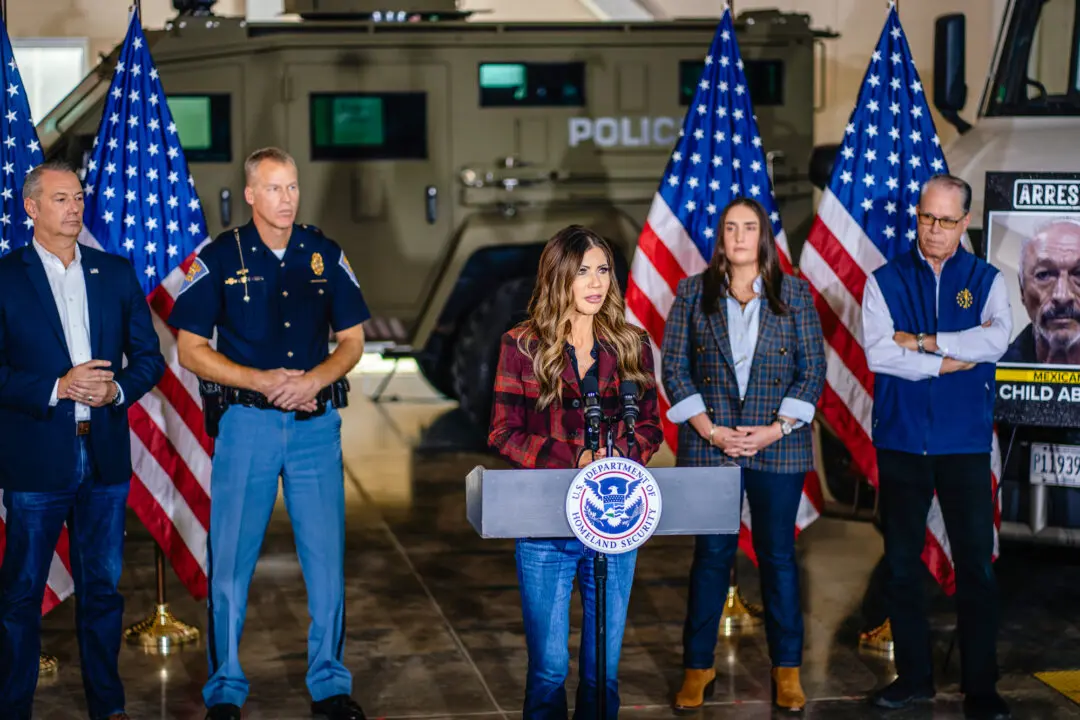
In a high-profile appearance at Customs and Border Protection (CBP) headquarters in New York’s One World Trade Center on Thursday, U.S. Department of Homeland Security Secretary Kristi Noem announced that federal immigration officers had arrested 54 individuals linked to the Dominican American Trinitarios gang in a multi-month operation dubbed “Operation Salvo.” The arrests come amid heightened national debate over federal immigration enforcement following the fatal shooting of a U.S. citizen in Minneapolis by a federal officer.
Noem emphasized that the arrests were part of an effort to tackle violent gang activity and illegal immigration in New York. The operation followed a July 19, 2025, shooting in Fort Washington Park, Upper Manhattan, in which an off-duty Customs and Border Protection officer was seriously injured. Two men, Miguel Mora Nunez, 21, and Christhian Aybar-Berroa, 22, were charged in connection with the attack, entering not guilty pleas shortly after the incident. Noem noted that the broader sweep of arrests included individuals “loosely affiliated” with the Trinitarios gang, many of whom were residing in the United States without authorization.
Frank Russo, CBP’s Director of Field Operations in New York, clarified that the affiliations ranged from direct contact with gang members to minimal interactions such as casual conversations. Despite the varied levels of involvement, Noem asserted that “the vast majority” of those arrested had pending criminal charges or prior convictions, although she did not provide exact figures. She also noted that roughly 60 percent of the arrested individuals had already been deported.
Noem framed the arrests as evidence of the federal government’s commitment to combating violent crime linked to immigration violations, a message that coincided with intense scrutiny of federal actions in Minneapolis, where Renee Nicole Good, a 37-year-old mother of three, was shot and killed by ICE agent Jonathan Ross during a controversial law enforcement operation.
Defending the Minneapolis shooting, Noem claimed that the officer was acting in accordance with training protocols and faced aggressive behavior from the motorist and surrounding protesters. “The officer was following his training, and was surrounded and assaulted and locked in by protesters,” she said. These statements have drawn widespread criticism from local officials and civil rights advocates, who argue that multiple videos contradict the federal account of events.
Minneapolis Mayor Jacob Frey described the federal narrative as “bulls—” while Minnesota Governor Tim Walz warned citizens not to trust the “propaganda machine” and encouraged peaceful protest. Critics of the federal response have characterized the shooting as an excessive use of force against a civilian, highlighting the heightened tension between local authorities and federal immigration enforcement.
Noem also used her New York appearance to criticize local policies she views as enabling criminal activity. She condemned what she called the “abject failure” of New York City’s bail reform laws and sanctuary city policies, which limit cooperation between city law enforcement and federal immigration authorities. Kenneth Genalo, ICE’s New York Field Director, emphasized that individuals involved in the July CBP officer shooting had previously been in NYPD custody, framing the operation as a consequence of the city’s legal and policy decisions.
The Secretary’s comments drew pushback from New York City Mayor Zohran Mamdani, who defended the city’s sanctuary policies as lawful and essential for public safety. “My responsibility as the mayor of this city is to protect each and every New Yorker and to make sure we are following the law,” Mamdani said in an interview with NPR. He described ICE raids as “cruel,” “inhumane,” and ineffective at promoting public safety, while asserting that the city would continue to adhere to its sanctuary rules.
Critics of Noem and federal enforcement initiatives argue that her statements and actions reflect a broader political agenda rather than measured law enforcement priorities. Advocacy groups, including the New York Civil Liberties Union, sharply criticized the Department of Homeland Security, stating, “Your agency is dangerous, cruel, inept, and lawless, and has no place on our streets. Contrary to your spin, the facts are that New York’s long-standing, bipartisan sanctuary laws have made our city safer, fueled our economy, strengthened our communities, and made it easier for people to access vital services that support public safety.”
Despite the criticism, Noem framed her visit to One World Trade Center as a demonstration of federal resolve against gang violence and illegal immigration. The Secretary presented a series of mugshots of those arrested under Operation Salvo and emphasized that the operation was conducted with the goal of protecting communities and supporting lawful immigration enforcement. She also highlighted the federal government’s concerns regarding local resistance to cooperation, suggesting that tension between federal and municipal authorities had hampered broader enforcement efforts.
The arrests and subsequent deportations reflect a key facet of the Trump administration’s second-term immigration policy, which has sought to target criminal elements within undocumented immigrant populations while simultaneously promoting a narrative of strict border and interior enforcement. The operation in New York mirrors similar federal crackdowns nationwide and is part of a wider political strategy emphasizing law and order, particularly in urban areas with large immigrant populations.
Observers have noted the timing of Noem’s announcement amid national attention on the Minneapolis shooting, suggesting that the Secretary intended to shift public focus toward federal successes in crime prevention and gang suppression. By juxtaposing Operation Salvo with the controversial enforcement actions in Minneapolis, Noem reinforced the administration’s portrayal of federal officers as protectors of public safety confronting both criminal networks and hostile political environments.
The case also underscores the growing conflict between federal and municipal authorities over immigration policy. Sanctuary city policies, designed to protect undocumented residents from deportation in certain circumstances, remain a flashpoint for the federal government. Critics argue that these policies hinder law enforcement and public safety, while supporters maintain they foster trust between immigrant communities and local police, ultimately enhancing security and community well-being.
Noem declined to comment on whether there would be an increase in ICE enforcement actions in New York City following Operation Salvo, leaving open questions about the administration’s next steps. Her remarks, however, indicate continued federal scrutiny of local immigration policies and a willingness to publicly challenge elected city officials who do not fully cooperate with federal enforcement objectives.
The Department of Homeland Security Secretary’s statements and the New York arrests have drawn national attention, igniting debate over the balance between law enforcement, immigration policy, and civil liberties. Supporters argue that targeting gang affiliates and deporting individuals with criminal records enhances public safety, while opponents contend that aggressive federal enforcement undermines local governance, jeopardizes immigrant communities, and risks escalating tensions between law enforcement agencies.
As federal authorities and New York City officials continue to navigate these complex issues, the operation highlights the intersection of immigration enforcement, urban crime, and federal-local relations. With ongoing controversy over the Minneapolis shooting and increased scrutiny of federal immigration policies, Noem’s announcement reflects a broader political and operational strategy designed to demonstrate law enforcement resolve while challenging local jurisdictions that resist federal priorities.
Ultimately, Operation Salvo and the surrounding discourse illuminate the fraught and often contentious nature of immigration enforcement in America’s major cities, where policy, politics, and public safety collide. The arrests of 54 individuals, the deportations, and the defense of federal actions in Minneapolis are likely to continue fueling national debates about the appropriate scope of federal authority, the role of local governance, and the treatment of immigrant communities in law enforcement operations.

Emily Johnson is a critically acclaimed essayist and novelist known for her thought-provoking works centered on feminism, women’s rights, and modern relationships. Born and raised in Portland, Oregon, Emily grew up with a deep love of books, often spending her afternoons at her local library. She went on to study literature and gender studies at UCLA, where she became deeply involved in activism and began publishing essays in campus journals. Her debut essay collection, Voices Unbound, struck a chord with readers nationwide for its fearless exploration of gender dynamics, identity, and the challenges faced by women in contemporary society. Emily later transitioned into fiction, writing novels that balance compelling storytelling with social commentary. Her protagonists are often strong, multidimensional women navigating love, ambition, and the struggles of everyday life, making her a favorite among readers who crave authentic, relatable narratives. Critics praise her ability to merge personal intimacy with universal themes. Off the page, Emily is an advocate for women in publishing, leading workshops that encourage young female writers to embrace their voices. She lives in Seattle with her partner and two rescue cats, where she continues to write, teach, and inspire a new generation of storytellers.